Life in one compartment
Leave a bowl of soup on the counter overnight and by morning it may smell sour. Nothing crawled in. A few bacteria that were already there, too small to see, spent the night eating and dividing, and there are now billions of them.
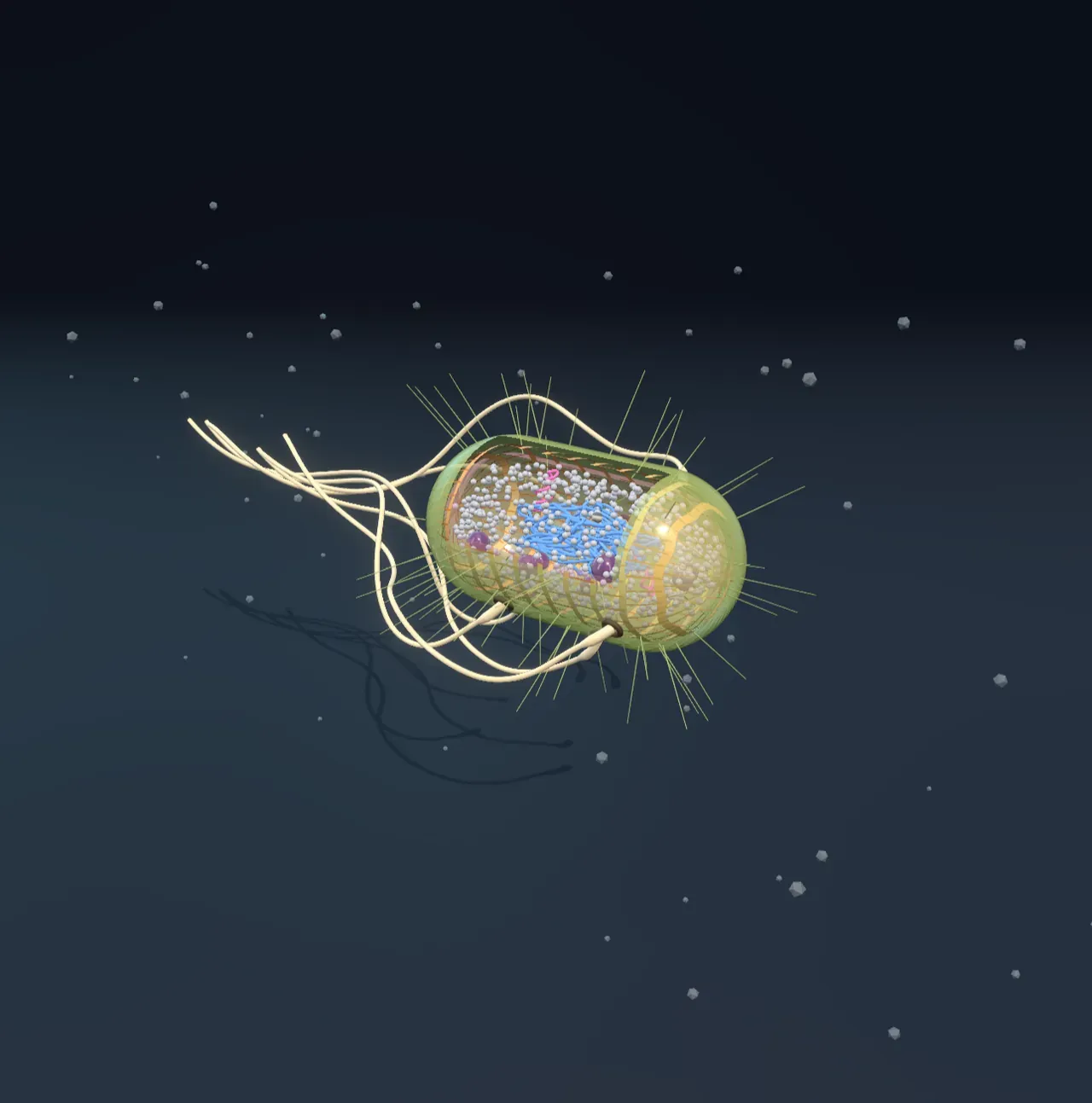
A bacterium is a single living cell, and one of the smallest that lives on its own. The one in the Scene is Escherichia coli, or E. coli, which lives in the gut of every person and most warm-blooded animals. It is a rod about 2 micrometres long and 1 wide: a thousand of them end to end would span two millimetres, the width of a pinhead. Most bacteria are harmless, and many are useful. Your gut holds tens of trillions of them, about as many as there are cells in your body, and they help digest your food and crowd out the few kinds that cause disease.
What makes a bacterium different from the cells of a plant or an animal is what it lacks. It has no nucleus, no mitochondria and no other compartments wrapped in membranes. Everything happens in one space. Cells like that are called prokaryotes, from the Greek for “before the kernel”. Your own cells, with a nucleus, are eukaryotes, and they are about ten times wider and a thousand times bigger by volume (see the Cells Article).
Inside the envelope
Around the cell is a tough envelope in three layers. E. coli is Gram-negative, named for a staining test it fails: it has an outer membrane, then a thin wall of peptidoglycan, then the inner membrane that actually holds the cell’s contents in. Peptidoglycan is a single giant molecule, a mesh of sugar strands running round the cell, knitted together by short chains of amino acids. It is what gives the rod its shape and stops it from bursting: the inside of a bacterium is so crowded with dissolved molecules that water presses in hard, at a pressure of a few atmospheres, like the air in a bicycle tyre. Bacteria with thick walls and no outer membrane, such as the Staphylococcus on your skin, are called Gram-positive.
Inside, the cell is packed. About a quarter of its volume is protein, and tens of thousands of ribosomes, the machines that build proteins, are scattered through it. Its genes are in one ring of DNA, the chromosome, about 4.6 million letters long. Stretched out it would be 1.5 millimetres, almost a thousand times the length of the cell, so it is wound into a tangle called the nucleoid. Many bacteria also carry plasmids, small extra rings of DNA with a handful of genes, which they can copy and pass to each other.
Swimming with a motor
On its surface are hundreds of short, straight hairs called pili, which it uses to grip surfaces and other cells, and a few long, corkscrew-shaped tails called flagella. Each flagellum is turned at its base by a genuine rotary motor in the envelope, powered by protons flowing into the cell. The motor spins at up to a hundred turns a second. When all of them turn the same way, the flagella wind together into one bundle behind the cell and drive it forward like a propeller, at about 20 to 30 micrometres a second: ten body lengths every second. Every second or so one motor reverses, the bundle flies apart and the cell tumbles, then sets off in a new direction. By running longer when things are getting better, it drifts towards food.
One becomes two
A bacterium multiplies by binary fission: it grows to twice its length and splits down the middle. First it copies its chromosome. Copying starts at one point on the ring and runs both ways round it, and as the two copies are made they are pulled towards opposite ends of the cell. Meanwhile the cell keeps growing, adding new wall along its length. Then a ring of a protein called FtsZ gathers round the middle, under the inner membrane, and tightens like a drawstring. New wall is built into the closing gap until it seals, and two daughter cells, each with a complete chromosome, round off their new ends and come apart.
Try it: scrub Time from Newborn cell to Two cells. Watch the second copy of the DNA grow and the copies move apart, then the orange FtsZ ring appear and pinch the middle shut.
In ideal conditions E. coli can do all this in about 20 minutes. That is less time than it takes to copy its chromosome, about 40 minutes; it manages by starting the next round of copying before the last one has finished, so a fast-growing cell carries DNA already part-copied for its grandchildren.
Doubling and warmth
Each division doubles the number of cells, and because each new cell divides too, the numbers grow very fast. One cell dividing every 20 minutes makes 8 in an hour, 4,096 in four hours and about 17 million in eight. That is exponential growth, and on the chart’s log scale it is a straight line: each hour adds the same number of zeros.
How fast depends on temperature. E. coli is fastest at about 40 °C, close to the inside of the body it lives in. At room temperature it takes about an hour and a half to divide, and below about 7 °C, the inside of a fridge, it hardly grows at all. It is not dead, only slowed: the chemistry of its enzymes runs slower in the cold. Above about 45 °C its proteins begin to come apart, growth falls off steeply, and by 48 °C it stops.
Try it: press the Fridge, Room and Body presets under Temperature and watch the doubling time and the eight-hour count on the chart. At 4 °C the cell waits, and the count stays at one.
Real growth cannot go on doubling for long. A broth runs out of food and fills with waste, and a culture usually stops at around a billion cells in each millilitre.
Why penicillin bursts a bacterium
In 1928 Alexander Fleming noticed that a mould growing on one of his plates had cleared a ring of dead bacteria around it. The mould made penicillin, the first antibiotic. Penicillins, including the ampicillin in the Scene, which gets through the outer membrane of E. coli, block the enzymes that knit new strands into the peptidoglycan wall.
A cell that is not growing barely notices. But a growing cell keeps cutting its wall open to add new material, and at the pinch in the middle it must build a whole new wall across the cell. With the knitting blocked, the wall there is left with a hole. The pressure inside pushes the inner membrane out through it as a bulge, and the bulge swells until it bursts. This is why penicillins kill only growing bacteria, and why they are harmless to us: human cells have no wall at all.
The dose that matters is the minimum inhibitory concentration, or MIC: the lowest concentration that stops a culture growing. For an ordinary E. coli strain and ampicillin it is a few milligrams in each litre. Below it the wall is weakened but most cells still divide, so the culture grows more slowly. At it, about as many cells burst as divide. Above it, the count falls.
Try it: set Ampicillin to 8 mg/L, twice the MIC, and scrub Time again. The cell grows normally until it tries to divide, then bulges and bursts. Now press Fridge: a cold cell that is not growing is spared.
A few bacteria carry genes, often on plasmids, for an enzyme that breaks penicillins apart before they reach the wall. Such cells survive the dose and go on dividing. How a population of them can take over is the story of antibiotic resistance.
What this model leaves out
The Scene draws one cell about 10,000 times life size, swimming in place with specks of broth streaming past. The flagella are shorter and much thicker than real ones, which are about 20 nanometres thick, and they turn about a hundred times more slowly than the real motors so you can follow them. The envelope’s layers are drawn thicker than they are, and the cell holds hundreds of ribosomes instead of tens of thousands.
One cell cycle is drawn the same whatever the temperature: the temperature sets only how long it takes, which the chart shows. The growth rate comes from a simple model fitted to E. coli in rich broth, with no growth below 5 °C or from 48 °C, a doubling time of 20 minutes at 37 °C and a peak near 40 °C. The ampicillin response is a standard curve fitted to have its MIC at 4 mg/L, with the strongest killing twice as fast as the growth; real strains and real doses vary widely, and a drug’s concentration in the body rises and falls between doses. The Scene’s single cell always bursts at or above the MIC and always survives below it, where a real cell’s fate is a matter of chance, which is why the chart counts a whole population.