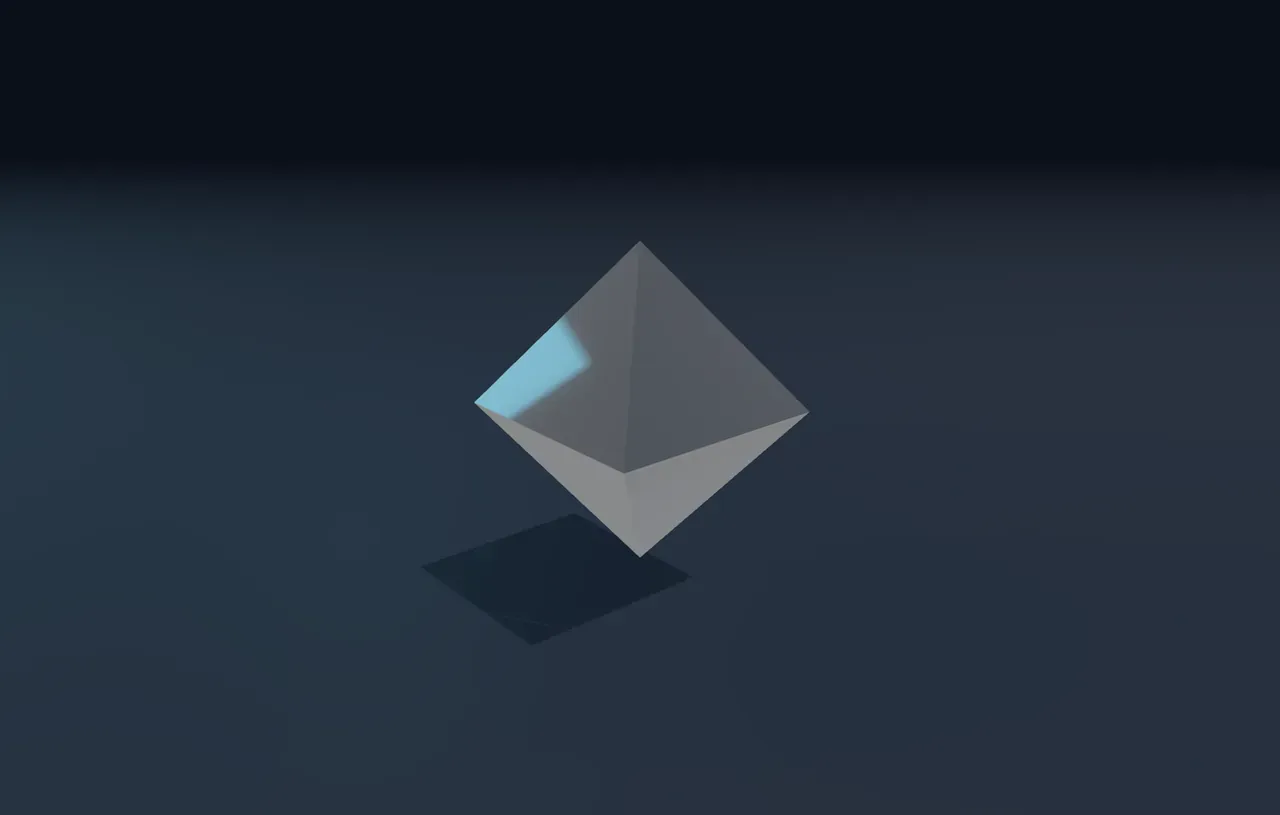
One element, many materials
A diamond ring and the “lead” in a pencil are made of the same element. Pencil lead is graphite (mixed with clay), and both graphite and diamond are pure carbon. One is the hardest natural material, clear and sparkling; the other is soft, grey and leaves marks on paper. Forms of one element with different structures are called allotropes. For carbon the difference is not in the atoms at all, only in how they are joined.
Diamond: a rigid network
In diamond every carbon atom is bonded to four others, 0.154 nanometres away, at the corners of a tetrahedron. Each of those is bonded to four more, in every direction, so the whole crystal is one continuous web of strong bonds. There is no direction in which it is easy to bend or split, which makes diamond the hardest natural material, 10 on the Mohs scale. Every outer electron is locked into a bond, so diamond does not conduct electricity, although it carries heat better than copper. It is also dense: 3.51 grams per cubic centimetre.
Graphite: sheets that slide
In graphite each carbon is bonded to only three neighbours, 0.142 nanometres away, in flat sheets of hexagons like chicken wire. The sheets stack 0.335 nanometres apart, more than twice the bond length, held only by the weak attraction between neighbouring sheets. They slide over each other easily, so graphite feels slippery and rubs off onto paper as you write. Each carbon’s fourth electron is shared across its whole sheet, so graphite conducts electricity along the sheets. At everyday pressure graphite, not diamond, is carbon’s most stable form, but turning diamond into graphite is so slow that diamonds last.
Try it: choose Graphite and push Slide the top layers up to 1 step, then try Diamond. Choose Atoms under Zoom to the atoms to see the sheets glide while diamond’s bonds stretch and break.
Graphene: one sheet
Peel graphite down to a single sheet and you have graphene, a layer one atom thick. Andre Geim and Konstantin Novoselov first isolated it in 2004, famously by peeling graphite with sticky tape, and shared the 2010 Nobel Prize in Physics. A single sheet absorbs only about 2.3% of the light passing through it, yet it is among the strongest materials ever measured and conducts electricity extremely well.
C₆₀: a molecular football
In 1985 Harold Kroto, Robert Curl and Richard Smalley found that vaporised carbon forms stable clusters of exactly 60 atoms. The atoms sit on the corners of 12 pentagons and 20 hexagons, the pattern of a football, in a closed cage about 0.7 nanometres across. They named it buckminsterfullerene, after the architect of geodesic domes, and shared the 1996 Nobel Prize in Chemistry. The bonds shared by two hexagons are slightly shorter than those beside a pentagon, about 0.140 against 0.145 nanometres.
What this model leaves out
The materials you see before zooming in are idealised: a diamond octahedron, a stack of graphite flakes, a graphene sheet and a dark crystal of C₆₀. Real graphite and graphene ripple and contain defects, and the sliding shown here moves whole halves at once. Other allotropes, such as nanotubes and amorphous soot, are not shown.