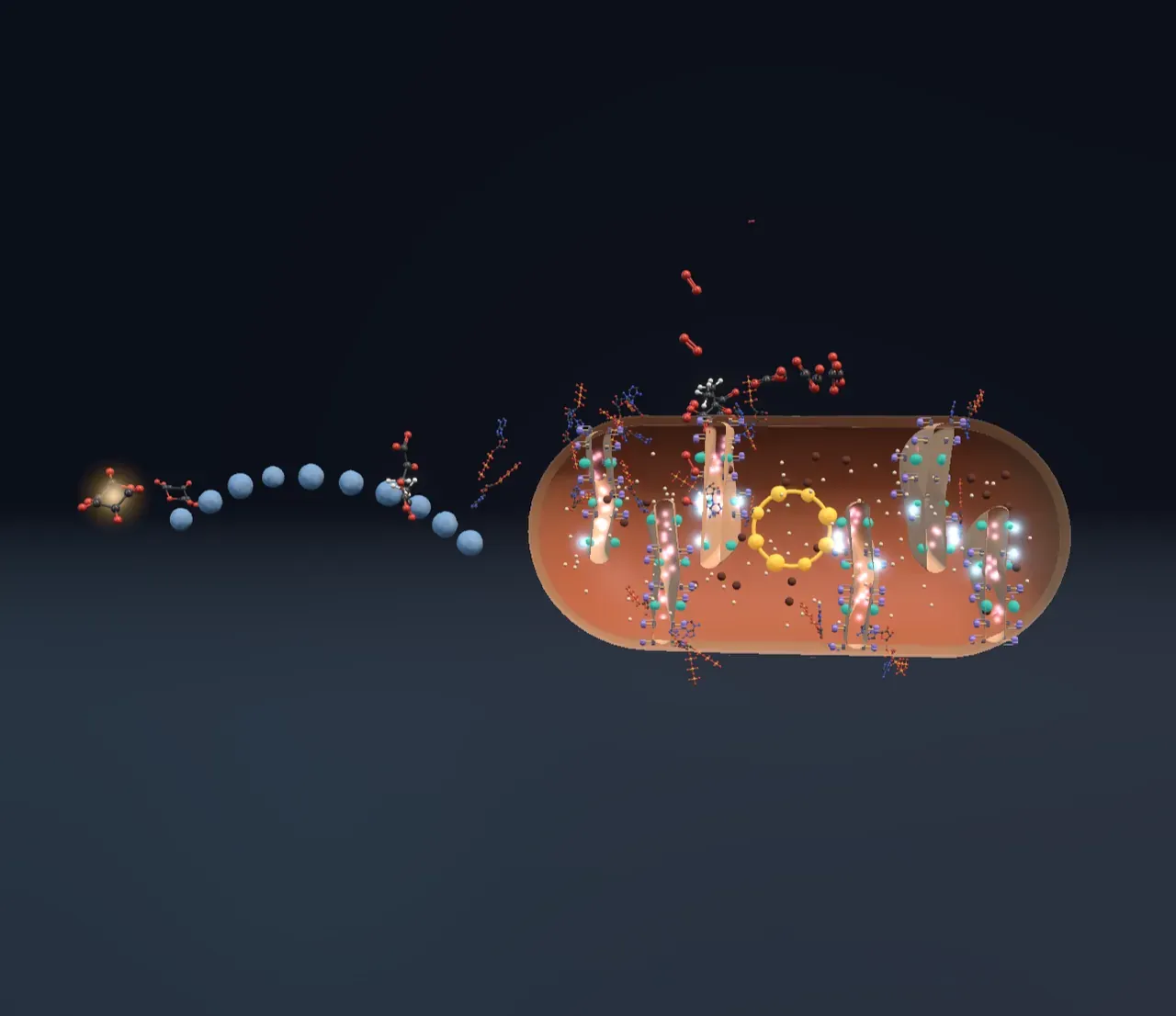
Why you breathe
Hold your breath and within a minute your body insists that you stop. Your lungs are not the reason; they are only the delivery service. The oxygen they take in is carried by your blood to every cell, and inside each cell it is used up in small bodies called mitochondria. There, the food you ate is broken down and its energy is captured in a form the cell can spend. That process is cellular respiration, and it runs in almost every living thing, from yeast to oak trees to you.
The overall result looks like burning: sugar and oxygen go in, carbon dioxide and water come out, and energy is released. A candle does the same chemistry in one hot rush. A cell does it in dozens of small steps, at body temperature, so that the energy can be caught a little at a time instead of escaping as heat and light.
The cell’s currency
The energy is caught in a molecule called ATP (adenosine triphosphate). It is a small molecule with a tail of three phosphate groups. Snapping off the last phosphate releases a convenient packet of energy, enough to drive one step of a muscle fibre’s pull, one pump in a nerve cell’s membrane, or one link added to a protein. The cell then rebuilds the ATP and spends it again. You make and break roughly your own body weight of ATP every day, so the question respiration answers is how to recharge it fast enough.
Splitting the sugar
The first stage happens outside the mitochondrion, in the fluid that fills the cell. A glucose molecule, six carbon atoms long, is passed along a chain of ten enzymes. Halfway along it is cut in two, and by the end it has become two molecules of pyruvate, three carbons each. This is glycolysis, which means sugar splitting. It costs 2 ATP to start and pays back 4, a profit of 2. It also strips off some hydrogen and its electrons, which are loaded onto carrier molecules for later.
Glycolysis needs no oxygen at all. It is probably the oldest part of the whole process, inherited from microbes that lived before the air had oxygen in it.
Inside the mitochondrion
With oxygen available, each pyruvate is carried into the mitochondrion, into the thick fluid at its centre called the matrix. There it is taken apart completely in a loop of reactions known as the Krebs cycle, after the biochemist who worked it out. Each turn of the loop hands its pieces round a ring of intermediate molecules. The carbon atoms leave as carbon dioxide, the same carbon dioxide you breathe out. The cycle makes only 2 more ATP per glucose. Its real product is electrons: it loads many more carrier molecules with the electrons stripped from the sugar.
The electron chain and the turbine
The inner membrane of a mitochondrion is folded into shelves called cristae, which pack a great deal of membrane into a small space. Set into that membrane is the electron transport chain, a row of large proteins. The loaded carriers drop their electrons at the start of the row, and the electrons are passed from protein to protein, a little lower in energy at each step. At the end they are handed to oxygen, which takes up hydrogen as well and becomes water. This is the only job oxygen does in respiration, but nothing else can do it: without something to take the spent electrons away, the whole chain jams.
The energy the electrons give up on the way is used to pump protons (hydrogen ions) across the membrane, into the space inside the folds. They pile up there like water behind a dam. The only way back is through ATP synthase, a protein shaped like a lollipop with a rotor in its stalk. As protons flow through, the rotor turns, up to a hundred times a second, and each full turn presses phosphate onto ADP to make three fresh ATP. It is a genuine rotary motor, about ten millionths of a millimetre across. The electron chain and ATP synthase together make about 28 of the roughly 32 ATP that one glucose yields.
Try it: under Follow the glucose, step through to Electron chain and watch the electrons run along the folds to the oxygen. Then set Oxygen supply to 0% and step through again: the pyruvate becomes lactate instead, and the tally beside the experiment drops to 2 ATP per glucose.
When oxygen runs short
With no oxygen, the electron chain stops, the protons stop being pumped and ATP synthase stands still. Pyruvate no longer goes into the mitochondrion. The cell can still run glycolysis, but only if it unloads the electron carriers somewhere, so it dumps their hydrogen back onto pyruvate, which turns it into lactate. Yeast does the same trick but makes ethanol and carbon dioxide instead, which is why bread rises and grape juice becomes wine.
The cost is steep. Without oxygen, one glucose gives 2 ATP instead of about 32, so a cell has to burn sugar about sixteen times as fast for the same energy. Your muscles do this during a sprint, when they use ATP faster than your blood can bring oxygen. It is quick, but it cannot last, and it is why a sprinter is out of breath long after crossing the line: the extra breathing pays back the shortfall.
In between, a cell that gets only part of the oxygen it needs burns only that share of its pyruvate and ferments the rest. Set Oxygen supply to 50% and the tally shows about 17 ATP per glucose.
The other half of photosynthesis
Respiration is photosynthesis run backwards. A leaf uses the energy of light to build sugar from carbon dioxide and water, releasing oxygen. Every living thing, plants included, then gets that energy back by combining the sugar with oxygen, returning the carbon dioxide and water. The mitochondria in your cells may once have been free-living bacteria that were swallowed by a larger cell and never left: they still carry their own small loop of DNA and divide on their own.
What this model leaves out
The Scene lumps about twenty reactions into three stages and does not show the carrier molecules (NADH and FADH₂) as molecules; it shows the electrons they carry as beads. It draws one mitochondrion and a few enzymes, where a muscle cell has hundreds or thousands of mitochondria and millions of copies of each enzyme. The molecules are drawn thousands of times too big and move far more slowly and tidily than the real jostle in a cell.
The oxygen supply is simplified to one number: the share of the oxygen the cell needs that actually reaches it. That share of the pyruvate is burned and the rest is turned into lactate, so the ATP per glucose rises in a straight line from 2 to 32. A real cell also speeds up glycolysis when oxygen is short, and its mitochondria keep working at quite low oxygen levels. The yield of about 32 ATP per glucose is the modern estimate; some energy leaks back across the membrane, and older textbooks give 36 or 38 from a less careful count.