A drop that spreads by itself
Drop food colouring into a still glass of water and wait. Nobody stirs, yet the colour creeps outward until the whole glass is evenly tinted, faster in warm water than in cold.
This is diffusion: dissolved particles spreading from where they are crowded to where they are scarce. Nothing pushes them. Every molecule in a liquid is constantly jostled by its neighbours and wanders on a random, zigzag path, heading nowhere in particular.
Random steps, one-way result
If each molecule moves at random, why does the colour only ever spread out? Because of numbers. Where molecules are crowded, many happen to wander outward; where they are scarce, few happen to wander back. The difference is a net flow from high concentration to low, and it stops only when the mix is even. Even then the molecules keep moving; they just cross in both directions equally.
Warmth makes molecules jostle harder and water runnier: sugar diffuses about twice as fast at 50 °C as at 20 °C. Diffusion is quick over tiny distances and painfully slow over large ones: a sugar molecule crosses a cell in about a tenth of a second, but needs about a day to wander a single centimetre. Large animals need hearts to carry things further.
A wall with small doors
Every cell is wrapped in a membrane, a film two molecules thick made of fatty phospholipids, with their water-loving heads facing out and oily tails tucked inside. Water slips through, helped by protein channels, but sugar and the charged ions of salt are mostly kept out. A membrane like this is called selectively permeable.
Osmosis: water follows the dissolved particles
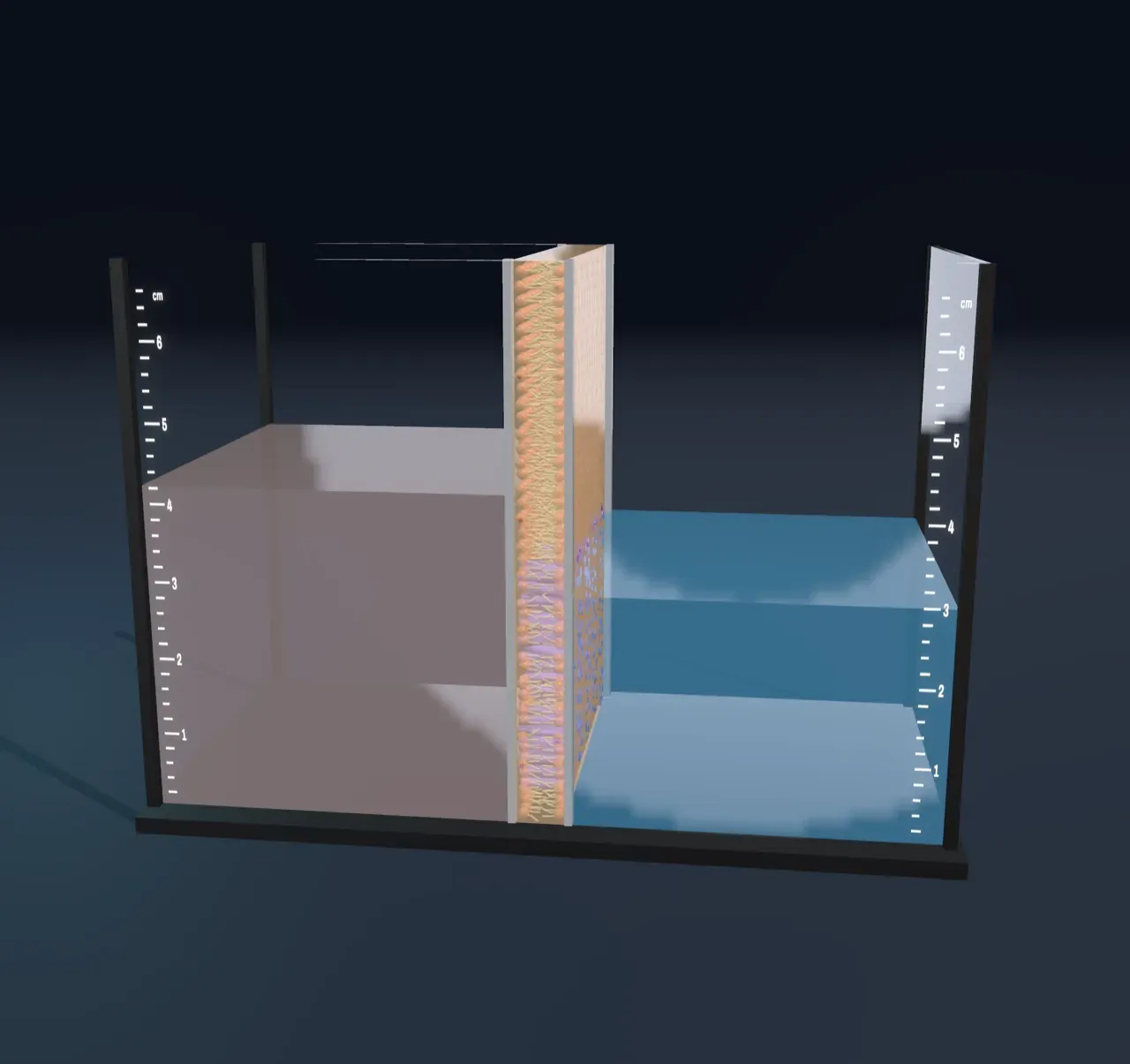
Now put a selectively permeable membrane between pure water and sugar water. Sugar cannot cross, but water can, and it does so in both directions. On the sugary side, some of the space next to the membrane is taken up by sugar, which also holds on to water molecules, so slightly fewer water molecules cross from that side. The net result is that water moves into the sugar solution, and its level rises. This is osmosis: water diffusing across a membrane towards the side with more dissolved particles.
Try it: set Membrane to Only water crosses and the right side to Pure water, and watch the left side fill up. Then choose Sugar can cross: now the sugar spreads instead and the levels stay put. Choose On under Show the molecules to see the net-flow arrows.
Cells in the balance
Choose Red blood cell. The fluid around a cell is called isotonic when it holds the same concentration of dissolved particles as the inside, hypotonic when it holds less, and hypertonic when it holds more. In pure water the cell takes in water until it bursts; in saltier water than blood it loses water and shrivels into a spiky ball. That is why drips in hospitals use saline at the same strength as blood.
It also explains why seawater makes you thirstier. Seawater holds more than three times as many dissolved particles as blood. Your kidneys cannot make urine salty enough to get rid of that salt without spending more water than you drank, so your cells end up losing water. Plants use osmosis the other way: water drawn into their cells presses outward against stiff cell walls, keeping stems firm. Without enough water, that pressure drops and the plant wilts.
What this model leaves out
The Scene shows a few hundred molecules where a real drop holds trillions upon trillions. Real osmosis through a cell membrane is driven by pressure as well as by random crossings, and the push can be enormous: blood-strength solution could, in principle, hold up a column of water more than seventy metres tall. The tank ignores that back-pressure entirely. The red blood cell’s volume follows a standard textbook relation, but real cells also pump ions and vary in how far they stretch before bursting.