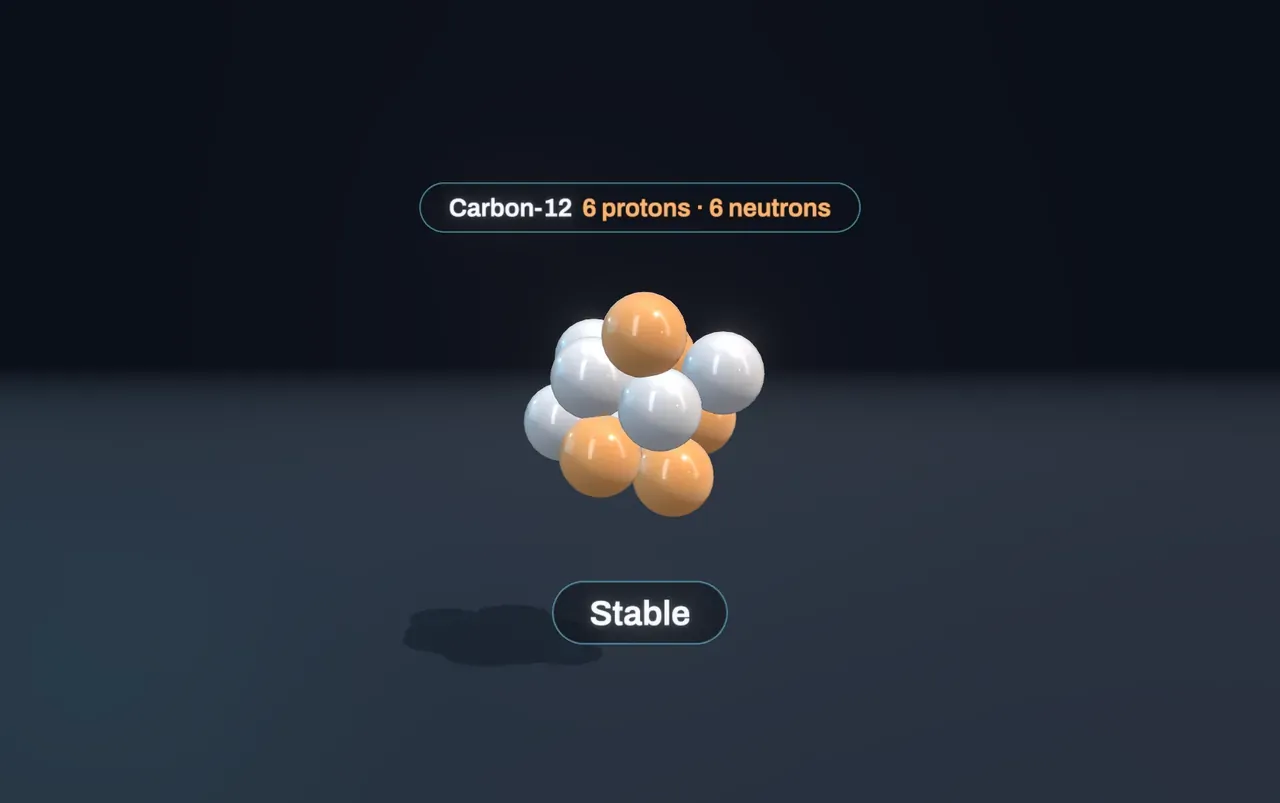
Same element, different weight
An atom’s nucleus is made of two kinds of particle: protons, which carry a positive charge, and neutrons, which carry none. The number of protons decides which element the atom is. Six protons make carbon, always; seven would make nitrogen. The protons also fix how many electrons the atom holds, and electrons do all of its chemistry.
The number of neutrons can vary. Atoms of one element with different numbers of neutrons are its isotopes. They are named by their total count of protons and neutrons, the mass number: carbon-12 has 6 protons and 6 neutrons, carbon-13 has 6 and 7, carbon-14 has 6 and 8. Chemically they behave almost identically, so a carbon-14 atom bonds into sugar or bone just like carbon-12. What changes is the mass, and, for some, whether the nucleus lasts.
What holds a nucleus together
Protons repel one another, and inside a nucleus they are packed so close that the push is enormous. What holds them is the strong nuclear force, an attraction between every neighbouring pair of protons and neutrons that is far stronger than the electric push but reaches only about the width of one particle. Neutrons add this grip without adding any repulsion, so they act like glue.
More glue is not always better, though. Protons and neutrons each fill their own set of energy levels inside the nucleus, rather like seats filling from the front of a theatre. Pile in too many neutrons and the extras have to sit in high, costly seats while lower proton seats stand empty. A nucleus is most comfortable with a balanced mix, and how far it strays from that balance decides its fate.
Try it: drag Neutrons from Carbon-12 down to 3 and up to 14. Watch the label under the nucleus change from stable to β+ decay on one side and β− decay on the other, with half-lives shrinking from thousands of years to milliseconds as you move away.
Too few, too many, far too many
A nucleus with one neutron too many can fix itself by turning a neutron into a proton. An electron and a ghostly, almost massless antineutrino fly out. This is beta-minus decay, and the atom becomes the next element up: carbon-14 becomes nitrogen-14. A nucleus with too few neutrons does the opposite. A proton turns into a neutron and throws out a positron, the electron’s positively charged twin (beta-plus decay), or captures one of its own electrons instead. Carbon-11 becomes boron-11 this way.
The further a nucleus is from the balanced mix, the more energy it can release and the faster it goes. Carbon-14 is only one neutron out and lasts thousands of years; carbon-20, seven neutrons out, halves in 16 thousandths of a second. Stray far enough and the last neutron or proton is not held at all: carbon-21 loses a neutron the moment it forms, and nothing past carbon-22 has ever been made. That boundary is called the drip line.
The valley of stability
Draw every known nucleus on a grid, with its neutrons along the bottom and its protons up the side, and you get the chart of nuclides: about 3,300 squares, of which only about 250 are stable. The stable ones sit in a narrow band. Raise each square by how much energy it holds compared with the most stable nucleus of the same mass number, and the band becomes the floor of a deep valley. Every unstable nucleus sits up a wall and decays downhill, one step at a time, until it reaches the floor.
For light elements the floor runs along equal numbers of protons and neutrons. Heavier nuclei have so many protons pushing on each other that they need extra neutrons to stay together, and the valley bends away from the diagonal: iron-56 has 26 protons and 30 neutrons, lead-208 has 82 and 126. Beyond lead nothing is stable at all. The heaviest nuclei shed whole chunks instead, alpha particles of two protons and two neutrons, and that, with a few beta decays between, is how uranium slowly becomes lead.
Try it: step Zoom out to every nucleus to Light nuclei and follow the beads from your carbon isotope down to the valley floor. Then step to Every nucleus and find the bend.
Isotopes at work
Because isotopes share their chemistry but not their mass or stability, they make superb tracers and clocks. Living things take in carbon-14 from the air, and after death it halves every 5,730 years, which dates wood, bone and cloth up to about 50,000 years old. Hospitals inject short-lived beta-plus emitters such as fluorine-18 and image where the emitted positrons meet electrons. Nuclear reactors need uranium-235, only 0.7% of natural uranium, so the uranium is enriched by separating its isotopes by their tiny difference in mass. Even water varies: about one hydrogen atom in 6,400 is deuterium, with a neutron in its nucleus.
What this model leaves out
The nucleus is drawn as a cluster of touching balls. A real one is a blur of particles described by quantum mechanics, and it is about a hundred thousand times smaller than its atom, whose electrons are not shown. Decays happen at random moments; the scene repeats one now and then to show its kind, not its rate. Where a decay chain branches, for example when a beta decay also releases a neutron, only the main path is drawn.
Which nuclei are stable comes from measurement, as do the carbon half-lives, but the heights of the squares and the outer edge of the chart past calcium come from the liquid-drop model, a simple formula that treats the nucleus like a charged droplet. It gets the valley’s shape right and misses details such as the extra stability of nuclei with certain “magic” numbers of protons or neutrons. Spontaneous fission, the way some of the heaviest nuclei decay, is not shown.