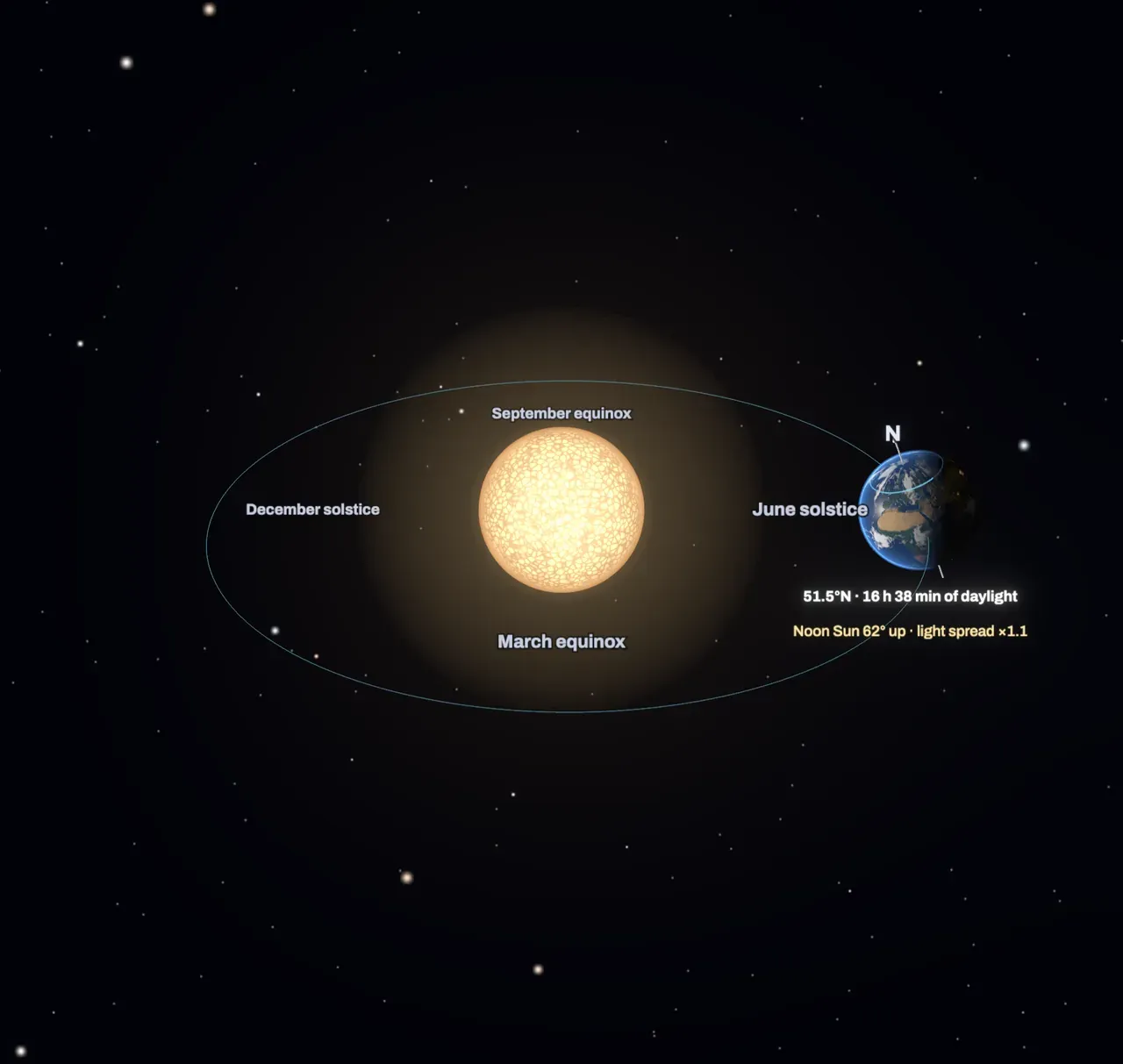
Closest in winter
A natural guess is that summer comes when the Earth is nearer the Sun. It does not. Earth’s orbit is almost a circle, and its distance from the Sun changes by only about 3 per cent through the year: about 147 million kilometres in early January and 152 million in early July. January is midwinter in Europe and midsummer in Australia, at the same distance. Whatever makes seasons has to treat the two hemispheres differently.
The tilted axis
The Earth spins about an axis that is not upright compared with its orbit. It leans by 23.44 degrees, and, crucially, it keeps leaning the same way in space all year, pointing near the Pole Star. As the Earth travels round the Sun, that fixed lean means the northern half tips toward the Sun for one half of the orbit and away from it for the other.
Around 21 June the north leans most toward the Sun. That is the June solstice: northern summer, southern winter. Six months later, on the far side of the orbit, the same lean points the north away from the Sun, and the seasons swap. Halfway between, at the equinoxes in March and September, the axis leans sideways, along the orbit, and neither hemisphere is favoured.
High sun, long days
Tilt changes two things at once. The first is how high the Sun climbs. When the Sun is overhead, a beam of sunlight lands on a patch exactly its own size. When the Sun is low, the same beam is smeared across a much bigger patch, so each square metre of ground gets less of it. The second is the length of the day. Tipped toward the Sun, a latitude spends more of each turn of the Earth on the lit side, so the Sun has longer to heat it.
In London, at 51.5° north, the summer Sun climbs to 62 degrees and stays up for about 16 hours 38 minutes. In December it rises only 15 degrees and sets after about 7 hours 50 minutes. High and long beats low and short, and that difference, not distance, is summer against winter.
Try it: choose Jun solstice, then Dec solstice, and watch the axis keep pointing the same way. Then choose Sunlight up close under Zoom to the sunlight, compare the two beams’ bright patches, and pick Tromsø: from Sun all day in June to no sunrise at all in December.
Where the Sun is overhead
At noon on the June solstice the Sun stands straight overhead at 23.44° north, the Tropic of Cancer. In December it is overhead at 23.44° south, the Tropic of Capricorn. Through the year the overhead point swings between the two. Within 23.44 degrees of each pole, the polar circles, there are days when the Sun never sets and days when it never rises.
The scene works this out from the tilt and the Earth’s place on its orbit: the overhead latitude swings back and forth through the year like a slow pendulum, reaching the full tilt north and south at the solstices and crossing the equator at the equinoxes. Set a bigger tilt and the tropics move toward the poles, the polar circles toward the equator, and the seasons become extreme. With no tilt at all the Sun would stay over the equator every day of the year, and every place would have one unchanging season.
What the model leaves out
The scene shows the geometry: where sunlight falls and for how long. Real temperatures also depend on stored heat. Oceans and land take weeks to warm and cool, which is why the hottest weeks come after the June solstice rather than on it. Clouds, winds and ocean currents move heat around too, and over about 21,000 years a slow wobble of the axis, together with a slow turning of the orbit itself, shifts which season falls when the Earth is nearest the Sun. The Earth and Sun are drawn far too large for their distance.