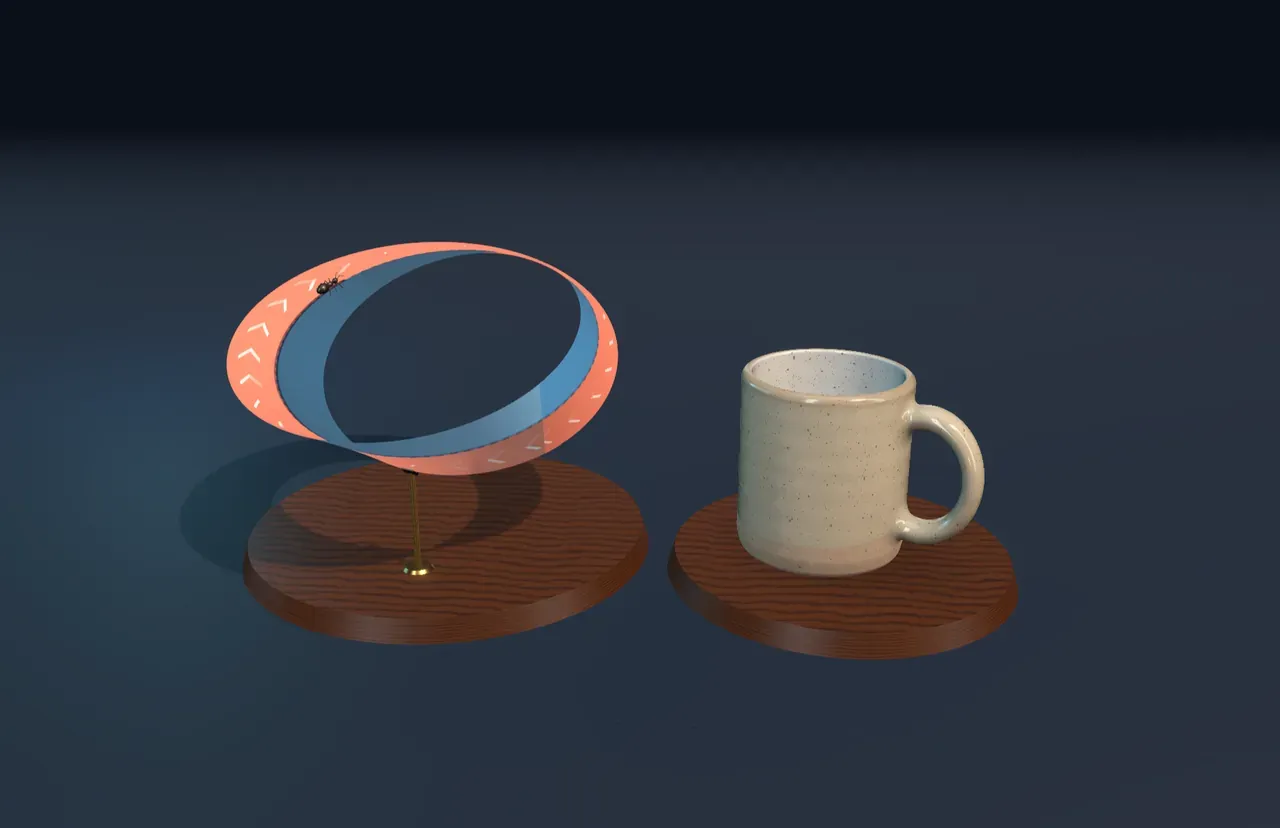
A loop with one side
Take a strip of paper and tape its ends together and you get a plain loop, like a paper crown. It has an inside and an outside: an ant walking along the outside can never reach the inside without stepping over an edge. It also has two edges, a top one and a bottom one.
Now give one end half a turn before you tape it. The loop looks almost the same, but something has changed completely. Follow the ant again: it walks once round and finds itself on what looked like the other face, directly under where it started. One more lap brings it home. It has visited every part of the paper without crossing an edge, so the paper has only one side. Run a finger along the edge and the same thing happens: there is only one edge.
This is the Möbius strip, described in 1858 by the German mathematician August Ferdinand Möbius, and independently in the same year by Johann Benedict Listing.
Try it: press Möbius and watch the two printed colours meet at the glued joint. Then press Loop, and set Half-twists to 2 and 3.
Odd and even twists
Only whether the number of half-twists is odd or even matters for sides and edges. With 0 or 2 half-twists the paper comes back the right way up, so the loop has two sides and two edges. With 1 or 3 it comes back upside down, so the two faces join into one side and the two edges join into one long edge.
That is why the coral and blue faces in the Scene meet at the joint only when the twists are odd. Printed paper makes the one-sidedness visible: you cannot colour one side of a Möbius strip without colouring all of it.
Cutting down the middle
Cut a plain loop along its middle line and you get what you expect, two thinner loops. Cut a Möbius strip the same way and it does not fall apart: you get one loop, twice as long, with two full twists in it. The cut runs along the middle line, which on a Möbius strip goes round only once while the edge goes round twice, so the cut never separates the paper into two pieces.
More twists give stranger results. Two half-twists give two loops linked together like links of a chain. Three half-twists give a single long loop tied in a trefoil knot, the simplest true knot. In the Scene, choose Cut under Cut down the middle to see each one, and Whole loop to put the paper back. The pieces are pulled apart by sliding every bit of paper straight away from the cut, so nothing passes through anything: the linking and the knot were already hidden in the strip.
Topology: shape without measurement
Topology studies the properties of a shape that survive any stretching, bending or squeezing, as long as nothing is torn and nothing is glued. Lengths, angles and curvature do not count. What counts is how the shape hangs together: how many pieces, how many edges, how many sides, how many holes. Listing coined the word in 1847.
The classic example is a coffee mug and a doughnut. Imagine the mug made of soft clay. Fill in the cup, which is only a dent, not a hole. Let the body shrink into the handle while the handle thickens into a ring. You end with a doughnut, and at no moment did you tear or join anything. Both shapes have exactly one hole, so to a topologist they are the same shape. A ball and a doughnut are not: no amount of squeezing makes a hole appear without tearing.
The mug on the right of the Scene is made of that soft clay. Drag Squeeze the mug slowly from 0, a coffee mug, to 1, a doughnut. First the cup fills in. Then the body shrinks into the handle while the handle swells into a ring, and last the ring lies down. Watch the hole through the handle: it never closes and no new one opens, so the doughnut’s hole is the handle’s hole. The half-twists and the cut belong to the paper loop; the mug is a second, separate example.
Where one-sided loops turn up
Engineers have used Möbius loops for conveyor belts and for loops of recording tape, because both faces then wear or get used evenly. Topology itself reaches far beyond paper: it describes how molecules of DNA knot and link, the possible shapes of the universe, and which networks can be drawn without crossings.
What this model leaves out
Real paper is stiff and does not like to twist. A paper Möbius strip takes a shape that bends without stretching, which is not quite the smooth twisted surface drawn here; the topology, which is all that matters for sides, edges and the cut, is the same. The Scene pulls the cut pieces apart in one particular way; real pieces would flop into other positions, but they could never unlink or untie themselves. The mug’s squeeze is one of endless possible smooth deformations, chosen so that it keeps exactly one hole at every moment. At the very end the glazed clay takes on the colours of a fried, iced doughnut, so that you can recognise it; topology cares only about the shape.