Power in moving air
Moving air carries energy. A turbine’s rotor sweeps a circle, and every second a cylinder of air passes through it. The power the wind brings is ½ρAv³: half the air’s density times the area swept by the blades, times the wind speed cubed.
The cube is the surprise. One factor of speed comes from how much air arrives each second, and two more from the energy each kilogram carries, which grows with speed squared. Twice the wind brings eight times the power. A 6 metre per second breeze through a 120 metre rotor carries about 1.5 megawatts; a 12 metre per second wind carries twelve.
Why a turbine can never take it all
If the rotor took every bit of the wind’s energy, the air would stop dead behind it, and no fresh air could get through. If it took nothing, the air would sail through untouched. The best a rotor can do lies between. A turbine works by slowing the wind down, and the air must be left moving fast enough to clear the way.
Following the air through, it starts slowing before it reaches the rotor and keeps slowing behind it, while the column of air that passes through spreads wider to carry the same mass at a lower speed. Albert Betz showed in 1919 that the most power any rotor can take is 16/27 of the wind’s power, about 59 %. That happens when the air passing through the rotor is slowed to two thirds of the wind speed and, far behind, to one third. Real blades lose a little more to drag and to the swirl they leave behind; the best modern turbines turn about 45 % of the wind’s power into electricity.
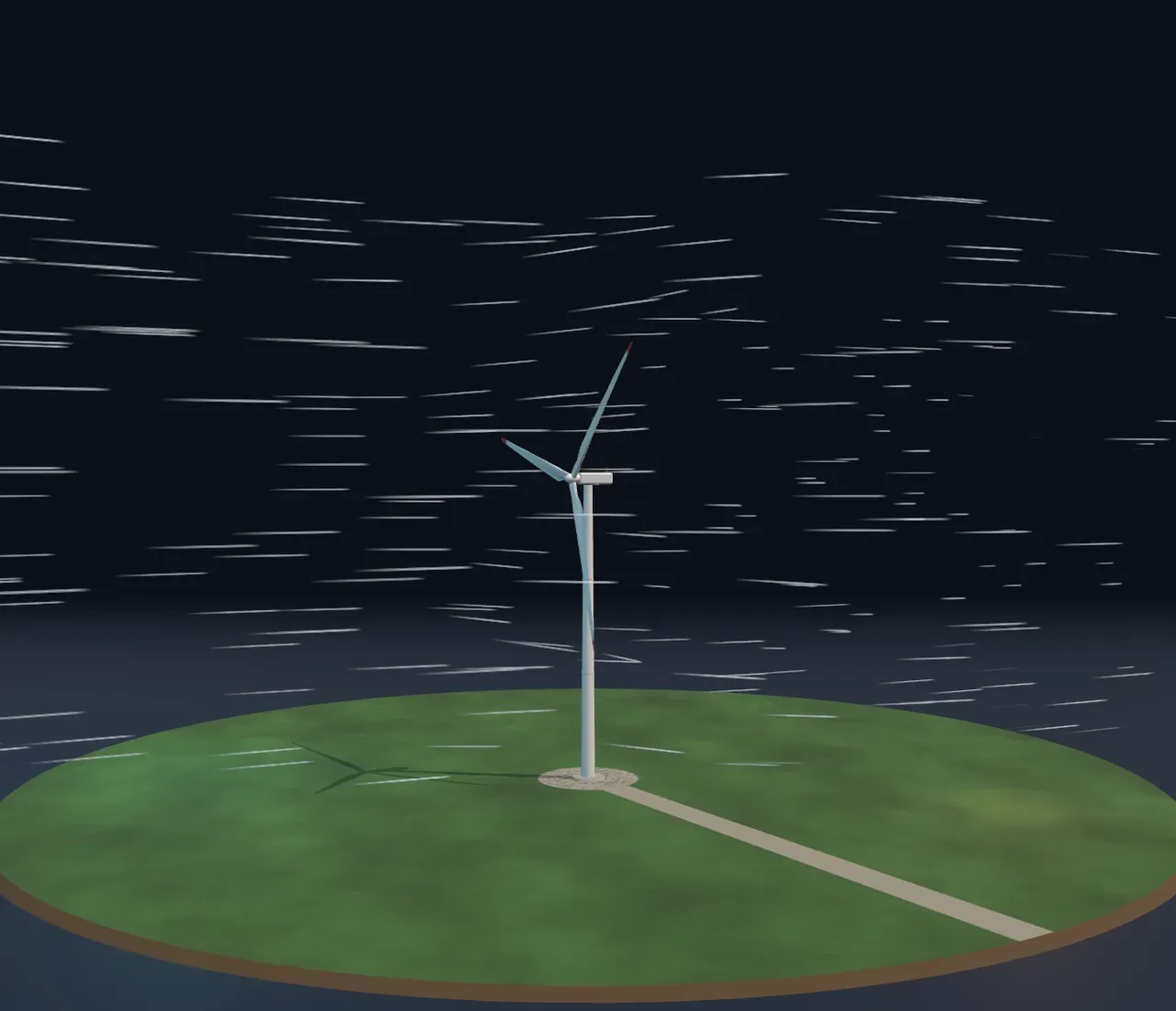
Try it: set Wind speed to 9 m/s and choose On under Show the power. The stream tube widens as the air slows from 9 to 6 at the rotor and to about 3 behind it, and the chart beside the Scene shows the turbine taking 44 % of what the wind brings.
Starting, holding, stopping
Below about 3 metres per second, the cut-in speed, there is too little power to be worth turning a generator, so the rotor waits. Above it, the rotor turns with its blade tips moving about seven and a half times faster than the wind, the speed at which the blades meet the air best, and the power climbs as the cube.
Around 11 metres per second the generator reaches its rated power, the most it is built to deliver. Beyond that, extra wind would only overload it. So the turbine twists each blade about its length, a move called pitching, so that it meets the air at a gentler angle and lets the extra wind spill past. The output stays flat while the wind keeps rising.
At about 25 metres per second, the cut-out speed, the forces on the blades and tower become dangerous. The turbine turns its blades edge-on to the wind, feathering them, and the rotor stops until the storm passes. That is why a turbine standing still on a calm day and one standing still in a gale are idle for opposite reasons.
Bigger rotors
Power grows with the area swept, so it grows with the square of the rotor’s diameter. A 160 metre rotor sweeps seven times the area of a 60 metre one and, in the same wind, gives seven times the power. Bigger blades also turn more slowly, because their tips are kept to about 85 metres per second. This is why turbines have grown so large, and why they stand on tall towers, up where the wind is stronger and steadier.
What this model leaves out
The scene treats the wind as steady and the same at every height. Real wind gets stronger with height, gusts and swirls, and changes direction; the turbine turns its whole head to face it. The slowing of the air follows simple momentum theory for a rotor that pushes evenly across its disc, ignoring the swirl the blades leave behind and the faint speeding up of air round the outside of the stream tube. The pitch angles are approximate, the power curve is idealised with sharp corners where real turbines round them off, and the generator is sized at a fixed 400 watts per square metre of rotor so that every rotor reaches rated power at the same wind speed.