A starling flock with no leader: each bird applies three rules, separation, alignment and cohesion, to its seven nearest neighbours, and the shape of the whole flock emerges by itself. What happens when you switch a rule off, and why the same happens in fish, ants and crowds.
Step 1 of 5 · No one in charge
Step 1 of 5
No one in charge
On winter evenings starling flocks gather over their roost before settling for the night: tens of thousands of birds as one cloud that stretches, folds, splits and flows back together. The display is called a murmuration, and from below it looks like choreography.
Step 2 of 5
Three rules, seven neighbours
Each bird in the Scene applies three rules to its neighbours. Separation: do not crowd them. Alignment: fly their way. Cohesion: stay with them, steering towards the middle of where they are. No rule mentions the flock, its edges or where it is going. Follow one bird is at One bird’s rules: a gold bird, with lines to the birds it watches, and its three steers as arrows.
Step 3 of 5
Take away a rule
Each rule does one job, and the clearest way to see it is to switch it off. Separation and Cohesion are locked at 50%.
Step 4 of 5
Knots
The flock you see is a balance: cohesion draws birds in, separation pushes them apart, and alignment makes them agree on a direction. When a falcon dives into the flock, the birds nearest it swerve, their neighbours copy them, and a wave of turning crosses a flock of hundreds in under a second.
Step 5 of 5
Emergence
A pattern in which large-scale order arises from small-scale rules, with no plan of the whole, is called emergent behaviour. Fish schools, ant trails, locust swarms and lanes in a human crowd form this way.
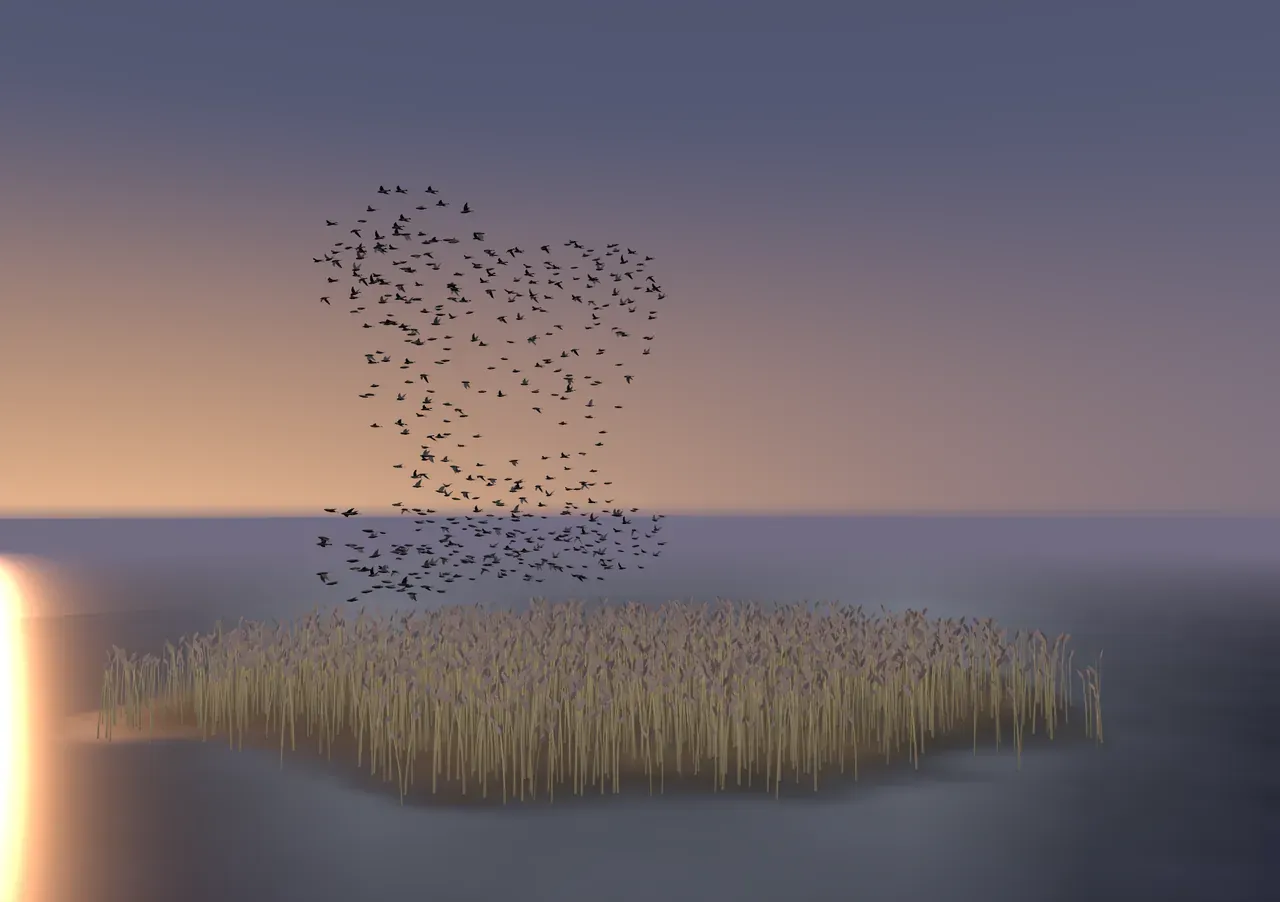
Loading the interactive version…
Loading the interactive version…
Each step sets up the Scene for you, and a control marked “fixed” stays put for that step.
Practice · Choose
Who decides which way the flock turns?
Practice · Choose
Who decides which way the flock turns?
Practice · Choose
Each starling follows its seven nearest neighbours, however far away they are. Why is that better than following everyone within a fixed distance?
Practice · Choose
Each starling follows its seven nearest neighbours, however far away they are. Why is that better than following everyone within a fixed distance?
Practice · Predict, then look
Predict what happens to the flock when Alignment goes down to 0%, with separation and cohesion as they are.
Practice · Predict, then look
Predict what happens to the flock when Alignment goes down to 0%, with separation and cohesion as they are.
Practice · Reach the target
Change one rule so the birds pile into tight knots, and press Check.
Practice · Reach the target
Change one rule so the birds pile into tight knots, and press Check.
Practice · Choose
Which of these is not emergent behaviour?
Practice · Choose
Which of these is not emergent behaviour?
Lesson complete. Every practice question here is done.