Three particles build every atom: protons and neutrons in a tiny nucleus, electrons around it. The atomic number decides the element, and the mass number counts everything in the nucleus.
Step 1 of 5 · Three particles
Step 1 of 5
Three particles
All matter, from a glass of water to a lump of iron, is made of atoms, and the atoms themselves are made of only three kinds of particle. At the centre of the atom is the nucleus, holding protons, which are positively charged, and neutrons, which have no charge. Around the nucleus move the electrons, which are negatively charged.
| Particle | Where | Charge | Relative mass |
|---|---|---|---|
| Proton | in the nucleus | | |
| Neutron | in the nucleus | | |
| Electron | around the nucleus | | |
The Scene shows a carbon atom: six protons (orange) and six neutrons (pale) packed in the nucleus, and six electrons on rings around it. Change Protons and see that a whole atom has one electron for every proton: the charges cancel, and the atom is neutral.
Step 2 of 5
The atomic number
What makes an atom oxygen rather than carbon? Only the number of protons in its nucleus. That number is the atomic number, written . Every oxygen atom in the world has eight protons, and every carbon atom has six. An element is a substance whose atoms all have the same atomic number, and the periodic table puts the elements in order of : hydrogen is , helium , and so on.
The Scene now shows oxygen, . Try adding one proton: the atom is no longer oxygen.
Step 3 of 5
The mass number
Protons and neutrons have almost the same mass, and electrons are almost 2000 times lighter. So an atom’s mass is set by the number of particles in its nucleus. That number is the mass number, :
where is the number of neutrons. So to find how many neutrons an atom has, subtract the atomic number from the mass number: .
The Scene now shows aluminium, with the protons locked. This atom’s mass number is . Work out how many neutrons its nucleus holds, and count them in the Scene if you like.
Step 4 of 5
Writing an atom
Chemists write an atom as the element’s symbol with the mass number at the top left and the atomic number at the bottom left. The aluminium from the last step is , and sodium is . All three numbers can be read from the symbol: protons, neutrons, and in a neutral atom electrons.
The Scene now shows potassium, .
Step 5 of 5
Finding an atom by its mass
The Scene draws each element’s most common atom. Carbon’s has six neutrons, so its mass number is ; oxygen’s has eight, and its mass number is . The heavier the atom, the more neutrons it usually has beyond its protons. Use Protons to find an atom by its mass number.
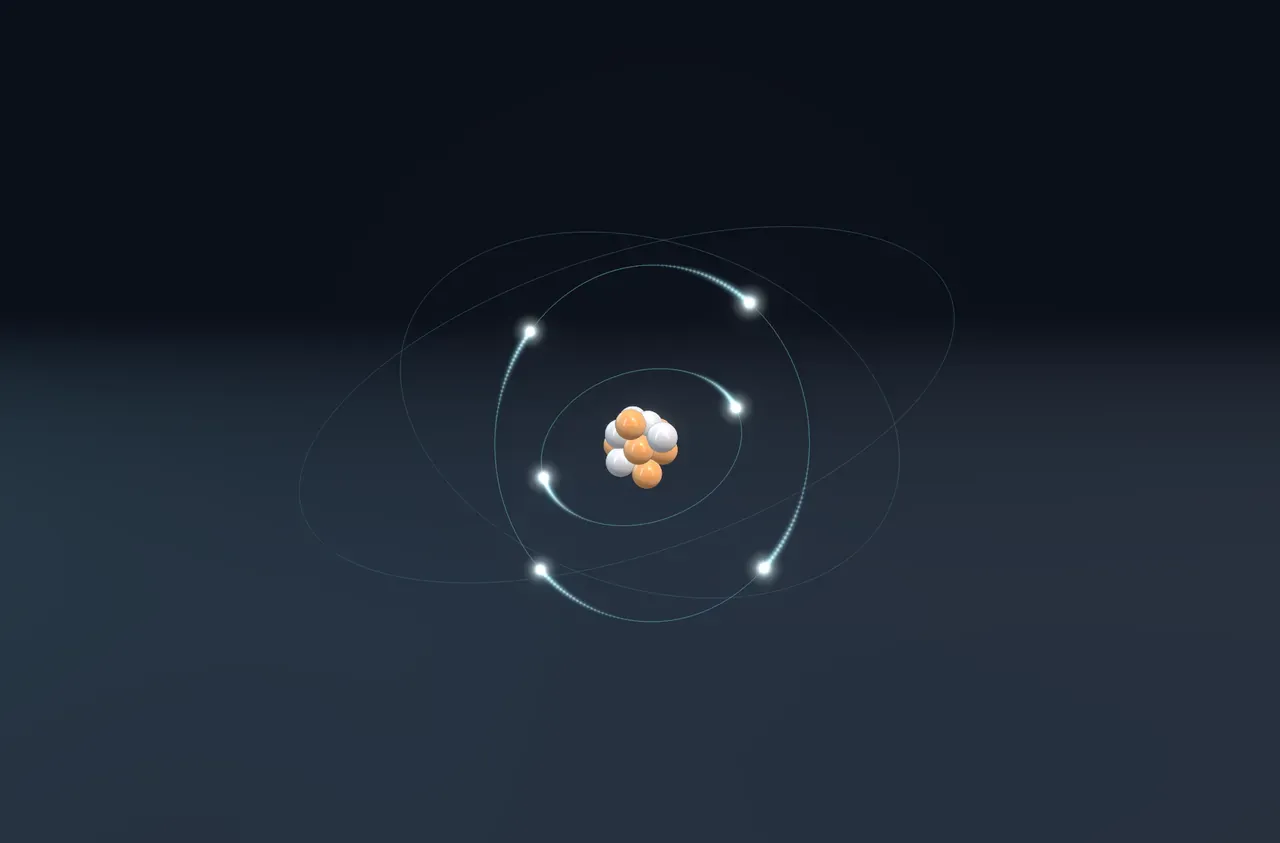
Loading the interactive version…
Loading the interactive version…
Each step sets up the Scene for you, and a control marked “fixed” stays put for that step.
Practice · Choose
A carbon atom has six protons, six neutrons and six electrons. Where is almost all of its mass?
Practice · Choose
A carbon atom has six protons, six neutrons and six electrons. Where is almost all of its mass?
Practice · Choose
The Scene shows an oxygen atom. Which of these decides that it is oxygen and not another element?
Practice · Choose
The Scene shows an oxygen atom. Which of these decides that it is oxygen and not another element?
Practice · Calculate
The aluminium atom in the Scene has , and its mass number is . How many neutrons are in its nucleus?
Practice · Calculate
The aluminium atom in the Scene has , and its mass number is . How many neutrons are in its nucleus?
Practice · Calculate
A neutral potassium atom is . How many electrons does it have?
Practice · Calculate
A neutral potassium atom is . How many electrons does it have?
Practice · Reach the target
Change Protons until the atom in the Scene has a mass number of , then press Check.
Practice · Reach the target
Change Protons until the atom in the Scene has a mass number of , then press Check.
Lesson complete. Every practice question here is done.