Why an 18-carat gold ring is harder than pure gold: layers of atoms that slip over each other, the yield strength, and odd-sized atoms that buckle the slip plane. And why silver hardly helps.
Step 1 of 6 · Metals bend by slipping
Step 1 of 6
Metals bend by slipping
Pure gold is very soft: you can dent a gold bar with a fingernail, and a coin of pure gold wears smooth in a few years. Most jewellery is 18-carat gold: 18 parts gold in 24 by weight, the rest usually copper and silver. A metal mixed with other elements is an alloy.
In the Lesson on lattices we saw that in a metal, layers of ions can slide over each other through the sea of electrons. In gold the atoms are stacked in close-packed layers, each nestled into the hollows of the one below. The Scene shows a block of pure gold, 24 ct. Predict what happens when the top half is pushed with a gentle Push, 50 MPa.
Step 2 of 6
The yield strength
A small push only leans the layers a little, and they spring back when you let go: the metal is behaving elastically. The push at which the layers start to slide for good is the yield strength. Beyond it the metal changes shape permanently.
Raise Push in small steps from zero, and find the largest push at which the block of pure gold still only leans and does not slip.
Step 3 of 6
Odd-sized atoms
In pure gold every atom is the same size, and the slip plane is smooth. A copper atom is about 11% smaller than a gold atom, so the atoms around it are pulled slightly towards it, and the layers buckle. A sliding layer keeps meeting places where the fit is wrong, and more force is needed to drag it on.
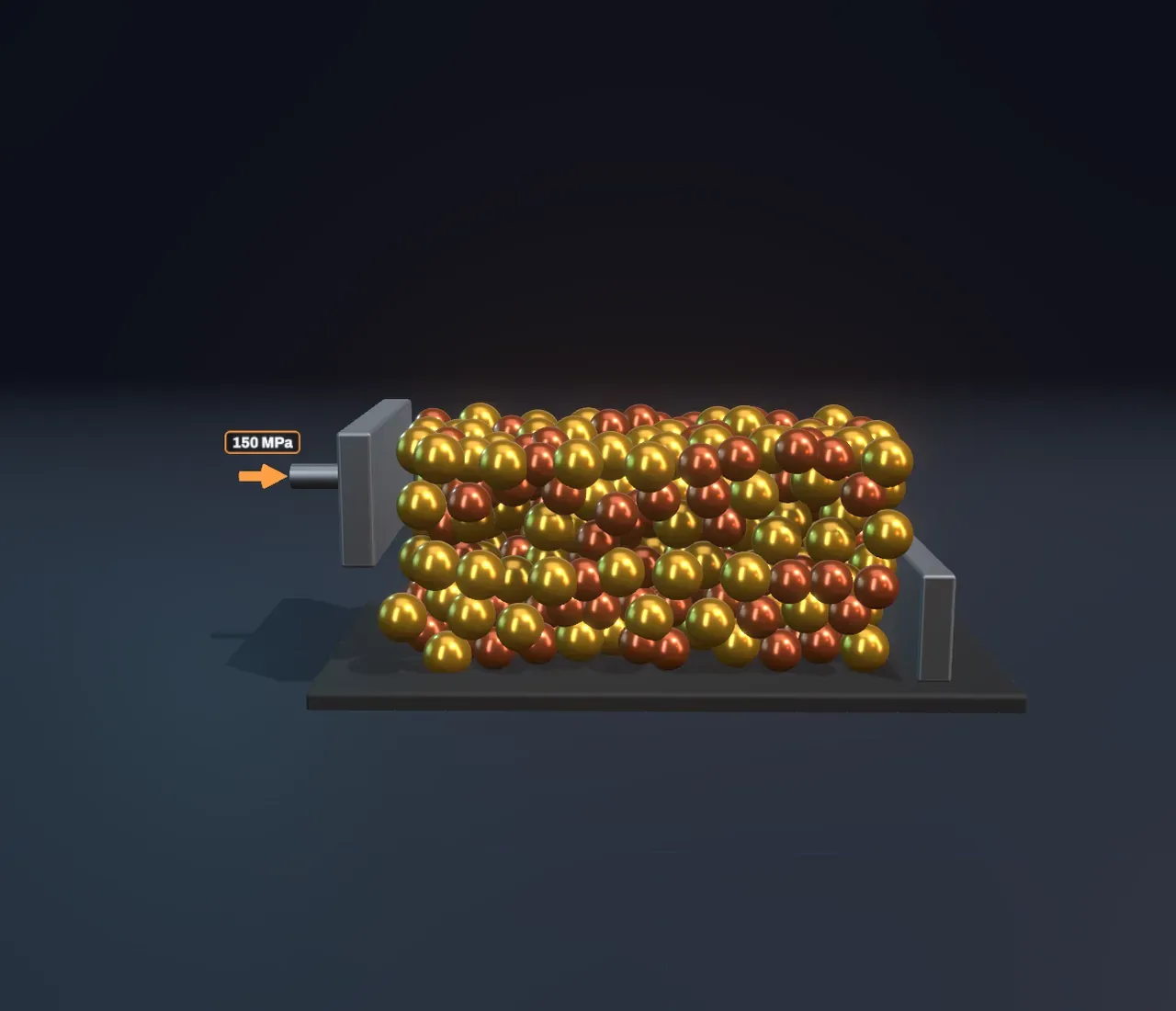
The Scene shows pure gold under a firm push, 150 MPa, and its top half has slipped. Predict what happens when you set Gold content to 18 ct.
Step 4 of 6
By weight and by atoms
Slip the layers is on Slip plane. Each ringed atom is the odd size out, a bump that a sliding layer has to climb over. In 18-carat gold three quarters of the weight is gold, but a copper atom weighs less than a third as much as a gold atom: 63.5 against 197 g/mol. How many copper atoms are there in every hundred atoms?
Step 5 of 6
Why silver hardly helps
Silver is a soft metal like gold, and its atoms are almost exactly the same size: a radius of 144.5 pm against gold’s 144 pm. Predict what happens to the 18-carat block under a firm 150 MPa push when you switch Mixed with from Copper to Silver.
Step 6 of 6
Steel and bronze
The same idea, foreign atoms that do not fit, explains the hardness of bronze (tin in copper), brass (zinc in copper) and sterling silver (copper in silver). In all of them the foreign atoms sit in the places of the host metal’s atoms. Steel is a little different: its carbon atoms, 0.2% to 2% of the weight, are far smaller than iron atoms.
Loading the interactive version…
Loading the interactive version…
Each step sets up the Scene for you, and a control marked “fixed” stays put for that step.
Practice · Predict, then look
Push the top half of a block of pure gold with a gentle Push, 50 MPa. What happens?
Practice · Predict, then look
Push the top half of a block of pure gold with a gentle Push, 50 MPa. What happens?
Practice · Reach the target
Find the largest Push at which the block of pure gold still only leans and does not slip, then press Check.
Practice · Reach the target
Find the largest Push at which the block of pure gold still only leans and does not slip, then press Check.
Practice · Predict, then look
Pure gold slipped under a firm push, 150 MPa. Set Gold content to 18 carat, with copper. What happens under the same push?
Practice · Predict, then look
Pure gold slipped under a firm push, 150 MPa. Set Gold content to 18 carat, with copper. What happens under the same push?
Practice · Calculate
18-carat gold with copper: 18 g of gold and 6 g of copper. The molar masses: gold 197 g/mol, copper 63.5 g/mol. How many copper atoms are there in every 100 atoms?
Practice · Calculate
18-carat gold with copper: 18 g of gold and 6 g of copper. The molar masses: gold 197 g/mol, copper 63.5 g/mol. How many copper atoms are there in every 100 atoms?
Practice · Predict, then look
Switch Mixed with from Copper to Silver, at the same 18 carat and under the same 150 MPa push. What happens?
Practice · Predict, then look
Switch Mixed with from Copper to Silver, at the same 18 carat and under the same 150 MPa push. What happens?
Practice · Choose
Carbon atoms are far smaller than iron atoms. Where do they sit in steel?
Practice · Choose
Carbon atoms are far smaller than iron atoms. Where do they sit in steel?
Lesson complete. Every practice question here is done.