When non-metals meet they share electrons: a shared pair, double and triple bonds, and lone pairs, and how the repulsion between electron pairs sets a molecule’s shape and its bond angles.
Step 1 of 6 · Sharing a pair
Step 1 of 6
Sharing a pair
When two non-metal atoms meet, neither will give electrons away. Instead they share them: each atom gives one electron, and the shared pair sits between the two nuclei and pulls on both. That is a covalent bond. A group of atoms held together this way is a molecule.
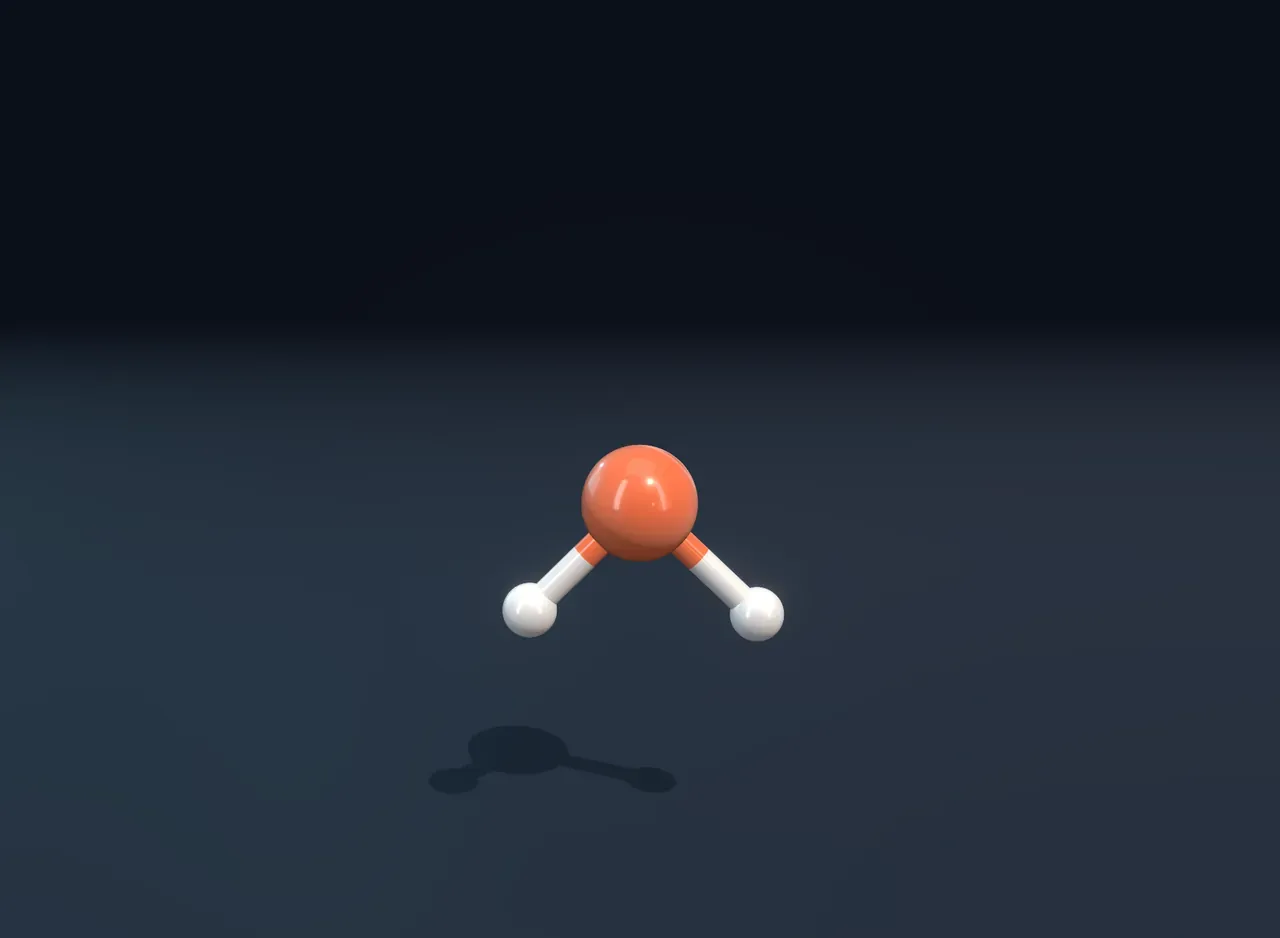
Each atom makes as many bonds as it is short of a full shell. Hydrogen is one short, so it makes one bond. The Scene shows water, H₂O: one oxygen atom and two hydrogen atoms. How many bonds does the oxygen make?
Step 2 of 6
Double and triple bonds
Sometimes one pair is not enough. In oxygen, O₂, each atom needs two more electrons, so the two atoms share two pairs: a double bond. In carbon dioxide, CO₂, the carbon has a double bond to each of its two oxygen atoms.
The Scene shows nitrogen, N₂, and each nitrogen atom has five outer electrons. How many pairs of electrons do the two atoms share?
Step 3 of 6
As far apart as possible
Electron pairs repel each other, so they spread as far apart as they can around the central atom. That simple rule sets the shape of a molecule. In methane, CH₄, four bonding pairs surround the carbon. On paper they look like a cross, but in three dimensions they can spread further: they point to the four corners of a tetrahedron. Turn the molecule and check the angle between two bonds.
Step 4 of 6
Is water straight?
Carbon dioxide is a straight line: two bonding pairs, one on each side of the carbon, at 180°. Water too has a central atom with two atoms bonded to it. Predict the shape of a water molecule, then choose water in Molecule.
Step 5 of 6
The pairs you cannot see
Oxygen has six outer electrons. Two of them take part in the bonds to the hydrogens, and the other four sit on the oxygen as two pairs that bond to nothing: lone pairs. The Scene shows only the atoms, but these pairs take up room too and push on the bonding pairs. So the oxygen is surrounded by four pairs, as in methane, and the two hydrogens are pushed towards each other: an angle of 104.5°, and a bent molecule.
Step 6 of 6
A pyramid
| Bonding pairs | Lone pairs | Shape | Angle | Example |
|---|---|---|---|---|
| | | linear | 180° | CO₂ |
| | | tetrahedral | 109.5° | CH₄ |
| | | pyramidal | 107° | NH₃ |
| | | bent | 104.5° | H₂O |
Each lone pair that takes a bonding pair’s place closes the angle a little more, because it sits close to the atom and pushes harder. Find the pyramid-shaped molecule in the Scene.
Loading the interactive version…
Loading the interactive version…
Each step sets up the Scene for you, and a control marked “fixed” stays put for that step.
Practice · Choose
Oxygen has six outer electrons. How many covalent bonds does an oxygen atom make?
Practice · Choose
Oxygen has six outer electrons. How many covalent bonds does an oxygen atom make?
Practice · Calculate
Each nitrogen atom has five outer electrons. How many pairs of electrons do the two atoms in an N₂ molecule share?
Practice · Calculate
Each nitrogen atom has five outer electrons. How many pairs of electrons do the two atoms in an N₂ molecule share?
Practice · Calculate
What is the angle between two bonds in a methane molecule?
Practice · Calculate
What is the angle between two bonds in a methane molecule?
Practice · Predict, then look
CO₂ and H₂O each have a central atom with two atoms bonded to it. CO₂ is straight. What shape is a water molecule?
Practice · Predict, then look
CO₂ and H₂O each have a central atom with two atoms bonded to it. CO₂ is straight. What shape is a water molecule?
Practice · Calculate
How many lone pairs are there on the oxygen atom in a water molecule?
Practice · Calculate
How many lone pairs are there on the oxygen atom in a water molecule?
Practice · Reach the target
Choose in Molecule the molecule whose bond angle is about 107°, with three bonding pairs and one lone pair, then press Check.
Practice · Reach the target
Choose in Molecule the molecule whose bond angle is about 107°, with three bonding pairs and one lone pair, then press Check.
Lesson complete. Every practice question here is done.