Four methods for one problem: bubble, insertion, merge and quicksort. Measure how many comparisons each makes on the same row, find that the number of swaps is fixed, and see that even a fast method has a worst case.
Step 1 of 5 · Four ways
Step 1 of 5
Four ways
One problem can have many algorithms. Algorithm offers four:
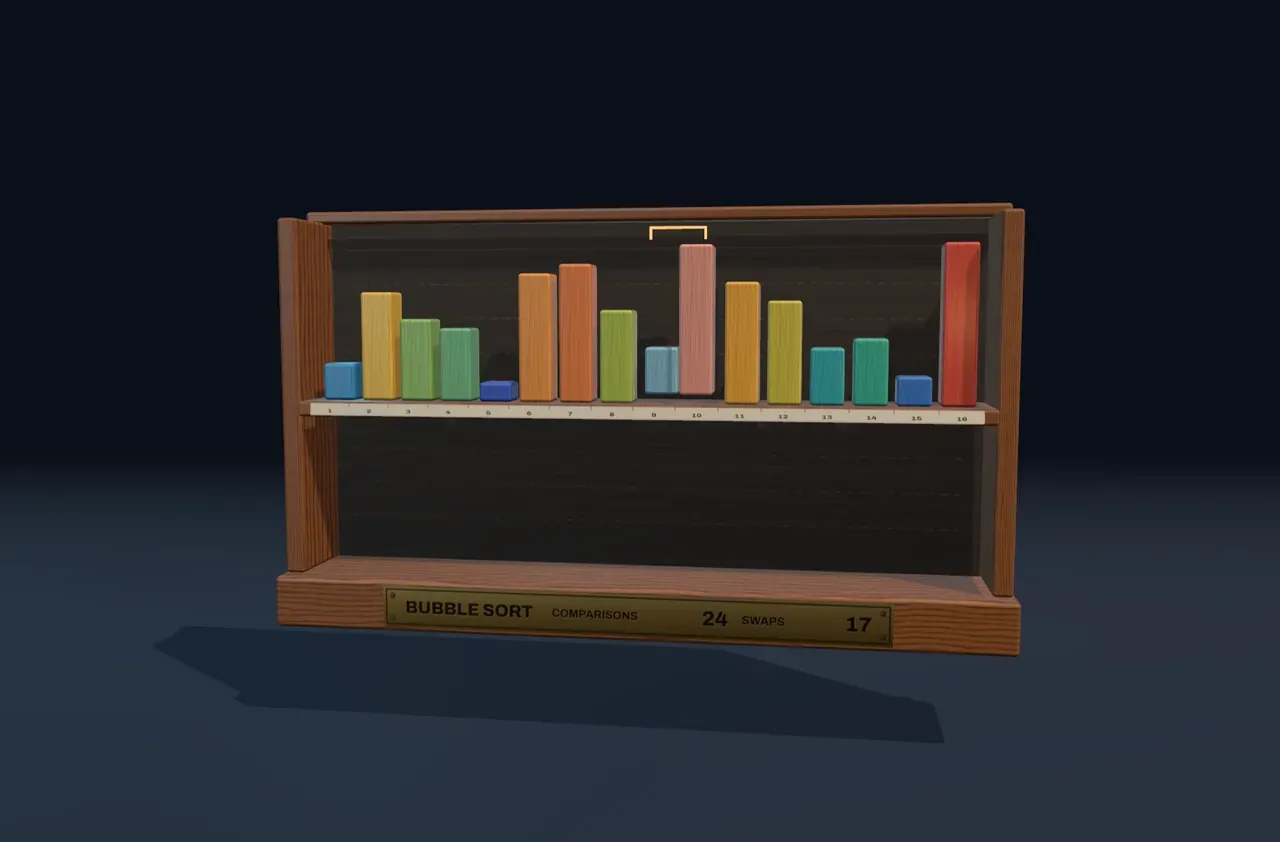
- Bubble compares neighbours and swaps, pass after pass.
- Insertion takes each block in turn and slides it left, swap after swap, until it meets a shorter block. So the left part of the row is always sorted, and grows by one block at a time.
- Merge splits the row into halves, and the halves into halves, down to single blocks, then merges pairs of sorted pieces: each comparison between the two front blocks lowers the shorter of them to the bottom shelf.
- Quick picks a pivot, here the last block, puts every shorter block to its left and every taller one to its right, and sorts each side the same way.
All of them end with the same sorted row. What sets them apart is how much work it takes. The row is now Nearly sorted: only a few blocks are a place or two out.
Step 2 of 5
Merge sort
Merge sort works in levels. Eight blocks split into two halves of four, four pieces of two and eight singles: levels. Then it merges back up, level by level. Merging two sorted pieces is quick, since it only takes comparing the two blocks at the front of each piece.
Merge sort’s plaque counts moves instead of swaps: each block goes down to the bottom shelf and back up, once per level.
Step 3 of 5
Swaps and inverted pairs
Bubble sort and insertion sort swap only neighbours. On this shuffled row bubble sort makes 120 comparisons and 72 swaps.
Step 4 of 5
The worst case
Quicksort is quick when the pivot lands in the middle, because then each partition halves the work, as in merge sort. But nothing guarantees it lands in the middle. An algorithm’s worst case is the input that makes it work hardest.
Step 5 of 5
Choosing a method
Now thirty-two blocks, Shuffled. Measure each of the four algorithms on the same row.
Loading the interactive version…
Loading the interactive version…
Each step sets up the Scene for you, and a control marked “fixed” stays put for that step.
Practice · Predict, then look
Sixteen blocks, Nearly sorted. Which Algorithm will sort this row in the fewest comparisons?
Practice · Predict, then look
Sixteen blocks, Nearly sorted. Which Algorithm will sort this row in the fewest comparisons?
Practice · Calculate
Merge on a Reversed row of 8 blocks. Bubble sort made 28 comparisons here. How many comparisons will merge sort make?
Practice · Calculate
Merge on a Reversed row of 8 blocks. Bubble sort made 28 comparisons here. How many comparisons will merge sort make?
Practice · Predict, then look
On this shuffled row of 16 blocks, bubble sort makes 72 swaps. Algorithm will change to Insertion, which also swaps only neighbours. How many swaps will it make?
Practice · Predict, then look
On this shuffled row of 16 blocks, bubble sort makes 72 swaps. Algorithm will change to Insertion, which also swaps only neighbours. How many swaps will it make?
Practice · Predict, then look
Quick sorts the shuffled row of 16 blocks in 57 comparisons. Starting order will change to Reversed. What will happen?
Practice · Predict, then look
Quick sorts the shuffled row of 16 blocks in 57 comparisons. Starting order will change to Reversed. What will happen?
Practice · Reach the target
Thirty-two blocks, Shuffled. Bubble sort needs 451 comparisons here. Choose the Algorithm that sorts this row in the fewest comparisons, and press Check.
Practice · Reach the target
Thirty-two blocks, Shuffled. Bubble sort needs 451 comparisons here. Choose the Algorithm that sorts this row in the fewest comparisons, and press Check.
Lesson complete. Every practice question here is done.