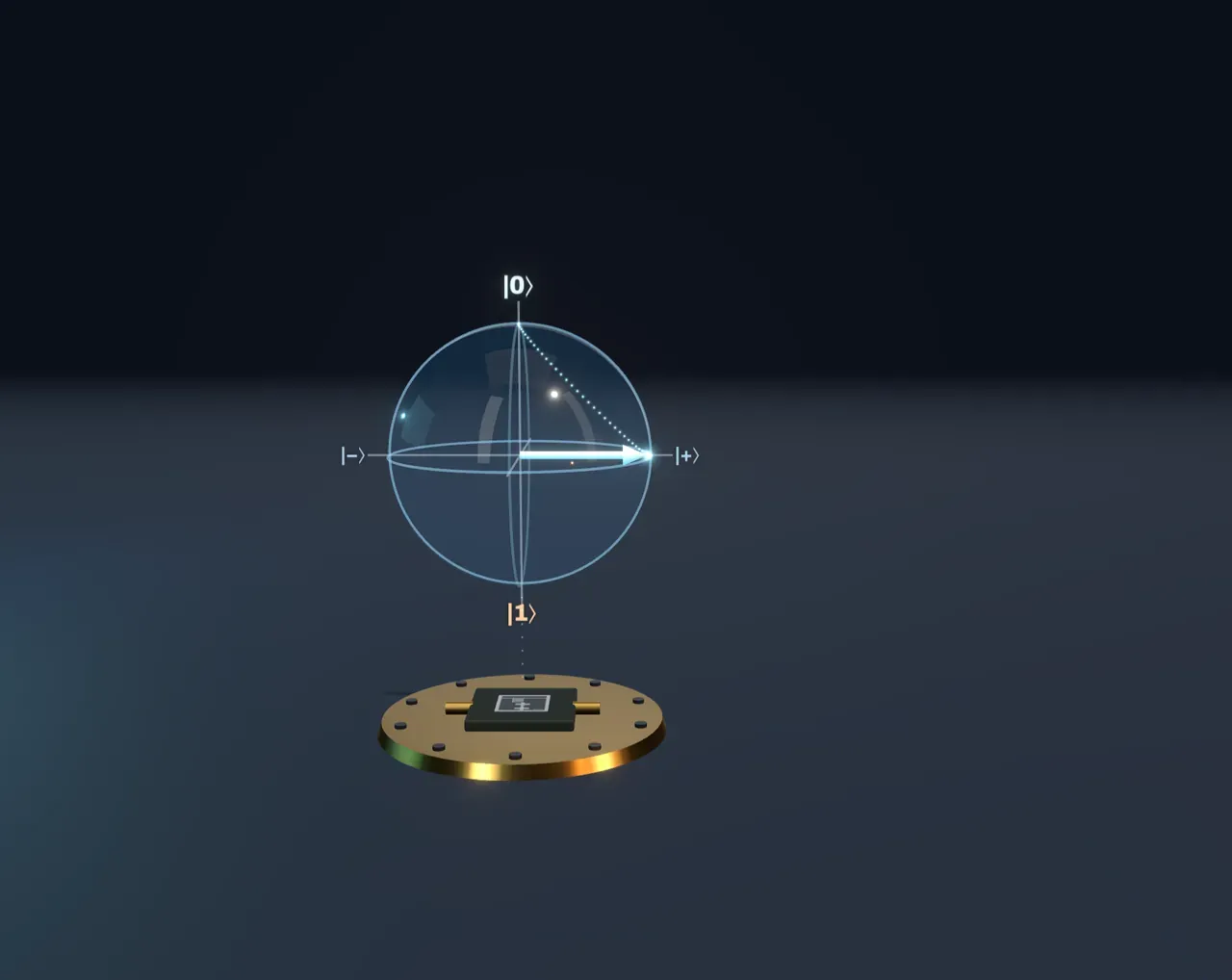
A qubit as an arrow on a sphere: a gate that makes a superposition, a measurement that gives 0 or 1 by chance, phase that makes interference, and Grover's search, which finds one item in an unsorted store in far fewer steps than an ordinary search.
Step 1 of 9 · A qubit
Step 1 of 9
A qubit
An ordinary bit is 0 or 1. A qubit is a quantum bit, and its state is drawn here as an arrow on a sphere: up is , down is , and every other direction is a superposition, a blend of both. The qubit itself is a tiny circuit on the chip under the sphere, a superconductor that works only when it is extremely cold, close to absolute zero.
Gates are a quantum computer’s operations, like AND and NOT among logic gates, and each gate turns the arrow. The X (NOT) gate turns it half a turn, from to , just like NOT. The H gate tips it onto the equator. Measure and search is locked at Qubit now. Predict what the measurements will give.
Step 2 of 9
Phase
Now the measurements are running: each one flies from the arrow into one of the tubes, 0 or 1, and the ring marks the chance. Gate is at H, then Z. The Z gate turns the arrow half a turn about the upright axis, to the far side of the equator. The arrow’s direction around that axis is called phase.
Try: switch between H and H, then Z and compare the tubes.
Step 3 of 9
Interference
H and Z on their own do not look useful: one gives a random result, and the other changes something a measurement cannot see. The power comes when gates are combined. Gate is locked at H now. Predict what a second H will do.
Step 4 of 9
Search
Grover’s search finds one marked item among unsorted items. With qubits there are items, and at the start an H gate on every qubit gives them all the same chance: a measurement is a blind guess. Each round flips the sign of the answer and then reflects every bar about the average, and the answer’s bar grows. On the sphere, the arrow moves by the same angle each round, from “every wrong answer” at the top pole towards the answer at the bottom pole.
The start is very close to “every wrong answer”, and the angle each round adds is small, in proportion to . So it takes about rounds to reach the answer. The Search size and Search rounds are locked now.
Step 5 of 9
Too many rounds
16 items and 3 rounds: the answer’s bar is tall, and the arrow is nearly at the bottom pole. Search rounds is locked. Predict what will happen if you keep turning.
Step 6 of 9
A million items
An ordinary search of an unsorted store checks item after item, and on average needs looks. Grover’s search needs about rounds. When the store is small the difference is small, but it grows with : the looks grow like , and the rounds only like .
Try: change the Search size and the Search rounds, and find for each size the number of rounds with the highest chance.
Step 7 of 9
A flip
Not every gate makes randomness. Start with the gate an ordinary computer has too.
Step 8 of 9
How many items
Under Measure and search at Search each item is one combination of noughts and ones.
Step 9 of 9
The ordinary way
To know how much the quantum search saves, you need to know what an ordinary search costs.
Loading the interactive version…
Loading the interactive version…
Each step sets up the Scene for you, and a control marked “fixed” stays put for that step.
Practice · Predict, then look
After the H gate the arrow lies on the equator, halfway between and . A qubit like this is prepared again and again and each one is measured. What will each measurement give?
Practice · Predict, then look
After the H gate the arrow lies on the equator, halfway between and . A qubit like this is prepared again and again and each one is measured. What will each measurement give?
Practice · Choose
Choose H, then Z. The Z gate turns the arrow round the equator to the far side. What is the chance a measurement gives 1 now?
Practice · Choose
Choose H, then Z. The Z gate turns the arrow round the equator to the far side. What is the chance a measurement gives 1 now?
Practice · Predict, then look
One H gate gives half-and-half measurements. What will the chance of 1 be after H, then H?
Practice · Predict, then look
One H gate gives half-and-half measurements. What will the chance of 1 be after H, then H?
Practice · Calculate
The Search size is 6 qubits: items, one of which is the answer. How many Search rounds bring the chance of finding it closest to 100%?
Practice · Calculate
The Search size is 6 qubits: items, one of which is the answer. How many Search rounds bring the chance of finding it closest to 100%?
Practice · Predict, then look
16 items and 3 rounds: the chance of finding the answer is about 96%. What will happen to the chance if you run 6 rounds?
Practice · Predict, then look
16 items and 3 rounds: the chance of finding the answer is about 96%. What will happen to the chance if you run 6 rounds?
Practice · Choose
In an unsorted store of a million items, an ordinary search checks item after item, and on average needs about half a million looks. About how many rounds does Grover’s search need?
Practice · Choose
In an unsorted store of a million items, an ordinary search checks item after item, and on average needs about half a million looks. About how many rounds does Grover’s search need?
Practice · Calculate
Gate: X (NOT). The qubit started at , and the gate flipped it. What is the chance a measurement gives ?
Practice · Calculate
Gate: X (NOT). The qubit started at , and the gate flipped it. What is the chance a measurement gives ?
Practice · Calculate
The Search size is locked at 5 qubits. How many items can they search?
Practice · Calculate
The Search size is locked at 5 qubits. How many items can they search?
Practice · Calculate
The Search size is locked at 6 qubits, items, one of which is the answer. An ordinary search checks item after item, in random order. How many looks does it need on average before it finds the answer, ?
Practice · Calculate
The Search size is locked at 6 qubits, items, one of which is the answer. An ordinary search checks item after item, in random order. How many looks does it need on average before it finds the answer, ?
Lesson complete. Every practice question here is done.