What the word information means in computer science: how much uncertainty a message removes, why a fair coin flip carries one bit, and why a rare outcome is more surprising.
Step 1 of 5 · What information is
Step 1 of 5
What information is
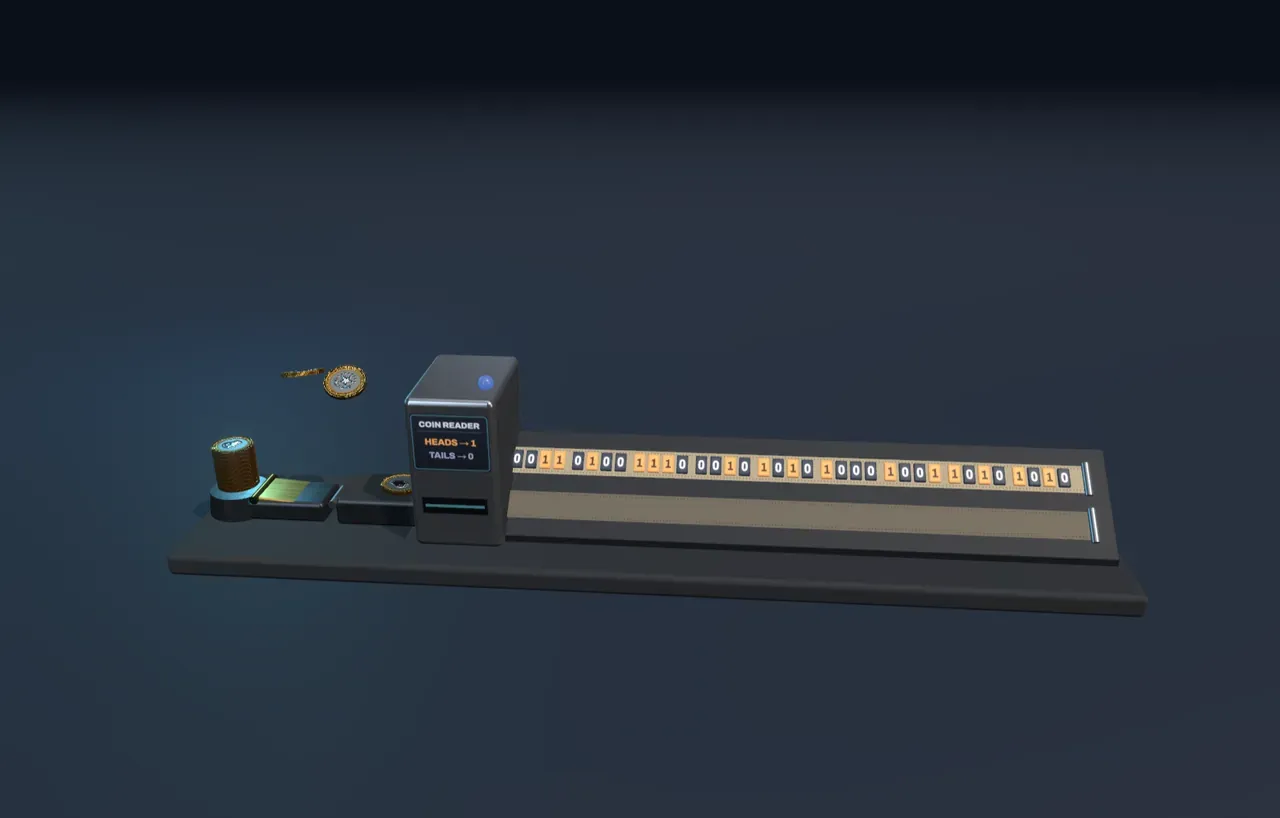
A machine flips coins and prints each flip on a tape: for heads, for tails. Before each flip you do not know what the next digit will be, and after it you know exactly. That change, from not knowing to knowing, is what computer science calls information.
This definition, Claude Shannon’s from 1948, does not ask whether a message is important, true or interesting. It asks only how much uncertainty the message removes: how much you did not know before it arrived. A message you could have guessed in advance tells you nothing.
Step 2 of 5
One bit
Uncertainty is measured in bits. One bit is the answer to one yes-or-no question when both answers are equally likely: exactly what a fair coin gives.
Shannon measured the surprise of an outcome with probability like this:
is the power you must raise to in order to get . For example, , because . Chance of heads is now fixed at 50%. Work out how much surprise a heads carries.
Step 3 of 5
A biased coin
Now the coin is biased, and lands heads nine flips out of ten. Watch the tape: it fills with 1s, and you could have written most of it without looking at the coin.
When an outcome is expected, it adds almost no knowledge. When it surprises, it adds a lot. Rare events are big news.
Step 4 of 5
Every halving is a bit
The formula says something simple: every time an outcome’s chance is halved, its surprise grows by one bit. An outcome with chance carries one bit, one with chance two, and one with chance three.
That is also the number of bits it takes to record the outcome: to tell four equal possibilities apart, two binary digits are enough, 00, 01, 10 and 11. And the surprises of independent flips add: two fair flips carry two bits.
Step 5 of 5
Rare news
Measure and compress is at Entropy: the glass board shows the surprise of each face of the coin. Change Chance of heads and watch the surprise of heads grow as it becomes rare, and shrink as it becomes expected.
Loading the interactive version…
Loading the interactive version…
Each step sets up the Scene for you, and a control marked “fixed” stays put for that step.
Practice · Choose
Two messages reach you. The first says “The sun rose this morning”. The second gives the result of a fair coin flip. Which carries more information, in Shannon’s sense?
Practice · Choose
Two messages reach you. The first says “The sun rose this morning”. The second gives the result of a fair coin flip. Which carries more information, in Shannon’s sense?
Practice · Calculate
The coin is fair: Chance of heads is fixed at 50%. The surprise of an outcome with probability is bits. How many bits of surprise does heads carry?
Practice · Calculate
The coin is fair: Chance of heads is fixed at 50%. The surprise of an outcome with probability is bits. How many bits of surprise does heads carry?
Practice · Predict, then look
Now the coin is biased: it lands heads in 90% of flips. Which face carries more surprise? Choose, and then Measure and compress moves to Entropy and shows the surprise of each face.
Practice · Predict, then look
Now the coin is biased: it lands heads in 90% of flips. Which face carries more surprise? Choose, and then Measure and compress moves to Entropy and shows the surprise of each face.
Practice · Calculate
Chance of heads is now fixed at 25%. How many bits of surprise does heads carry?
Practice · Calculate
Chance of heads is now fixed at 25%. How many bits of surprise does heads carry?
Practice · Reach the target
Tails on a 90% coin carries bits. Change Chance of heads until heads carries exactly the same surprise, then press Check.
Practice · Reach the target
Tails on a 90% coin carries bits. Change Chance of heads until heads carries exactly the same surprise, then press Check.
Lesson complete. Every practice question here is done.