What an atom is made of: protons and neutrons in a tiny nucleus with electrons around it, the atomic number and the mass number, isotopes, electron shells, and why an electron is not a planet.
Step 1 of 6 · What is inside an atom
Step 1 of 6
What is inside an atom
In the electricity Unit we met positive and negative charge. An atom is built of both. At its centre is the nucleus, holding protons, which are positively charged, and neutrons, which have no charge. Around the nucleus move the electrons, negatively charged, with a charge equal in size to a proton’s. An electron is almost times lighter than a proton, so nearly all of an atom’s mass is in its nucleus.
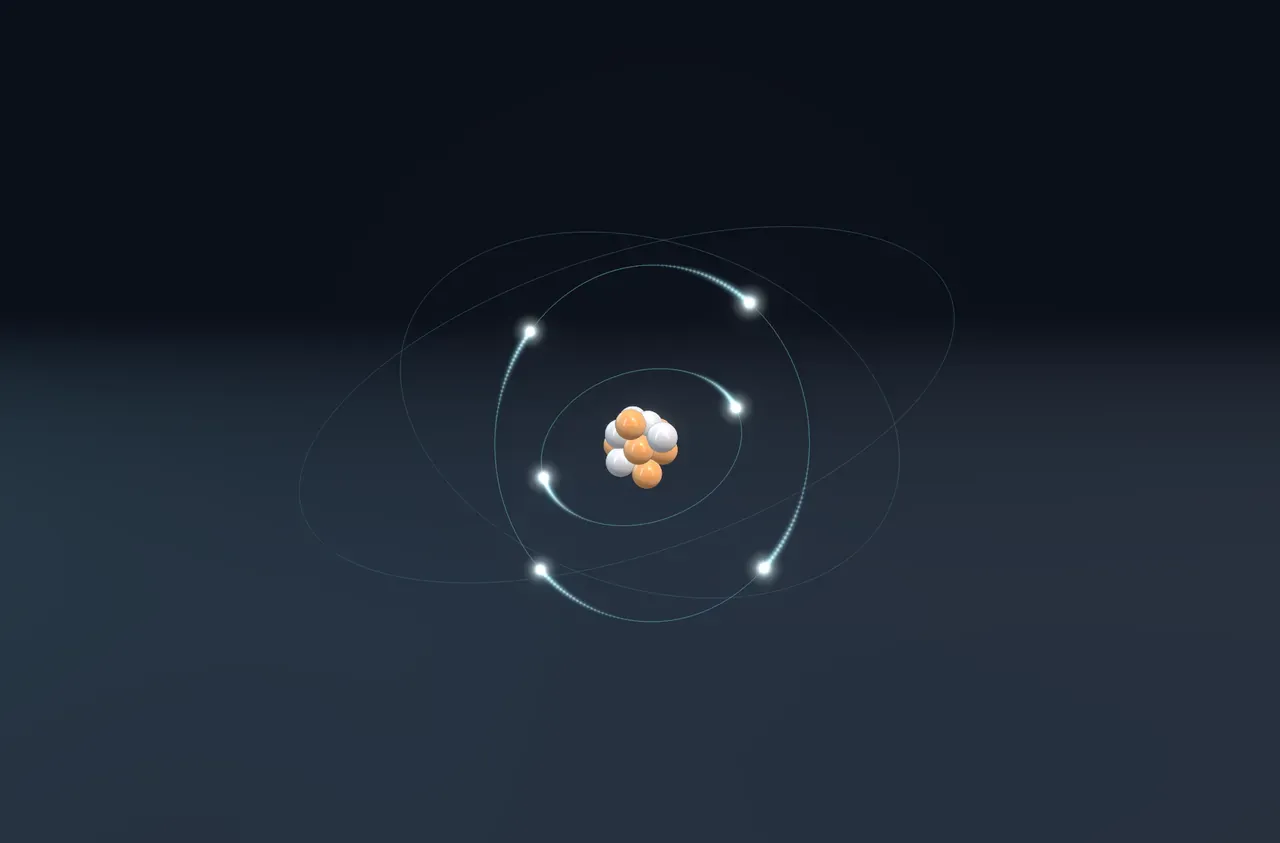
A neutral atom has exactly one electron for every proton, and the charges cancel. The Scene shows carbon: six protons in the nucleus and six electrons around it. Change Protons and watch each new proton bring an electron with it.
Step 2 of 6
Counting neutrons
The number of protons is the atomic number, , and it decides which element this is: six protons are always carbon, eleven are always sodium. The number of protons and neutrons together, every particle in the nucleus, is the mass number, . If is the number of neutrons, then
A nucleus is written with both numbers before the element’s symbol: the mass number on top and the atomic number below. Carbon with six neutrons is . The Scene now shows sodium, with the protons locked.
Step 3 of 6
Isotopes
Not every atom of an element has the same number of neutrons. Most carbon has six, about one atom in a hundred has seven, and very few have eight. These are isotopes of carbon: , and . All of them have six protons and six electrons, and so the same chemistry; they differ only in mass. They are also called carbon-12, carbon-13 and carbon-14, after the mass number.
The Scene draws each element’s most common isotope. In the next Lesson we will see isotopes whose nucleus is not stable, such as carbon-14.
Step 4 of 6
Shells
Electrons are arranged in shells. The first shell has room for two electrons, and the second and third for eight each, in the elements shown here. Electrons fill the inner shells first. The Scene shows neon, Z = 10: two electrons in the first shell and eight in the second, both full.
An element’s chemistry is set mostly by its outer shell. Predict how many electrons the outer shell will hold when one more proton is added, then look.
Step 5 of 6
A full outer shell
Neon and helium have a full outer shell, and they react with almost nothing: they are noble gases. The third row of the periodic table has a gas like that too. Find it with Protons.
Step 6 of 6
Clouds, not orbits
The rings in the Scene are a drawing that helps with counting, not a picture of the atom. Quantum mechanics says you cannot tell where an electron is or what path it follows; you can only say how likely you are to find it in each place. The Scene has moved to Cloud: the brightness shows where that chance is high. The shells are regions like that, one inside another.
And the nucleus? In the drawing it is a small dot, but in fact it is far smaller still. An atom is about metres across, and a nucleus about metres: times less. If the atom were the size of a football stadium, the nucleus would be a grain of rice at its centre, and nearly all the mass would be in that grain.
Loading the interactive version…
Loading the interactive version…
Each step sets up the Scene for you, and a control marked “fixed” stays put for that step.
Practice · Calculate
A sodium nucleus is . How many neutrons does it have?
Practice · Calculate
A sodium nucleus is . How many neutrons does it have?
Practice · Predict, then look
Neon has two full shells. How many electrons will the outer shell of sodium hold, with one more proton?
Practice · Predict, then look
Neon has two full shells. How many electrons will the outer shell of sodium hold, with one more proton?
Practice · Reach the target
Use Protons to find an atom with three shells, the outer one full, and press Check.
Practice · Reach the target
Use Protons to find an atom with three shells, the outer one full, and press Check.
Practice · Choose
What best describes an electron in an atom?
Practice · Choose
What best describes an electron in an atom?
Lesson complete. Every practice question here is done.