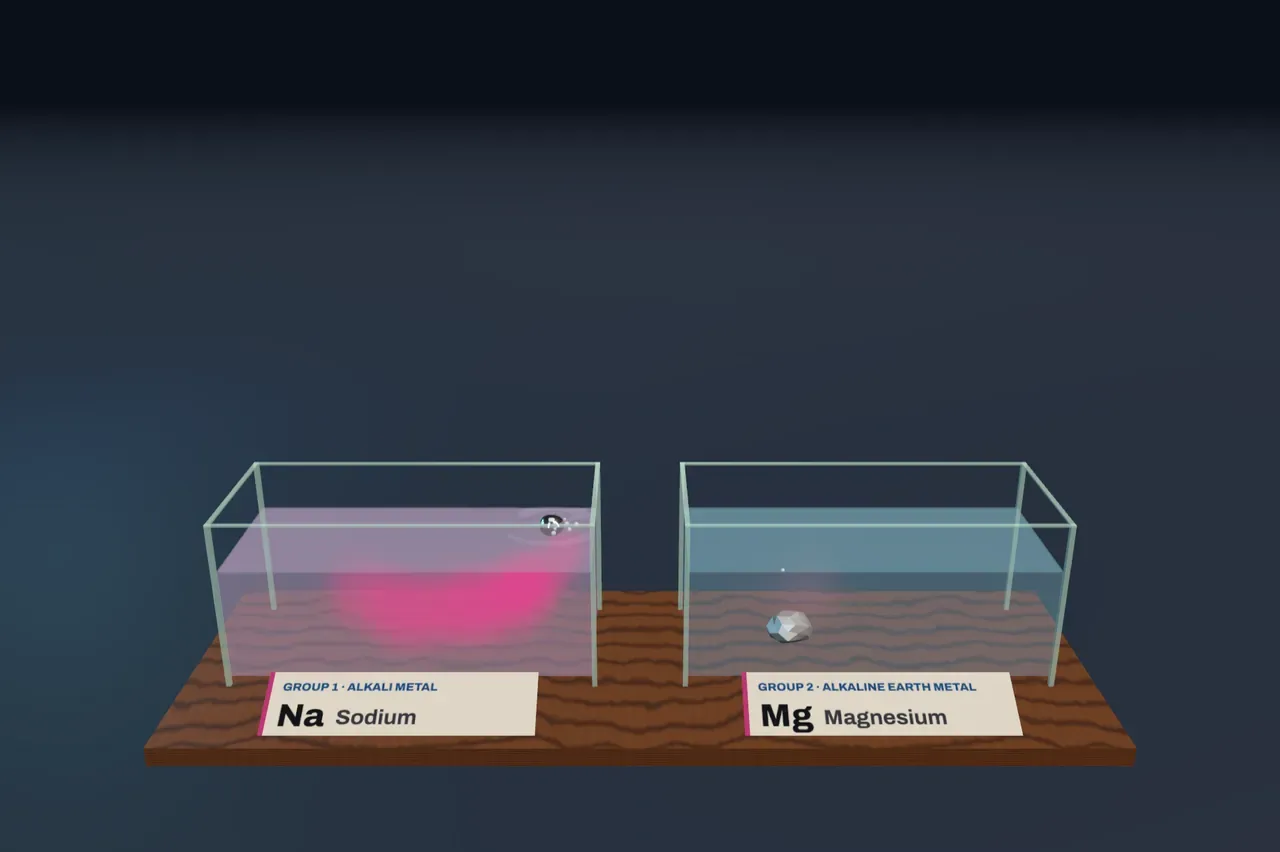
Ten metals, one trough of water
The first two columns of the periodic table hold the most reactive metals there are. Group 1, the alkali metals, runs down from lithium through sodium, potassium and rubidium to caesium. Group 2, the alkaline earth metals, runs from beryllium through magnesium, calcium and strontium to barium. (Francium and radium sit at the bottom of each column too, but they are so radioactive that they are left out here.)
None of these metals is ever found pure in nature: each one is always locked up in a compound, such as sodium in salt or calcium in chalk. The alkali metals are soft enough to cut with a knife, and a fresh cut shines like silver for only a moment before air dulls it. That is why they are stored under oil.
Drop a piece into water and the difference between them becomes obvious. Lithium floats and fizzes steadily. Sodium melts into a shining ball that races about the surface. Potassium races faster still, and its gas catches fire with a lilac flame. Rubidium and caesium sink, and burst apart almost at once. In the second column, beryllium does nothing at all and magnesium barely bubbles, while calcium, strontium and barium sink and fizz harder and harder.
Try it: under Row of the table, step from Li · Be down to Cs · Ba. Each row down, the left-hand metal gets wilder, and in every row it beats its neighbour on the right.
What the bubbles and the pink are
Every one of these reactions does the same thing. The metal pulls water molecules apart, keeping the oxygen and one hydrogen as hydroxide and letting the other hydrogen go as hydrogen gas, the bubbles. For sodium:
A group 2 metal does the same with two water molecules for every atom, giving for calcium. A solution of a metal hydroxide is an alkali, a strong base. That is where both groups get their names: “alkali” comes from an Arabic word for plant ashes, which are rich in potassium compounds, and the group 2 oxides were once called “earths” because they did not melt or change in a fire.
The pink is phenolphthalein, an indicator that is colourless in neutral water and turns pink as the water becomes alkaline. In the scene it blooms where hydroxide spreads from the metal. Calcium hydroxide dissolves only a little, so the extra makes the water cloudy as well, the milkiness of limewater.
The reaction also gives off heat. Sodium melts at 98 °C, so its own reaction melts it into a ball, and the hydrogen fizzing out underneath pushes it about the surface. Potassium melts at only 63 °C and reacts faster, hot enough to set its hydrogen alight; the lilac colour is potassium’s own glow. Lithium melts at 180 °C, so it stays a solid chunk.
Why lower metals react faster
The answer is inside the atom. Atoms of these metals react by losing their outermost electrons to water, so the easier those electrons are to remove, the faster the reaction goes.
Going down a group, each row adds another shell of electrons. The single outer electron of a group 1 atom sits further from the nucleus each time, and the filled shells inside it shield it from most of the nucleus’s pull. Caesium has 55 protons to lithium’s 3, but its outer electron feels only a little more of their pull than lithium’s does, and from much further away. Removing that electron from a mole of lithium atoms takes 520 kJ; from caesium, only 376 kJ.
Try it: choose Atoms under Zoom to the atoms, then step through the rows. The gold outer ring grows each row down, and the energy on the tag below it falls.
Why group 2 lags behind group 1
Step one place to the right, from sodium to magnesium. The atom keeps the same number of shells but gains a proton, so the nucleus pulls every electron in a little harder and the atom is smaller. And magnesium has two outer electrons to give up, not one. Removing both takes 2,188 kJ for a mole of magnesium atoms, more than four times sodium’s 496 kJ for its one.
So in every row, the group 2 metal reacts more slowly than its group 1 neighbour. Magnesium needs hot water to fizz steadily, or steam, in which it burns with a brilliant white light. Beryllium, the smallest of them, holds its electrons so tightly, and grows such a tough skin of oxide, that it does not react with water at all.
Try it: choose Na · Mg and slide Water temperature up to 80 °C. Sodium only hurries a little, but magnesium wakes up from barely a bubble to a steady fizz.
Where you meet them
Lithium stores the charge in phone and car batteries. Sodium is half of table salt, and its yellow glow lit streets for decades. Potassium is a plant nutrient in fertiliser, and caesium’s atoms keep time in atomic clocks. Magnesium makes light alloys for bikes and laptops, and calcium is in bones, teeth, chalk and cement. Strontium gives fireworks their red, and barium their green.
None of the metals themselves should be handled without training: even sodium can spit burning metal, and the heavier alkali metals react violently with the moisture in air and skin.
What this model leaves out
The scene ranks how fast and how violently each metal reacts, as a demonstration would show it, but its speeds are not measured. A real reaction also depends on the size and shape of the piece and on how much oxide already coats it. The rule that every reaction doubles in pace for each 20 °C warmer is a rough rule of thumb.
How fast a metal reacts is not the same as how much energy it releases. Lithium actually gives out slightly more heat per atom than caesium does, because its small ion grips the surrounding water molecules very strongly, yet it reacts the most slowly of its group. Speed depends on how easily the reaction can get going, which is why the energy to remove the outer electrons, and not the total energy released, tracks what you see.
The explosions of rubidium and caesium are drawn as a flash and a splash. High-speed films suggest that alkali metals can react this fast because electrons leave the metal so quickly that the positive ions left behind repel each other and the surface flies apart, exposing fresh metal. The scene does not model that, or the steam the heat makes.
The atoms are Bohr pictures: electrons on circular rings. Real electrons are spread out as clouds (the Atoms article shows them), and the rings here are spaced only to show which shells are inside and which is outermost. The outer ring is drawn at each metal’s atomic radius, so the sizes compare correctly from atom to atom.