Why sodium skates over water and potassium catches fire, how metals are ranked by how readily they lose electrons, and what the ranking predicts: which metal pushes which out of solution, and which gives off hydrogen in acid.
Step 1 of 6 · Down the group
Step 1 of 6
Down the group
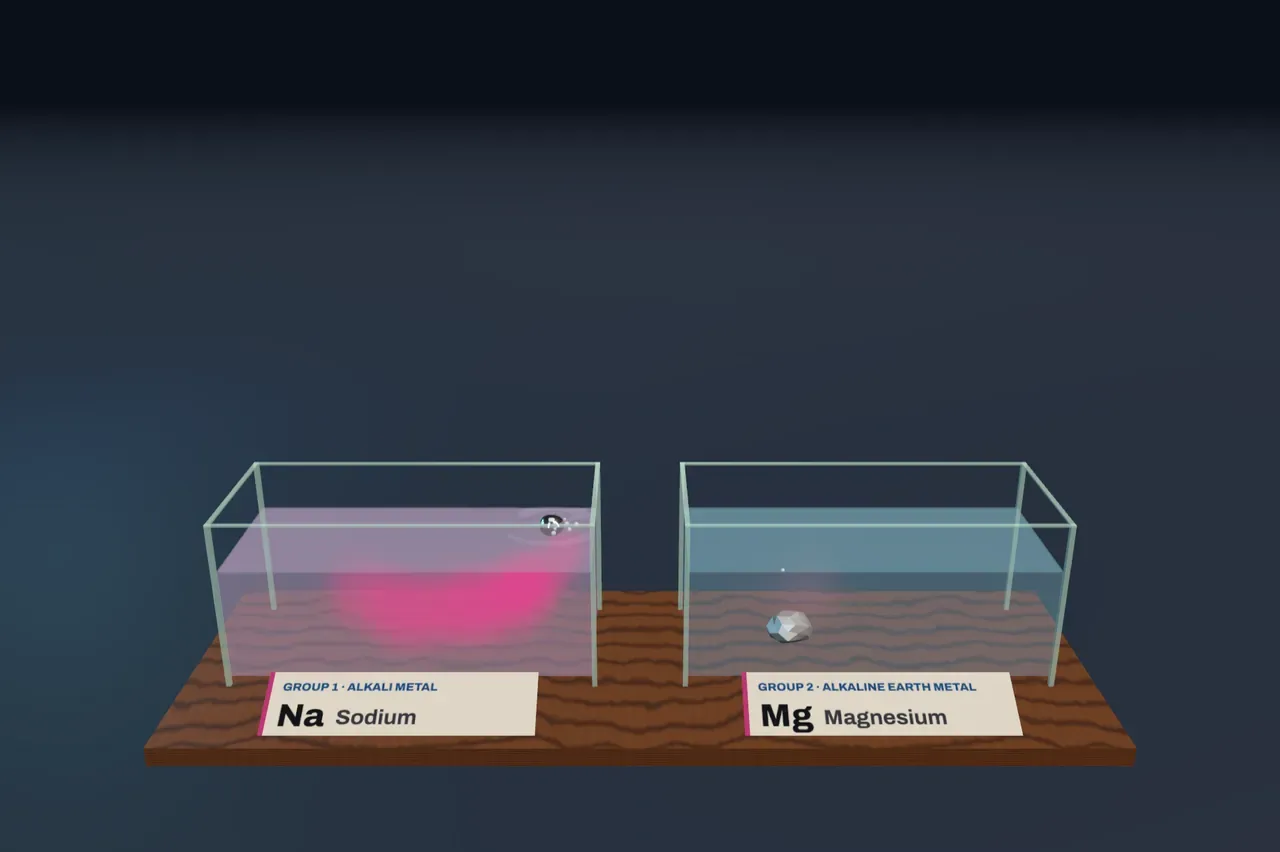
The Scene shows two troughs of water with indicator. Into the left one drops a metal from group 1 of the table, an alkali metal, and into the right its neighbour from group 2, an alkaline earth metal. Each reacts with the water, giving off hydrogen, and the hydroxide that forms turns the indicator pink:
In this reaction the sodium is oxidised: it loses its outer electron. Row of the table is now fixed at Na · Mg.
Step 2 of 6
Why
Zoom to the atoms is on Atoms: above each trough is an atom of the metal, with its shells and its outer electrons lit. This is the sixth row: caesium and barium. Compare their size with lithium and beryllium in the second row.
Step 3 of 6
Group 2
Group 2 metals have two outer electrons, and they must lose both. So they are less reactive than their group 1 neighbours. Magnesium hardly reacts with cold water. Water temperature is now fixed at 293 K.
Step 4 of 6
Displacement
All the metals can be ranked by how easily they lose electrons. That ranking is the reactivity series:
A more reactive metal gives electrons to the ions of a less reactive one, and displaces it from the solution.
Step 5 of 6
Not the other way
Displacement works only one way: from higher in the reactivity series to lower. A metal low in the series cannot displace one above it.
Step 6 of 6
Metals and acids
Hydrogen has a place in the reactivity series too, though it is not a metal. An acid holds ions, and a metal above hydrogen gives them electrons, releasing hydrogen gas. A metal below hydrogen does not react with dilute acid.
Loading the interactive version…
Loading the interactive version…
Each step sets up the Scene for you, and a control marked “fixed” stays put for that step.
Practice · Predict, then look
In the left trough sodium skates over the water, fizzing. What will potassium, below sodium in the table, do?
Practice · Predict, then look
In the left trough sodium skates over the water, fizzing. What will potassium, below sodium in the table, do?
Practice · Choose
Why does caesium react with water far more violently than lithium?
Practice · Choose
Why does caesium react with water far more violently than lithium?
Practice · Predict, then look
In the right trough magnesium sits in cold water, and almost nothing happens. What will happen when you heat the water to 80 °C?
Practice · Predict, then look
In the right trough magnesium sits in cold water, and almost nothing happens. What will happen when you heat the water to 80 °C?
Practice · Choose
A zinc strip is dipped in blue copper sulfate solution, . What will you see after a few minutes?
Practice · Choose
A zinc strip is dipped in blue copper sulfate solution, . What will you see after a few minutes?
Practice · Choose
And what will happen to a silver wire in the same copper sulfate solution?
Practice · Choose
And what will happen to a silver wire in the same copper sulfate solution?
Practice · Choose
Which of these metals will give off hydrogen in dilute acid? Choose all of them.
Practice · Choose
Which of these metals will give off hydrogen in dilute acid? Choose all of them.
Lesson complete. Every practice question here is done.