How a redox reaction makes electricity: anode and cathode, voltage from standard potentials, why the poles can swap, how much voltage is lost inside the cell, and what the salt bridge does.
Step 1 of 5 · A cell’s voltage
Step 1 of 5
A cell’s voltage
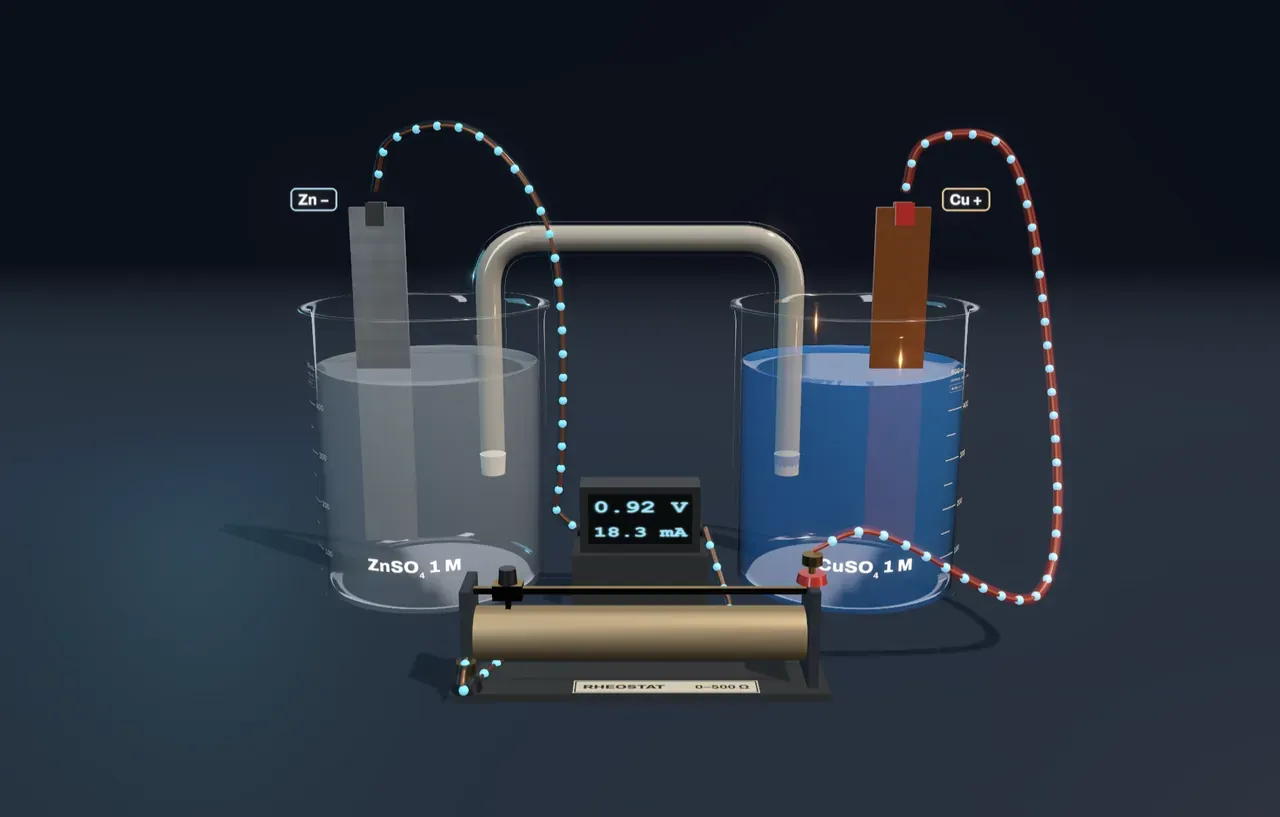
When zinc is dipped in a solution of copper ions, the electrons go straight from the zinc to the ions, and the energy turns into heat. A galvanic cell separates the two halves of the reaction, so the electrons have to travel through a wire, where they can be used. The electrode where oxidation happens is the anode, the negative terminal; the one where reduction happens is the cathode, the positive terminal.
How strongly each half-cell “pulls” electrons is measured by its standard reduction potential, , against a hydrogen electrode, in 1 mol/L solutions at 25 °C. The cell’s voltage with no current flowing, its electromotive force (emf, ), is the difference:
Step 2 of 5
Choosing the metals
| Metal | |
|---|---|
| Magnesium | −2.37 V |
| Zinc | −0.76 V |
| Iron | −0.44 V |
| Lead | −0.13 V |
| Copper | +0.34 V |
| Silver | +0.80 V |
The metal in the right half-cell is always copper. Load resistance is fixed at 500 Ω, nearly an open circuit, and Left metal is free.
Step 3 of 5
The poles swap
Which electrode is the anode is not fixed in advance: it is always the metal with the lower potential of the two. Show ions and electrons is On, and Left metal is now fixed at zinc.
Step 4 of 5
Voltage under load
Like any source of voltage, the cell has internal resistance: the ions have to travel through the solutions and the salt bridge, and that costs voltage. In the Scene’s cell the internal resistance is 10 Ω. When a current flows, the voltage at the terminals is less than the emf: . Now Load resistance is 20 Ω.
Step 5 of 5
The salt bridge
In the zinc beaker positive ions are made all the time, and in the copper beaker positive ions are used up. The salt bridge, a tube of salt solution, closes the circuit inside the cell. Show ions and electrons is On: watch what moves through it.
Loading the interactive version…
Loading the interactive version…
Each step sets up the Scene for you, and a control marked “fixed” stays put for that step.
Practice · Calculate
The standard reduction potentials are and . What is the voltage of a zinc–copper cell with no current flowing?
Practice · Calculate
The standard reduction potentials are and . What is the voltage of a zinc–copper cell with no current flowing?
Practice · Reach the target
Choose, with Left metal, the metal that gives the cell the highest voltage, then press Check.
Practice · Reach the target
Choose, with Left metal, the metal that gives the cell the highest voltage, then press Check.
Practice · Predict, then look
In the zinc–copper cell the zinc dissolves. Which strip will dissolve when you change the left metal to Silver?
Practice · Predict, then look
In the zinc–copper cell the zinc dissolves. Which strip will dissolve when you change the left metal to Silver?
Practice · Calculate
The zinc–copper cell, 1.10 V, has an internal resistance of 10 Ω. Load resistance is 20 Ω. What does the meter across the load read?
Practice · Calculate
The zinc–copper cell, 1.10 V, has an internal resistance of 10 Ω. Load resistance is 20 Ω. What does the meter across the load read?
Practice · Choose
What does the salt bridge between the two beakers do?
Practice · Choose
What does the salt bridge between the two beakers do?
Lesson complete. Every practice question here is done.