A battery is a galvanic cell you can run backwards: what runs down as it discharges, what charging does, and how electrolysis makes metals and plates objects with them, gram by gram.
Step 1 of 10 · A battery is a cell
Step 1 of 10
A battery is a cell
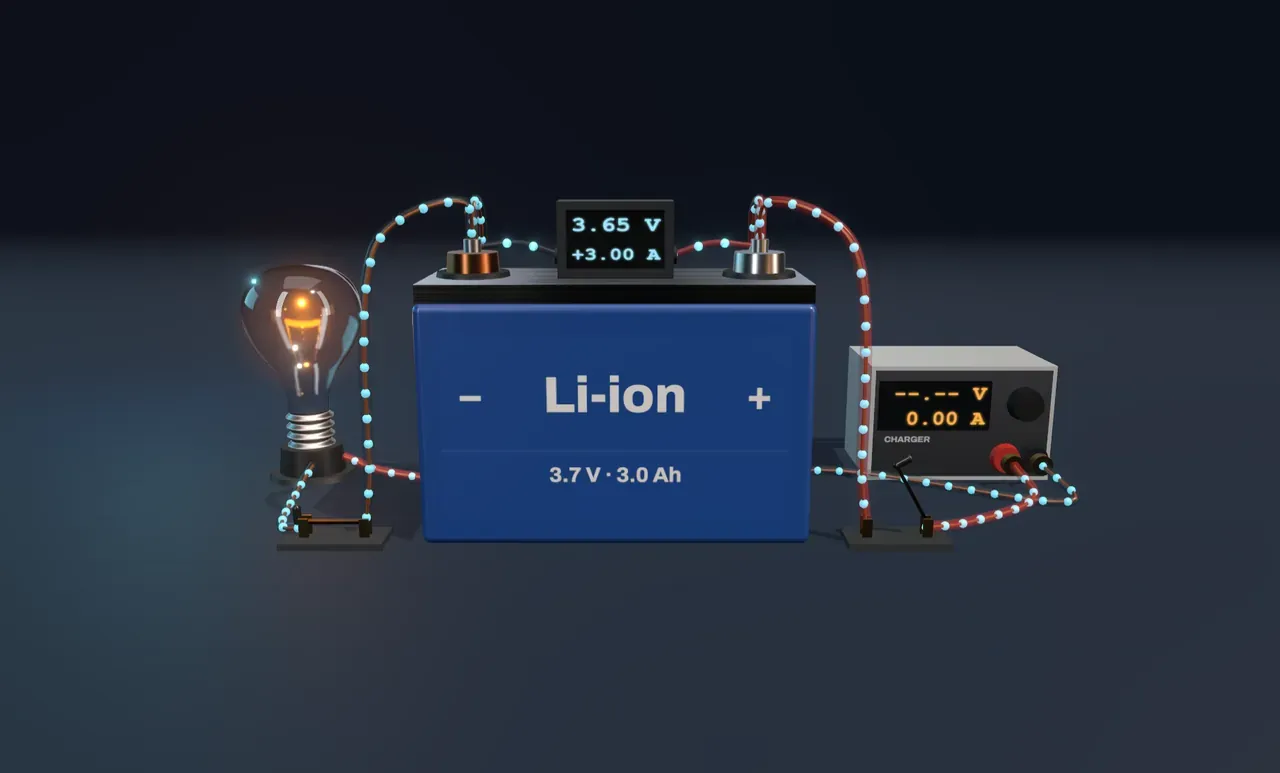
The Scene shows a lithium-ion battery, like the one in a phone. Zoom to the ions is at Ions: on one side layers of graphite, on the other a metal oxide, and between them an electrolyte in which lithium ions move. When the battery discharges, lithium in the graphite is oxidised and gives an electron to the wire, and the ion crosses inside the battery to the oxide. It is a galvanic cell: the reaction runs by itself and drives a current.
Step 2 of 10
Charging
A lithium-ion battery can be charged: an outside supply applies a voltage higher than the battery’s, the other way round, and forces the reaction to run backwards. Current is now fixed on discharging; guess what the ions will do when you switch to charging.
Step 3 of 10
Electrolysis
Running a redox reaction by force, with an electric current, is called electrolysis. That is how reactive metals such as sodium and aluminium are made, since no chemical reduces them easily. In electrolysis too, oxidation happens at the anode and reduction at the cathode, but here the supply sets the poles: the cathode is connected to the negative terminal.
Step 4 of 10
How much metal
In electrolysis every electron that passes through the wire reduces one ion, or part of one. So the amount of substance made is proportional to the charge that passed. The charge in coulombs is , and the charge of a mole of electrons is Faraday’s constant, . That is how objects are plated with copper, silver or gold, to a thickness set in advance.
Step 5 of 10
Counting charge
The same working describes a battery. A battery’s capacity is measured in ampere-hours: how long it can supply a given current. Now the battery is discharging at a gentle current.
Step 6 of 10
A faster current
A battery’s current is measured against its capacity: 1C is the current that empties it in an hour.
Step 7 of 10
At the terminals
The current flows inside the battery too, from electrode to electrode, and the battery has a resistance of its own.
Step 8 of 10
The power out
How much energy each second does the battery give the bulb when it discharges fast?
Step 9 of 10
Heat inside
Under Zoom to the ions you see the ions pushing through the battery. That push heats it.
Step 10 of 10
How full it is
A battery’s voltage at rest depends on how much lithium is left on the graphite side.
Loading the interactive version…
Loading the interactive version…
Each step sets up the Scene for you, and a control marked “fixed” stays put for that step.
Practice · Choose
When a phone runs on its battery all day, what does the battery lose?
Practice · Choose
When a phone runs on its battery all day, what does the battery lose?
Practice · Predict, then look
The battery is discharging: lithium ions cross inside it from the graphite to the oxide. What will the ions do when you plug in a charger?
Practice · Predict, then look
The battery is discharging: lithium ions cross inside it from the graphite to the oxide. What will the ions do when you plug in a charger?
Practice · Choose
In the electrolysis of molten sodium chloride a current is passed between two electrodes. What forms at the negative electrode?
Practice · Choose
In the electrolysis of molten sodium chloride a current is passed between two electrodes. What forms at the negative electrode?
Practice · Calculate
A key is copper-plated: a current of 2.0 A passes through a solution for 965 s. How many grams of copper build up on the key? Faraday’s constant , and copper’s molar mass is 63.5 g/mol.
Practice · Calculate
A key is copper-plated: a current of 2.0 A passes through a solution for 965 s. How many grams of copper build up on the key? Faraday’s constant , and copper’s molar mass is 63.5 g/mol.
Practice · Calculate
A phone battery supplies a current of 0.5 A for two hours. How much charge has passed round the circuit?
Practice · Calculate
A phone battery supplies a current of 0.5 A for two hours. How much charge has passed round the circuit?
Practice · Calculate
The battery’s capacity is 3 Ah. A Current of 1C means a current that empties it in one hour. The current is now locked at 2C. How many amperes flow?
Practice · Calculate
The battery’s capacity is 3 Ah. A Current of 1C means a current that empties it in one hour. The current is now locked at 2C. How many amperes flow?
Practice · Calculate
With no current flowing, the battery at 60% reads 3.80 V. Now it supplies 3 A, and its internal resistance is 0.05 Ω. What voltage reaches its terminals?
Practice · Calculate
With no current flowing, the battery at 60% reads 3.80 V. Now it supplies 3 A, and its internal resistance is 0.05 Ω. What voltage reaches its terminals?
Practice · Calculate
The Current is locked at 2C, 6 A. The battery reads 3.80 V with no current, and its internal resistance is 0.05 Ω. What power does it deliver to the bulb?
Practice · Calculate
The Current is locked at 2C, 6 A. The battery reads 3.80 V with no current, and its internal resistance is 0.05 Ω. What power does it deliver to the bulb?
Practice · Predict, then look
At a Current of 1C, 0.45 W of heat stays inside the battery. Predict: how much heat will stay in it when the current doubles to 2C?
Practice · Predict, then look
At a Current of 1C, 0.45 W of heat stays inside the battery. Predict: how much heat will stay in it when the current doubles to 2C?
Practice · Reach the target
With no current flowing, a lithium battery’s voltage tells how charged it is. Lower the Charge level until the voltage at rest is 3.60 V, and press Check.
Practice · Reach the target
With no current flowing, a lithium battery’s voltage tells how charged it is. Lower the Charge level until the voltage at rest is 3.60 V, and press Check.
Lesson complete. Every practice question here is done.