What a battery holds
A battery does not hold electricity the way a bucket holds water. It holds chemicals that would like to react, and keeps them apart so that the reaction can only happen if electrons take the long way round, through whatever you have plugged in. Nothing is used up in the sense of disappearing. The same atoms are inside a flat battery as a full one; they have simply moved.
Lithium with two homes
In a lithium-ion cell the thing that moves is lithium, and it has two places to live. One is graphite, the layered carbon in pencil lead, spread on a thin copper foil. Lithium atoms can slip in between its sheets. The other is a metal oxide, a layered crystal of lithium, oxygen and metals such as nickel, cobalt or manganese, spread on aluminium foil. Lithium can sit between its layers too.
A thin plastic separator keeps the two apart. It is full of tiny pores soaked in electrolyte, a liquid that lets lithium ions through but not electrons.
Lithium is much more comfortable in the oxide than in the graphite, the way a ball is more comfortable at the bottom of a hill. A charged cell has most of its movable lithium pushed up into the graphite. The difference in comfort shows up as the cell’s voltage: about 4.2 volts when full, easing down through 3.7 and falling towards 3 volts as the graphite runs out of lithium to give.
Discharging: two paths
Close the bulb’s switch and lithium in the graphite gives up an electron and leaves as a positive ion. The ion crosses the electrolyte to the oxide. The electron cannot follow it, because the separator blocks electrons, so it leaves through the copper foil, runs round the wire and through the bulb, and comes back in through the aluminium foil to meet its ion again in the oxide.
Ions inside, electrons outside: the two paths together make one closed loop. If either is broken, both stop, which is why a battery on a shelf keeps its charge.
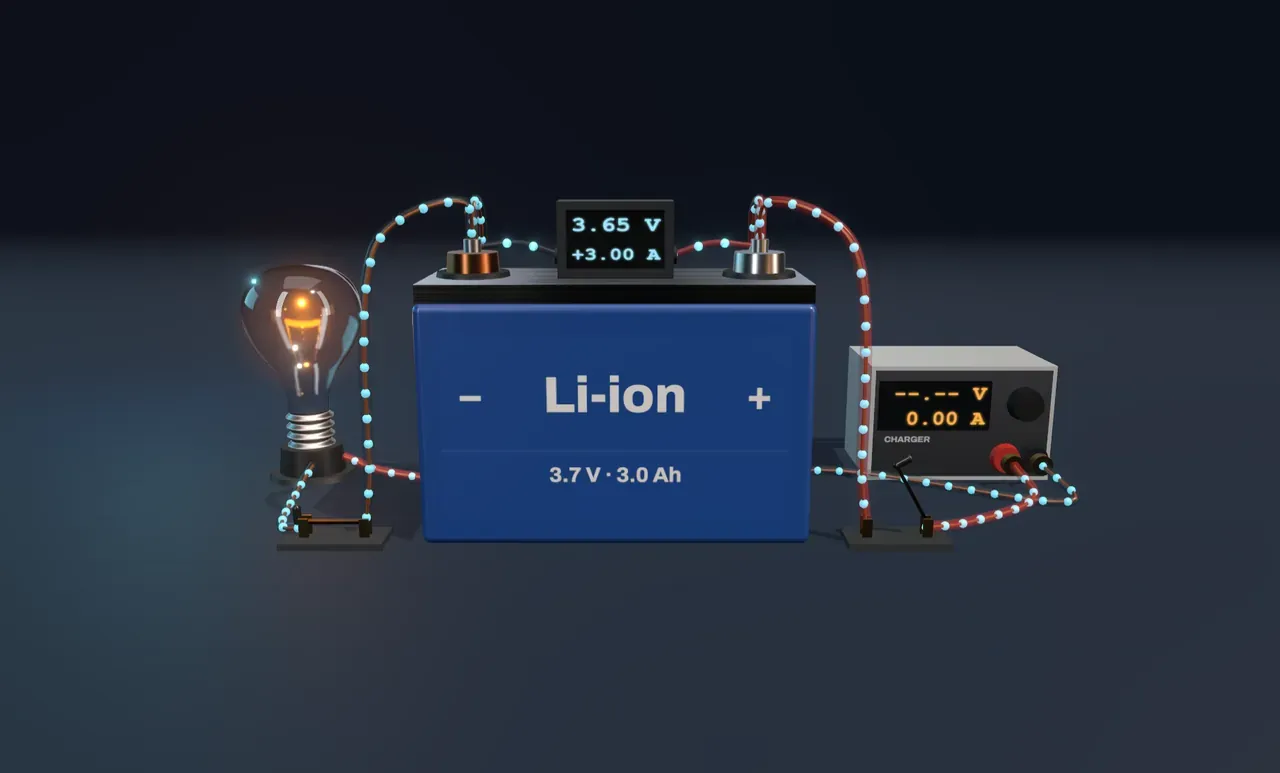
Try it: set Current to 2 C and choose Ions under Zoom to the ions. Then slide Current down to −1 C and watch the ions in the electrolyte turn round, while the electrons switch to the charger’s loop.
Charging: back up the hill
A charger runs the same reaction backwards. Its voltage is set a little higher than the cell’s, so it can push electrons into the graphite through the copper foil and pull them out of the oxide. Lithium ions leave the oxide and cross back through the electrolyte to meet them. The energy the charger spends is stored as lithium held where it would rather not be.
Current and voltage
Battery currents are often counted in C: 1 C is the current that would empty the cell in one hour, 3 amps for this cell. Hard use at 2 C empties it in half an hour.
The meter shows the voltage dropping when current flows out and rising when the charger pushes current in. That is the cell’s internal resistance. Pushing ions through the electrolyte and electrons through the foils takes some of the voltage, and that share becomes heat inside the cell. At 2 C this cell gives about 0.3 volts less than at rest, which is part of why a phone warms while it charges fast.
What this model leaves out
The scene magnifies a single slice of a cell. A real electrode is a coating of tiny grains held together with binder, not one tidy crystal, and a real cell is a long sandwich of these layers rolled or stacked many times over. The ions and atomic layers are drawn far apart and far too few.
The electrolyte carries negative ions as well as lithium ions; they are not drawn. The resting voltage follows a typical curve for graphite and nickel-rich oxide cells, and the internal resistance is a fixed number, though in reality it grows in the cold and as the cell ages.
Real cells also wear out. Each cycle traps a little lithium in a thin film on the graphite, so the cell holds slightly less. Real chargers slow down as the cell nears full, and a protection circuit stops a cell from being run completely flat; the scene’s charge level stops at 5 and 95 percent instead.