Two metals and a wire
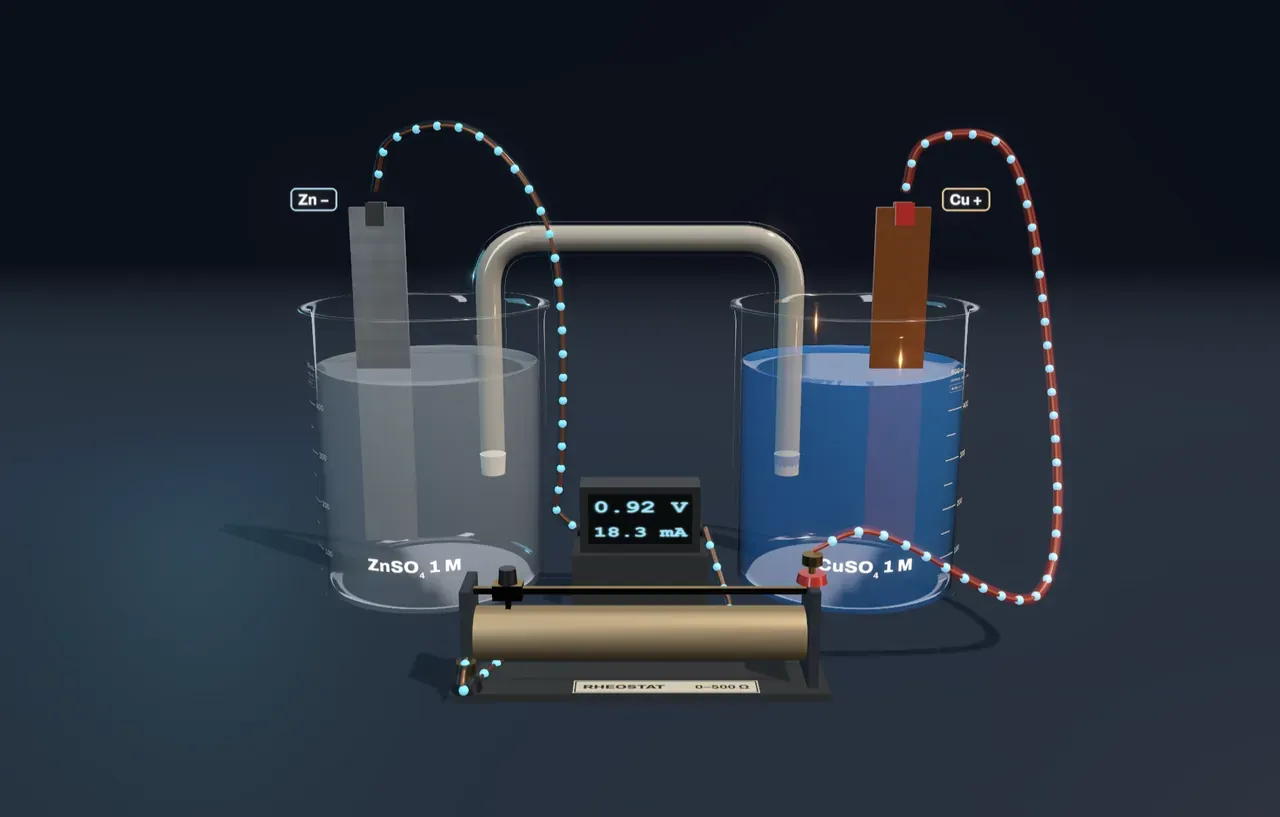
Stand a strip of zinc in a solution of zinc sulfate, a strip of copper in blue copper sulfate, and join the two beakers with a tube of salty jelly. Nothing happens until you connect the metals with a wire. Then a current flows, and a meter in the wire reads about one volt. You have built a galvanic cell, a version of the cell John Daniell built in 1836 to power telegraphs, and the ancestor of every battery since.
Electrochemistry is the study of reactions that move electrons from one substance to another along a path you can put a wire in. Normally, when zinc meets copper ions, the electrons jump straight across where they touch and the energy turns into heat. A cell keeps the two partners apart, so the only way for the electrons to get from one to the other is round the outside, through whatever you have connected: a meter, a motor, a phone.
Some metals let go of electrons more easily
Every metal holds on to its outer electrons with its own grip. Zinc lets go more easily than copper does. In the left beaker zinc atoms leave their two outer electrons in the strip and drift into the solution as zinc ions, Zn²⁺. That is oxidation, the loss of electrons, and the strip where it happens is the anode. The abandoned electrons crowd the zinc strip and make it the negative terminal.
In the right beaker copper ions, Cu²⁺, take up electrons arriving through the wire and settle on the copper strip as copper atoms. That is reduction, the gain of electrons, and that strip is the cathode, the positive terminal. Overall, zinc dissolves and copper plates out:
Zn + Cu²⁺ → Zn²⁺ + Cu
The cell’s voltage measures how much more readily one metal gives up electrons than the other. Chemists list each metal’s tendency as a standard electrode potential, in volts, measured against a reference electrode made with hydrogen. Copper’s is +0.34 V and zinc’s is −0.76 V, so a zinc–copper cell gives 0.34 − (−0.76) = 1.10 V.
Try it: change the Left metal. Magnesium against copper gives about 2.7 V, iron about 0.8 V, lead under half a volt. Then choose Silver: silver holds its electrons tighter than copper, so the roles swap. Copper dissolves, silver plates out, and the meter, still wired the same way, reads negative.
Show ions and electrons: ions and electrons
Choose On under Show ions and electrons and the solutions fade. Each time a pair of electrons sets off along the wire, an atom leaves the anode’s face as an ion, and on the cathode an ion arrives, takes two electrons and stays as a metal atom. The faster the electrons march along the leads, the faster this happens: the current in the wire and the reaction in the beakers are the same thing, counted in different places.
That would quickly stop on its own. The left beaker would fill with extra positive zinc ions and the right beaker would lose positive copper ions, and the charge building up in each would hold the reaction back. The salt bridge prevents that. It is a tube of gel made with a salt such as potassium nitrate, and its ions drift out into the beakers: negative nitrate ions towards the anode’s side, positive potassium ions towards the cathode’s. Electrons carry the current through the wire; ions carry it through the solutions and the bridge.
Why the voltage sags under load
A cell is not a perfect source of voltage. Its ions have to push through the solutions and the bridge, and that path has a resistance of its own, called the internal resistance. In this cell it is taken as 10 Ω. The current is set by the whole circuit:
current = cell voltage ÷ (load resistance + internal resistance)
With a large load resistance only a trickle of current flows, hardly any voltage is lost inside, and the meter reads close to the full 1.10 V. Lower the load and more current flows, but more of the voltage is spent inside the cell. At a short circuit the meter reads zero: all the cell’s voltage goes on driving current through itself, and it simply warms up.
Try it: slide Load resistance up to 500 Ω and read the meter, then down to 50 Ω, 5 Ω and 0 Ω. The voltage falls as the current rises. The load gets the most power when its resistance equals the cell’s own, 10 Ω.
This is why a torch battery that reads 1.5 V on a meter can show much less while it lights a bright bulb, and why a flat battery’s voltage seems fine until you ask it for current.
Cells, batteries, rust and electroplating
Stack cells in series and their voltages add, which is how a battery got its name: a battery of cells. Modern batteries swap the beakers and bridge for pastes and thin separators, and choose pairs of materials with a big difference in potential, such as lithium against a metal oxide in a lithium-ion cell.
The same reactions run in reverse when you push current the other way. That is electrolysis: it charges a rechargeable battery, coats steel with zinc or chrome by electroplating, refines copper and makes aluminium. And they run uninvited when two metals touch in wet, salty conditions: a steel bolt in a copper fitting corrodes far faster than either alone, because the pair makes a small cell with the iron as the anode. Ships carry blocks of zinc or magnesium bolted to their hulls for this reason; those dissolve instead of the steel.
What this model leaves out
The cell keeps its standard voltage for ever, but a real one changes as it runs: zinc ions build up, copper ions run out, and the voltage creeps down. The internal resistance is a single fixed number, while in a real cell it depends on the strength of the solutions, the temperature and how much of the electrodes is wet. Pulling a large current also makes the voltage sag in ways a resistance alone does not describe, as ions near each strip are used up faster than they can be replaced. The salt bridge here never runs out of ions. And standard potentials describe metals in solutions of their own ions at 1 mol per litre; magnesium in particular reacts with water by itself, and a real magnesium–copper cell gives less than its 2.7 V.