Reactions in which electrons pass from one substance to another: who loses and who gains, where the electrons go in a cell, oxidation numbers, and why oxidation never happens alone.
Step 1 of 4 · Losing electrons
Step 1 of 4
Losing electrons
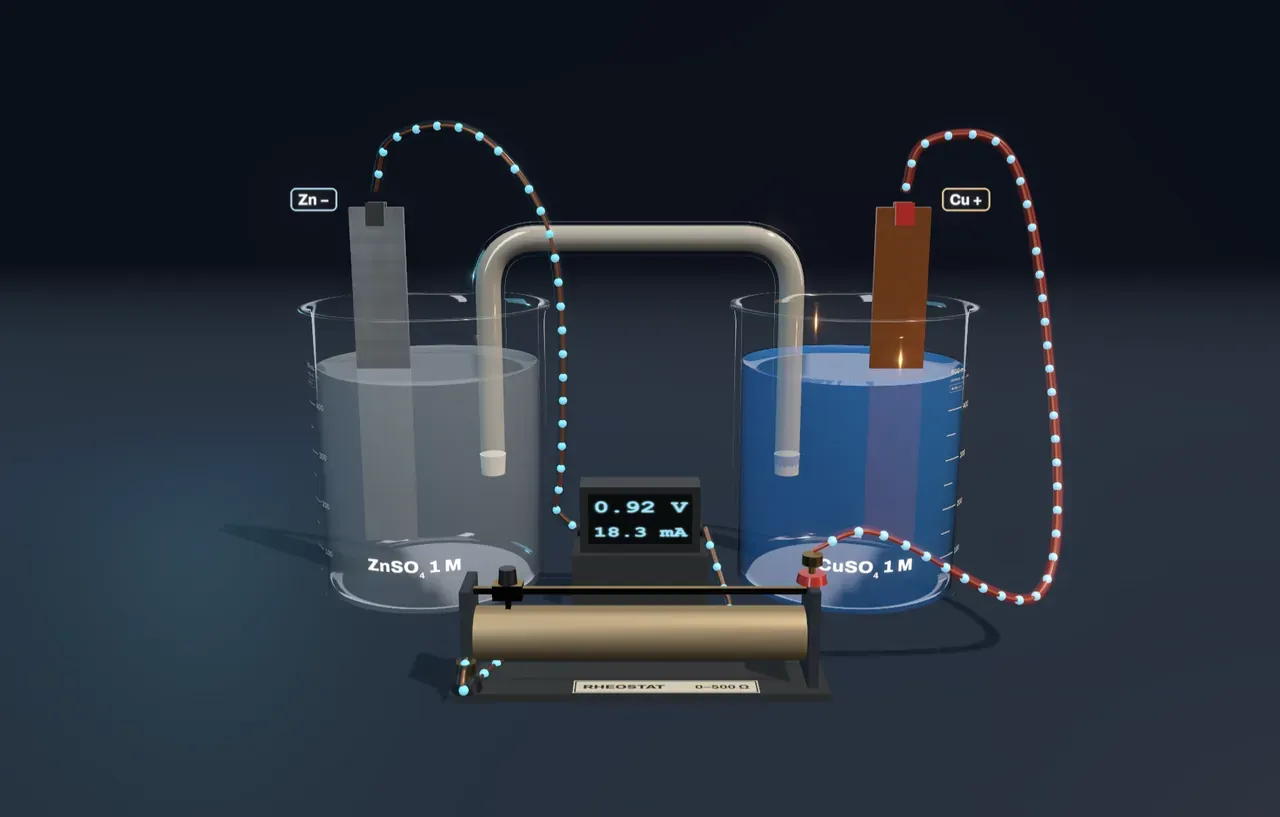
The Scene shows a simple electric cell: a zinc strip in a solution of zinc ions, a copper strip in a solution of copper ions, a wire between them and a meter in the middle. While the cell works, the zinc strip is slowly eaten away, and new copper builds up on the copper strip.
What happens to the zinc is oxidation. The word once meant “combining with oxygen”, but today the definition is wider: oxidation is losing electrons. The opposite, gaining electrons, is called reduction.
Step 2 of 4
Where the electrons go
At the copper strip, ions from the solution become copper atoms: . They are reduced. For that to happen, something has to supply them with electrons. Show ions and electrons will reveal the ions and the electrons; first guess which way the electrons flow.
Step 3 of 4
Oxidation numbers
To spot oxidation and reduction in compounds too, every atom is given an oxidation number: the charge it would have if all its bonds were ionic. The main rules:
- In an element, such as or , the oxidation number is 0.
- In a single-atom ion, such as , it is the ion’s charge.
- Oxygen in compounds is almost always −2, and hydrogen +1.
- The oxidation numbers add up to the total charge of the molecule or ion.
Oxidation is a rise in oxidation number, and reduction a fall.
Step 4 of 4
Always together
Electrons are neither made nor destroyed. So every oxidation comes with a reduction, and the electrons one substance loses exactly equal the electrons another gains. The substance that gives electrons, and is oxidised, is called the reducing agent; the one that takes them, and is reduced, is the oxidising agent. In the cell in the Scene the zinc is the reducing agent and the copper ions are the oxidising agent.
Loading the interactive version…
Loading the interactive version…
Each step sets up the Scene for you, and a control marked “fixed” stays put for that step.
Practice · Choose
In the cell the zinc strip is slowly eaten away: . What is happening to the zinc?
Practice · Choose
In the cell the zinc strip is slowly eaten away: . What is happening to the zinc?
Practice · Predict, then look
Show ions and electrons will reveal the ions and the electrons. Which way do the electrons flow?
Practice · Predict, then look
Show ions and electrons will reveal the ions and the electrons. Which way do the electrons flow?
Practice · Calculate
What is the oxidation number of sulfur in the sulfate ion, ? Answer with a signed number.
Practice · Calculate
What is the oxidation number of sulfur in the sulfate ion, ? Answer with a signed number.
Practice · Choose
Iron rusts in damp air: . The iron is oxidised. What happens to the oxygen?
Practice · Choose
Iron rusts in damp air: . The iron is oxidised. What happens to the oxygen?
Lesson complete. Every practice question here is done.