Lights at the top of the world
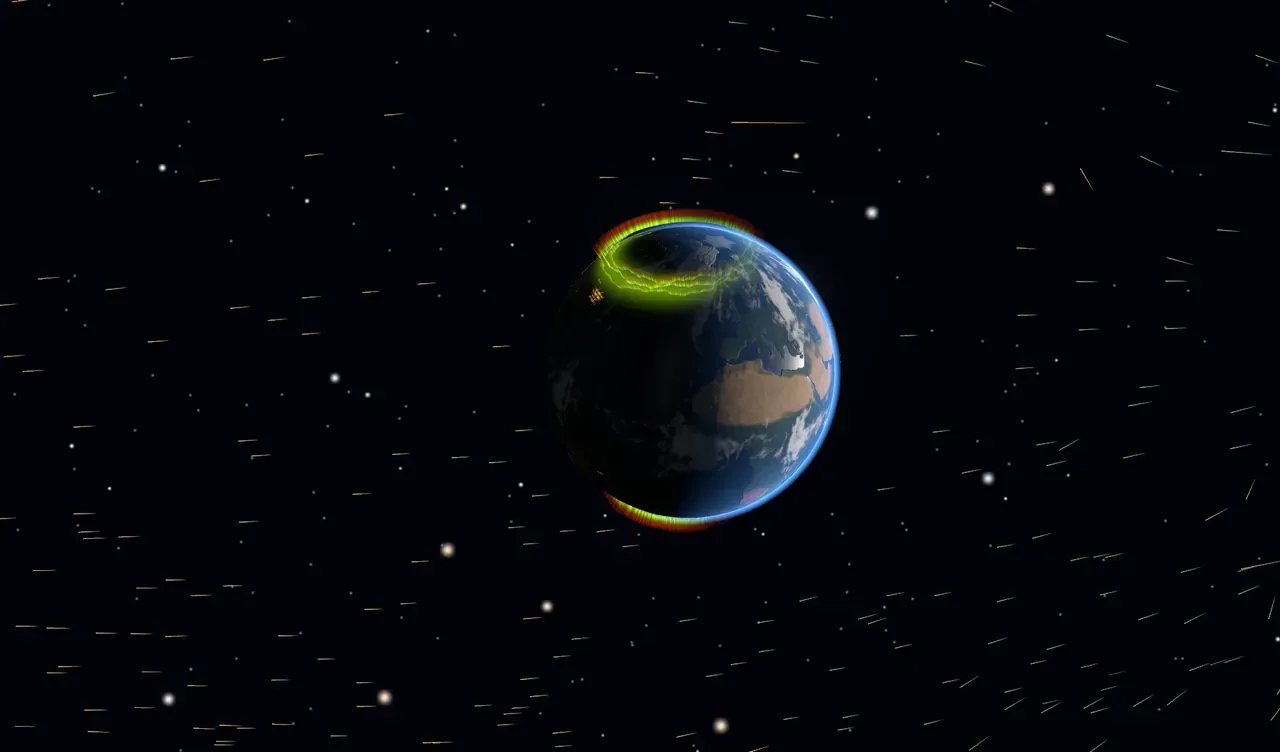
On a clear night in northern Norway, Alaska or Tasmania the sky sometimes fills with moving light: pale green curtains that fold and ripple, edged with pink below and topped with red. These are the northern lights (aurora borealis) and the southern lights (aurora australis). They happen near both poles at once, and from space they appear as a glowing ring round each end of the planet.
A wind from the Sun
The Sun constantly blows out a thin stream of charged particles, mostly protons and electrons, called the solar wind. It crosses the 150 million kilometres to Earth in a few days, travelling at around 400 kilometres a second, and it carries the Sun’s magnetic field with it.
Earth’s own magnetic field stands in its way. Charged particles cannot easily cross magnetic field lines, so the wind flows round a magnetic bubble called the magnetosphere. On the side facing the Sun the bubble is squashed to about ten Earth radii; on the night side it is stretched into a tail that reaches far beyond the Moon. Ahead of it, where the wind first slows, stands a bow shock, like the wave in front of a moving boat.
Down the field lines to the poles
Inside the magnetosphere, charged particles spiral round field lines and slide along them. Earth’s field lines converge on two places, near the north and south magnetic poles, so that is where particles can reach the atmosphere. The solar wind does not simply pour in: it strains the field and stores energy in the tail, and when the stretched tail snaps back, electrons there are accelerated down the field lines into a ring round each pole, called the auroral oval. They hit the thin upper air between about 100 and 300 kilometres up and make it glow, much as electricity makes the gas in a neon sign glow.
Why green, red and violet
Each colour comes from a particular gas giving off light. The common green, at a wavelength of 557.7 nanometres, comes from oxygen atoms around 100 to 200 kilometres up. Oxygen also glows deep red, at 630.0 nanometres, but that light takes nearly two minutes to come out, and lower down the atom usually bumps into a neighbour first and loses the energy. Only in the very thin air above about 200 kilometres does the red survive, so red sits on top. Nitrogen adds violet and blue, and the pink fringe along the bottom edge of bright curtains.
Storms push the oval towards the equator
Scientists track how disturbed the field is with the Kp index, from 0 for quiet to 9 for an extreme storm. When the Sun hurls out a large cloud of gas and field, a coronal mass ejection, and its field points opposite to Earth’s, energy floods in. The magnetosphere is squeezed, the oval brightens, widens and slides towards the equator, and red auroras appear over places that rarely see any. In the Carrington event of 1859 they were seen in the Caribbean, and in the storm of May 2024 they were photographed across southern Europe and Mexico.
Try it: slide Solar wind (Kp index) from 1 up to 9 and watch the rings round the poles. Then choose On under Show the magnetic field to see the bubble shrink.
What this model leaves out
Distances are compressed so the Earth, its auroras and its magnetosphere fit together, and the curtains are drawn taller than they are. The field shape is a simplified dipole squeezed into the Shue model’s boundary, not a full model of the magnetosphere, and the oval’s latitude for each Kp value is an average rule. The visible particles stand for a flow; real solar wind is far too thin to see, and auroral electrons come from the magnetotail rather than straight from the Sun.