The Earth's magnetic field holds off the solar wind and steers electrons into rings round the poles. See how a storm brings the aurora nearer the equator, and why it glows green and red.
Step 1 of 8 · Lights over the poles
Step 1 of 8
Lights over the poles
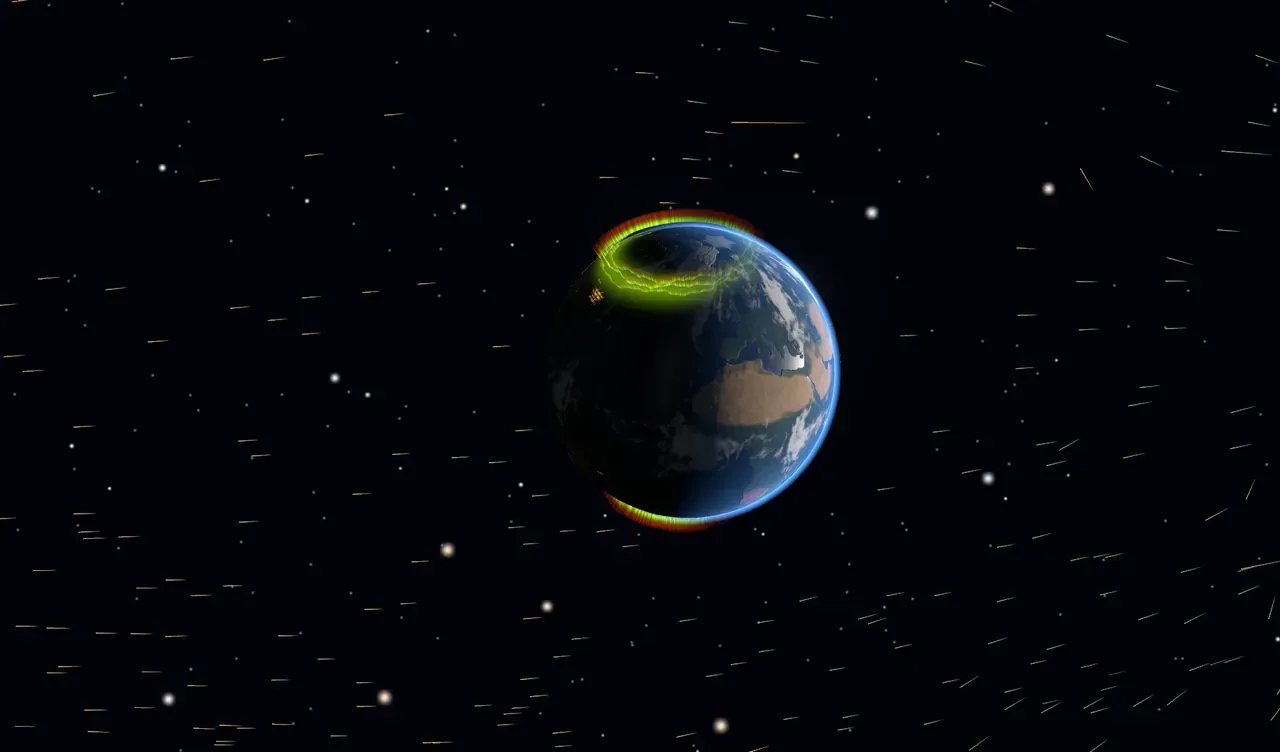
On a clear night in northern Norway, Alaska or Tasmania the sky sometimes fills with green curtains of light, edged with pink below and red above: the northern lights and the southern lights. From space they appear as a glowing ring round each pole, the auroral oval. In the Scene the Sun is far off to the right, and the Solar wind (Kp index) sets how stormy it is.
Step 2 of 8
The magnetic bubble
The Sun constantly blows out a thin stream of charged particles, mostly protons and electrons: the solar wind. It crosses the 150 million kilometres to the Earth in a few days, at about 400 km/s. In the Unit on magnetism we saw that a charged particle moving in a magnetic field circles round the field lines. So the wind does not easily cross the Earth’s field, and flows round a magnetic bubble, the magnetosphere. Ahead of it, where the wind first slows, stands a bow shock, like the wave in front of a boat’s bow.
Show the magnetic field is On. Distances from the Earth are drawn on a square-root scale, so that the whole bubble fits in the picture.
Step 3 of 8
A solar storm
Sometimes the Sun hurls out a huge cloud of gas and magnetic field, a coronal mass ejection. When it arrives the solar wind is several times stronger, and the field it carries can point south, against the Earth’s. Scientists measure how disturbed the field is with the Kp index, from for quiet to for an extreme storm.
Step 4 of 8
The oval moves
With every Kp step the auroral oval grows brighter and wider and moves towards the equator. In the Carrington storm of 1859 auroras were seen in the Caribbean.
Step 5 of 8
Down the field lines
Show the magnetic field is On. On the day side the bubble is squeezed, and on the night side it is stretched into a long tail, far beyond the Moon. The dots of electrons slide along the night-side field lines into the ovals.
Step 6 of 8
Green and red
Each colour in an aurora comes from a particular gas giving off light. The common green, at a wavelength of 557.7 nm, comes from oxygen atoms 100–200 km up. Oxygen also glows deep red, at 630.0 nm, and nitrogen adds violet and blue at the bottom edge. It is now an extreme storm, .
Step 7 of 8
How hard the wind pushes
The solar wind is very thin, a few particles in each cubic centimetre, but it is fast, so it presses on the magnetic bubble. Show the magnetic field shows how the bubble is squeezed in a storm.
Step 8 of 8
Where the oval goes
Every big storm brings reports of auroras in places where they are hardly ever seen.
Loading the interactive version…
Loading the interactive version…
Each step sets up the Scene for you, and a control marked “fixed” stays put for that step.
Practice · Choose
Solar wind (Kp index) is at 5, a storm. Rings of green light circle both poles, on the night side too. What is glowing there?
Practice · Choose
Solar wind (Kp index) is at 5, a storm. Rings of green light circle both poles, on the night side too. What is glowing there?
Practice · Calculate
Solar wind (Kp index) is locked at 1, quiet, and Show the magnetic field is On. The Earth’s radius is 6371 km. The nose of the magnetosphere, the boundary where the solar wind is held off, is about ten radii from the centre. How many kilometres is that, by the model?
Practice · Calculate
Solar wind (Kp index) is locked at 1, quiet, and Show the magnetic field is On. The Earth’s radius is 6371 km. The nose of the magnetosphere, the boundary where the solar wind is held off, is about ten radii from the centre. How many kilometres is that, by the model?
Practice · Predict, then look
Show the magnetic field is On, and the solar wind is quiet, . Raise it to an extreme storm, . What will happen to the nose of the magnetosphere?
Practice · Predict, then look
Show the magnetic field is On, and the solar wind is quiet, . Raise it to an extreme storm, . What will happen to the nose of the magnetosphere?
Practice · Reach the target
Near 50° of magnetic latitude lie central Europe, southern Canada and southern Australia. Raise the Solar wind (Kp index) until the edge of the auroral oval nearest the equator, on the night side, reaches 50°, and press Check.
Practice · Reach the target
Near 50° of magnetic latitude lie central Europe, southern Canada and southern Australia. Raise the Solar wind (Kp index) until the edge of the auroral oval nearest the equator, on the night side, reaches 50°, and press Check.
Practice · Choose
Show the magnetic field is On. The solar wind strikes the day side of the Earth, yet the aurora is a ring round each pole, brightest on the night side. Why?
Practice · Choose
Show the magnetic field is On. The solar wind strikes the day side of the Earth, yet the aurora is a ring round each pole, brightest on the night side. Why?
Practice · Choose
An extreme storm, : above the green curtains red appears. Both colours come from oxygen. Why is the red always on top?
Practice · Choose
An extreme storm, : above the green curtains red appears. Both colours come from oxygen. Why is the red always on top?
Practice · Calculate
Solar wind (Kp index) is locked at an extreme storm, . Each Kp step multiplies the pressure the wind puts on the magnetic bubble by about . How many times harder does it push now than when quiet, ?
Practice · Calculate
Solar wind (Kp index) is locked at an extreme storm, . Each Kp step multiplies the pressure the wind puts on the magnetic bubble by about . How many times harder does it push now than when quiet, ?
Practice · Predict, then look
On a quiet day, , the middle of the auroral oval on the night side is at about of magnetic latitude, over northern Norway. Predict: where will it be when the Solar wind (Kp index) rises to 9, an extreme storm?
Practice · Predict, then look
On a quiet day, , the middle of the auroral oval on the night side is at about of magnetic latitude, over northern Norway. Predict: where will it be when the Solar wind (Kp index) rises to 9, an extreme storm?
Lesson complete. Every practice question here is done.