Gravity that wins
Throw a ball upwards and it falls back. Throw it faster than about 11 kilometres a second and it escapes the Earth for good. That escape speed depends on how much mass is packed inside how small a radius. Crush the Earth into a marble about 18 millimetres across, and the escape speed at its surface would reach the speed of light. Nothing can go faster, so nothing, not even light, could leave. That is a black hole.
The boundary from which nothing returns is the event horizon. Its radius, the Schwarzschild radius, grows in step with mass: about 3 kilometres for every Sun’s worth. Karl Schwarzschild found it in 1916, within weeks of Einstein completing his theory of gravity, general relativity.
Light that bends
Gravity bends the paths of light, not just of balls. Astronomers measured starlight curving past the edge of the Sun during the 1919 solar eclipse, by the amount Einstein predicted. Near a black hole the bending is enormous. At one and a half Schwarzschild radii, the photon sphere, light can circle the hole in an orbit, though the slightest nudge sends it falling in or flying out.
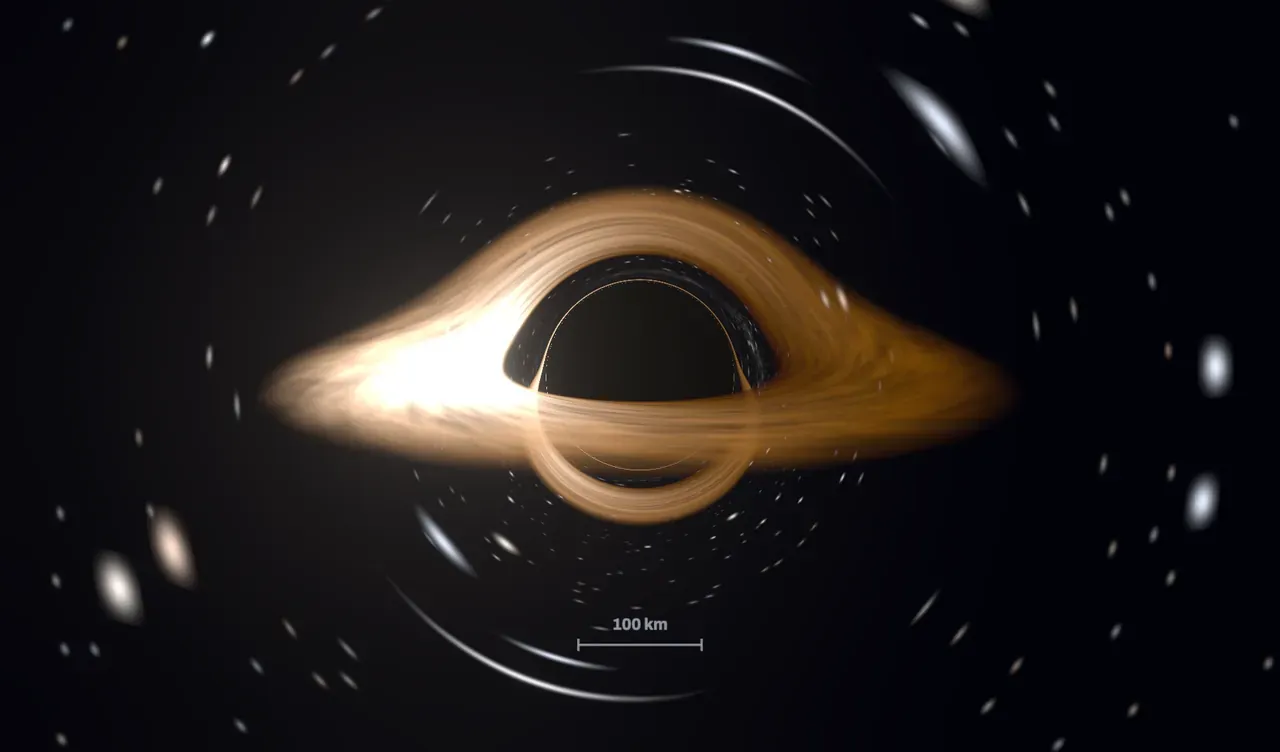
So the dark patch in the scene is larger than the horizon itself. Any light aimed to pass within about 2.6 Schwarzschild radii of the centre is swallowed, leaving a shadow 2.6 times the horizon’s width, edged by a thin bright photon ring of light that looped round the hole before escaping.
Try it: choose Straight light under Straighten the light. The shadow shrinks to the horizon itself and labelled rings show the photon sphere and the innermost stable orbit. Then slide Mass from 4 up to 21 Suns, the mass of Cygnus X-1, and watch every ring grow with it.
The glowing disc
A black hole on its own is invisible. What we see is gas falling towards it. Gas from a companion star does not drop straight in; it swirls into a flat accretion disc, rubbing and heating as it spirals inward. Gas can orbit stably only down to three Schwarzschild radii, the innermost stable circular orbit, where it moves at about half the speed of light. Inside that it plunges.
At such speeds the side of the disc rushing towards you is boosted brighter and bluer, and the receding side dims and reddens. Seen face on, with Viewing angle at 0°, nothing moves towards you, so the glow is even. Tilt towards edge on, near 86°, and gravity does something stranger: light from the far side of the disc is bent up over the shadow and down beneath it, so you see the back of the disc as a bright arch.
Seeing the unseeable
The first black hole widely accepted as one was Cygnus X-1, a source of X-rays found in the 1960s, now weighed at about 21 Suns. In 2015 the LIGO detectors felt ripples in space from two black holes merging over a billion light years away. In 2019 the Event Horizon Telescope, a planet-sized network of radio dishes, imaged the shadow of the giant black hole in the galaxy M87, six and a half billion times the mass of the Sun, and in 2022 the one at the centre of our own galaxy.
What this model leaves out
Real black holes spin, which drags space round with them, squashes the shadow slightly and lets the disc reach closer in. The scene’s disc is thin and smooth, while real discs are turbulent and puffed up by heat, and many black holes have jets. Close to a black hole time runs slow and tides would stretch an approaching object like spaghetti; neither is shown. The view is what an ideal eye would see if the disc shone in visible light.