Gravity not even light escapes: how big the horizon is, how it grows with mass, and why a black hole’s shadow is bigger than its horizon.
Step 1 of 8 · Gravity that wins
Step 1 of 8
Gravity that wins
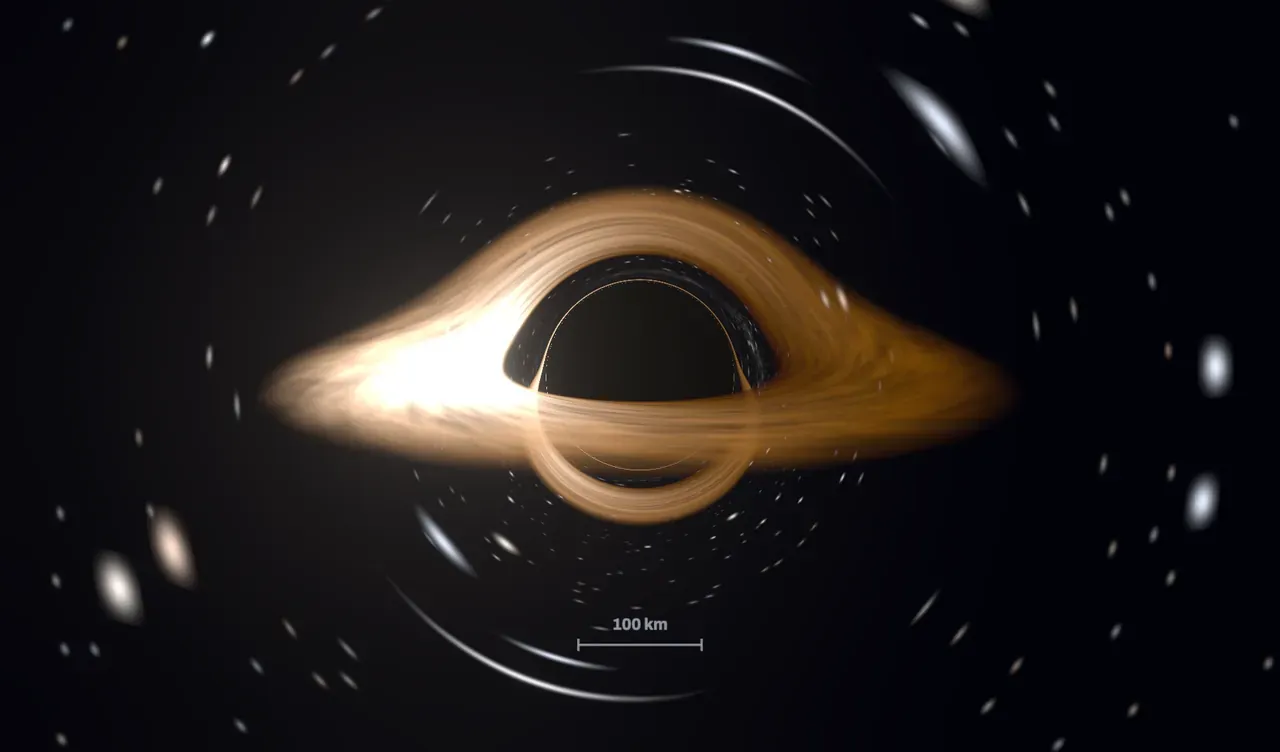
When the core of a very heavy star collapses, even the neutrons cannot hold out, and the matter is squeezed until the escape speed from it is more than the speed of light. In the Orbits and spaceflight Unit you saw that escape speed is . The Scene shows a black hole with an accretion disc of glowing gas round it.
Step 2 of 8
The horizon
Putting the speed of light in place of the escape speed, , gives the Schwarzschild radius:
The sphere of that radius is the event horizon: what goes in cannot come out, not even light.
Step 3 of 8
Heavier, bigger
Straighten the light is at Straight light: light no longer bends, so you see the horizon itself and the labelled rings round it. Predict what will happen to the horizon when the mass doubles.
Step 4 of 8
The glowing disc
Gas falling into the hole does not drop straight in: it circles in a disc, rubbing and heating up. The rings mark three distances: the horizon at , the photon sphere at , where light can circle the hole, and the disc’s inner edge at .
Step 5 of 8
Bent light
Straighten the light is back at Bent light. Gravity bends the disc’s light: you also see its far side, bent up over the hole and down under it. Turn Viewing angle from 0° to 86°.
Step 6 of 8
The photon sphere
Outside the horizon light can still escape, but not in every direction. Close enough to the hole, light setting off sideways bends so far that it comes back to where it started.
Step 7 of 8
The shadow
Straighten the light is off, and the light bends as it really does. The black shadow in the middle is bigger than the horizon itself.
Step 8 of 8
How dense
A black hole sounds like the densest thing in the universe. But that depends on how heavy it is.
Loading the interactive version…
Loading the interactive version…
Each step sets up the Scene for you, and a control marked “fixed” stays put for that step.
Practice · Choose
Imagine the Sun suddenly turned into a black hole of exactly the same mass. What would happen to the Earth’s orbit?
Practice · Choose
Imagine the Sun suddenly turned into a black hole of exactly the same mass. What would happen to the Earth’s orbit?
Practice · Calculate
Mass is locked at solar masses. What is the Schwarzschild radius, , in kilometres? , , .
Practice · Calculate
Mass is locked at solar masses. What is the Schwarzschild radius, , in kilometres? , , .
Practice · Predict, then look
What will happen to the horizon’s radius when Mass doubles from to solar masses?
Practice · Predict, then look
What will happen to the horizon’s radius when Mass doubles from to solar masses?
Practice · Calculate
Straighten the light is at Straight light, and the labelled rings show. The disc ends at the innermost stable circular orbit, at . For solar masses, km. How many kilometres from the hole’s centre is the disc’s inner edge?
Practice · Calculate
Straighten the light is at Straight light, and the labelled rings show. The disc ends at the innermost stable circular orbit, at . For solar masses, km. How many kilometres from the hole’s centre is the disc’s inner edge?
Practice · Choose
With light bending as it really does, the black shadow in the middle looks times bigger than the horizon itself. Why?
Practice · Choose
With light bending as it really does, the black shadow in the middle looks times bigger than the horizon itself. Why?
Practice · Calculate
Mass is locked at 20 solar masses, and its Schwarzschild radius is about 59 km. At from the centre gravity is so strong that light can circle the hole: the photon sphere. What is its radius, in kilometres?
Practice · Calculate
Mass is locked at 20 solar masses, and its Schwarzschild radius is about 59 km. At from the centre gravity is so strong that light can circle the hole: the photon sphere. What is its radius, in kilometres?
Practice · Calculate
Mass is locked at 10 solar masses, kilometres. Because the light bends, the radius of the black shadow you see is . What is it, in kilometres?
Practice · Calculate
Mass is locked at 10 solar masses, kilometres. Because the light bends, the radius of the black shadow you see is . What is it, in kilometres?
Practice · Predict, then look
Divide the hole’s mass by the volume of a ball of radius , and you get the mean density inside the horizon. For 10 solar masses it is about 1.8 × 10¹⁷ kg/m³, like an atom’s nucleus. Predict: what will happen to it when Mass doubles to 20 solar masses?
Practice · Predict, then look
Divide the hole’s mass by the volume of a ball of radius , and you get the mean density inside the horizon. For 10 solar masses it is about 1.8 × 10¹⁷ kg/m³, like an atom’s nucleus. Predict: what will happen to it when Mass doubles to 20 solar masses?
Lesson complete. Every practice question here is done.