Two black holes spiral together and merge, sending ripples through space itself: how much mass turns into waves, why a heavy pair “sounds” low, and how tiny the change the detector measures is.
Step 1 of 5 · Ripples in space
Step 1 of 5
Ripples in space
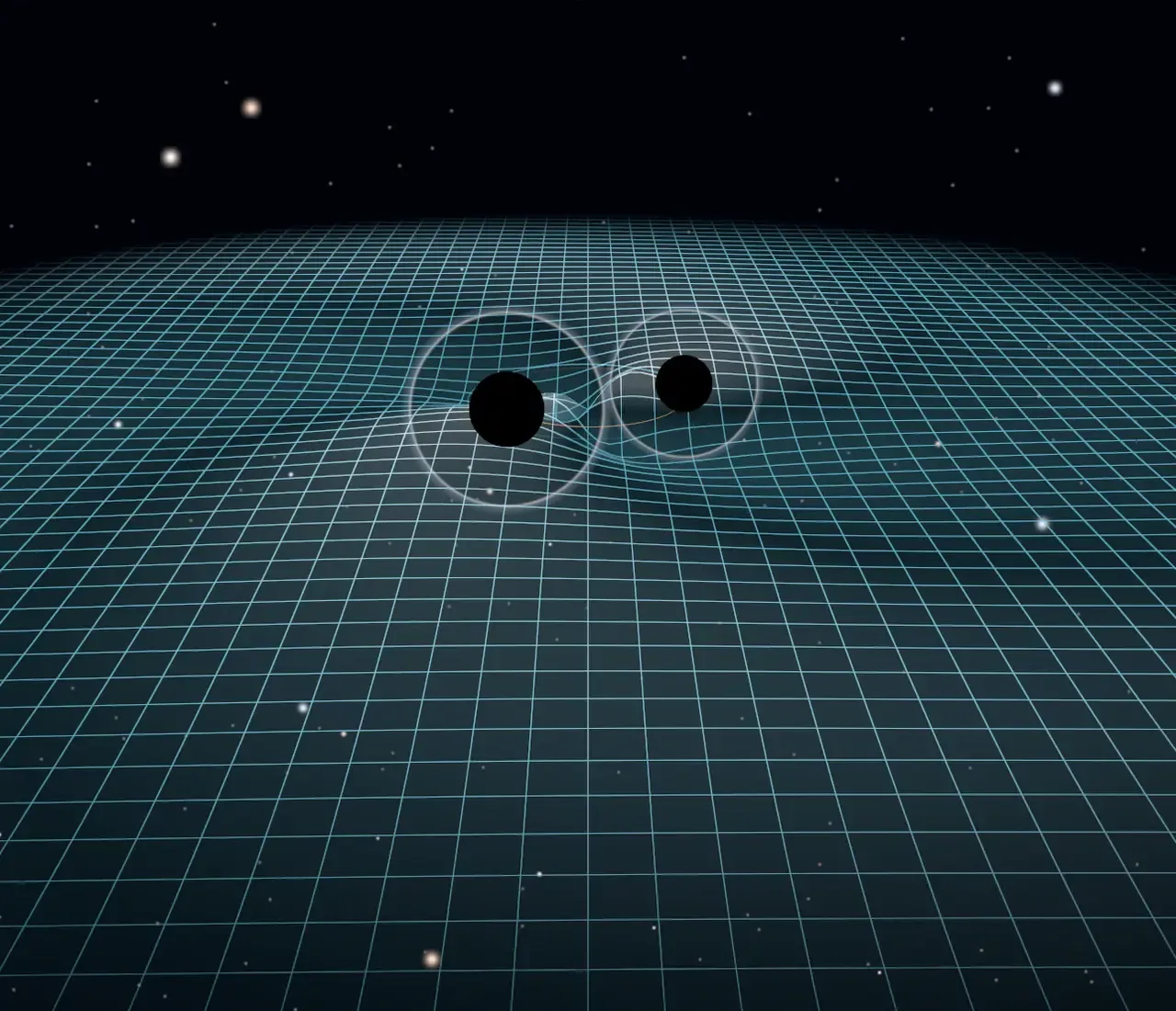
By general relativity, mass curves space, and mass that accelerates sends gravitational waves through it, travelling at the speed of light. A pair of black holes circling each other loses energy to the waves, draws closer, spins faster and finally merges. The sheet in the Scene shows the ripples spreading from the pair.
Step 2 of 5
Mass into waves
The mass missing from the final hole has not vanished: it left as the energy of the gravitational waves, by .
Step 3 of 5
Pitch
Follow to a detector is at At a detector: an L-shaped detector appears in front, its arms stretching and squeezing, and the chart shows the “chirp”. The waves’ frequency is twice the pair’s orbital frequency, and it rises as the holes draw closer.
Step 4 of 5
A balanced pair
Lighter hole is at 12%: a small hole circles a giant many times before it falls in, and the ripples on the sheet are weak.
Step 5 of 5
Catching a wave
The wave from this merger set off about billion years ago, about megaparsecs away. By the time it reached the Earth it had weakened like . The Scene exaggerates the arms’ stretch times, so it can be seen at all.
Loading the interactive version…
Loading the interactive version…
Each step sets up the Scene for you, and a control marked “fixed” stays put for that step.
Practice · Calculate
Heavier hole is solar masses, and Lighter hole of it, solar masses. In the merger about of the total mass leaves as gravitational waves. How many solar masses has the hole that is left?
Practice · Calculate
Heavier hole is solar masses, and Lighter hole of it, solar masses. In the merger about of the total mass leaves as gravitational waves. How many solar masses has the hole that is left?
Practice · Calculate
In the first detection’s merger about solar masses left as gravitational waves. How much energy is that, in joules? , .
Practice · Calculate
In the first detection’s merger about solar masses left as gravitational waves. How much energy is that, in joules? , .
Practice · Predict, then look
The detector “hears” the merger as a chirp that rises in pitch and ends on the final hole’s ringing. What will happen to that frequency when Heavier hole grows from to solar masses?
Practice · Predict, then look
The detector “hears” the merger as a chirp that rises in pitch and ends on the final hole’s ringing. What will happen to that frequency when Heavier hole grows from to solar masses?
Practice · Reach the target
Heavier hole is locked at solar masses, and the lighter one is only of it: the pair radiates about one per cent of its mass. Change Lighter hole until the waves carry off at least of the total mass, and press Check.
Practice · Reach the target
Heavier hole is locked at solar masses, and the lighter one is only of it: the pair radiates about one per cent of its mass. Change Lighter hole until the waves carry off at least of the total mass, and press Check.
Practice · Choose
Follow to a detector is at At a detector. When the first detection’s wave passed the Earth, by how much did one 4 km arm of a LIGO detector change? Use the chart.
Practice · Choose
Follow to a detector is at At a detector. When the first detection’s wave passed the Earth, by how much did one 4 km arm of a LIGO detector change? Use the chart.
Lesson complete. Every practice question here is done.