Ripples in space itself
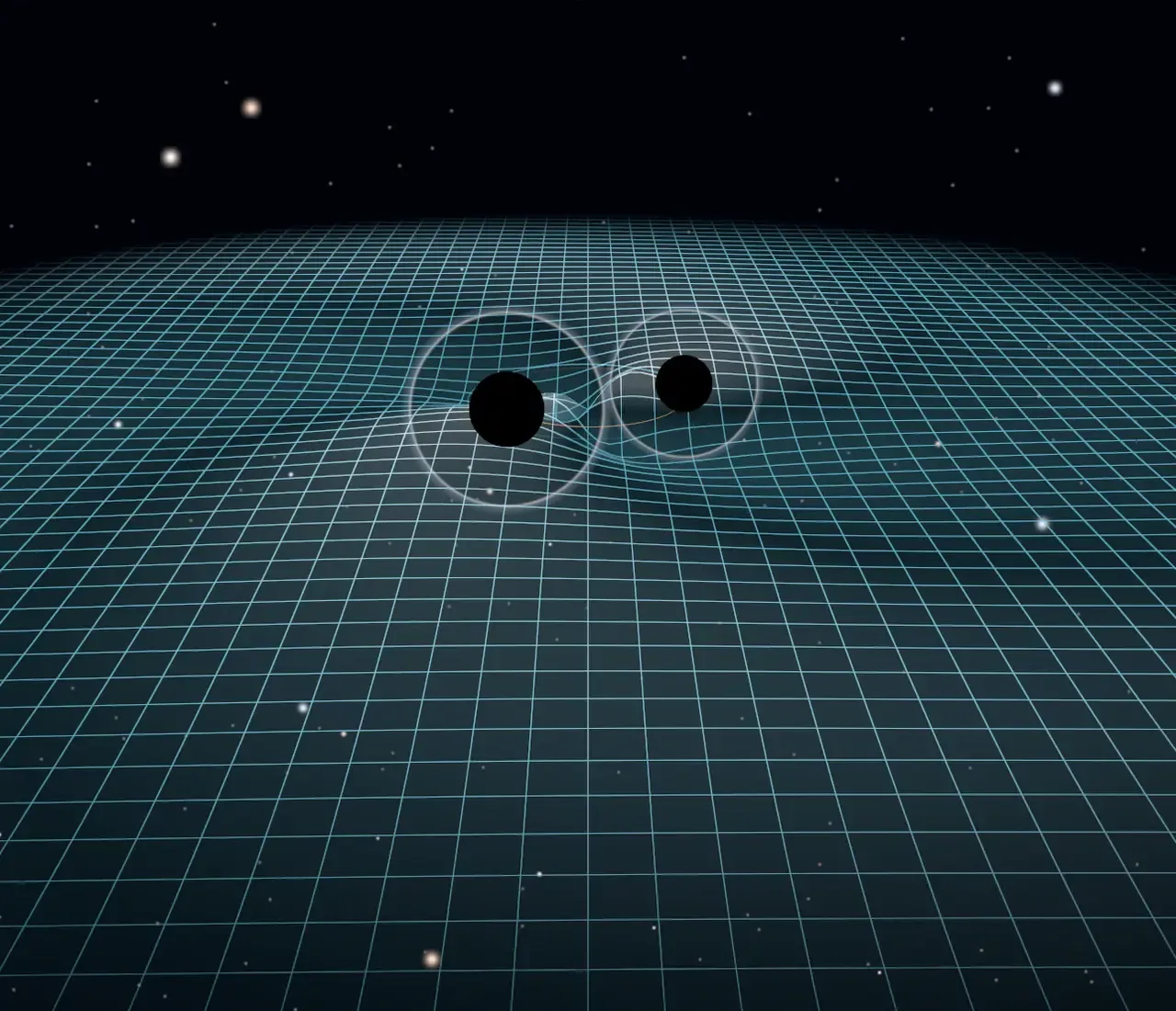
Drop a stone in a pond and rings spread across the water. In Einstein’s theory of gravity, general relativity, space and time can ripple too. Mass curves the space around it, and when masses move back and forth that curve changes, and the change travels outward at the speed of light. These travelling ripples are gravitational waves.
A gravitational wave does not push things along. It stretches space in one direction while squeezing it in the direction at right angles, then swaps over, again and again. Two black holes orbiting each other make the strongest waves in the universe, because they are enormously heavy, very small and move at a good fraction of the speed of light. Each orbit sends out two crests, so the wave’s frequency is twice the orbit’s. In the scene the two crests leave the pair as a two-armed spiral, trailing behind because each part of the ripple left the pair a little earlier.
Why the orbit shrinks
The waves carry energy away, and that energy comes out of the orbit. So the holes sink closer together. Closer orbits are faster, faster orbits make stronger waves, and stronger waves drain the orbit faster still. The last few orbits rush by. The frequency and the strength of the waves both climb in a rising sweep that physicists call a chirp, because turned into sound it rises like a bird’s call.
When the holes touch, their horizons join into one lopsided black hole. It shakes off its unevenness in a few thousandths of a second, giving out waves at one fixed pitch that die away, like a struck bell. This is the ringdown. The final hole spins, and weighs less than the two holes did: the difference left as waves. For the first pair ever detected, that was about three times the mass of the Sun, turned into energy in a fifth of a second.
Try it: drag Lighter hole from 100% to 12% of the heavier. The small hole now circles the big one many more times before it falls in, and the ripples on the grid are weaker. Then choose At a detector under Follow to a detector and watch the chirp grow on the chart.
Pitch from the masses
Nothing in the theory sets a natural size for a black hole. Double both masses and every length doubles and every time doubles, so the dance looks exactly the same, only bigger and slower. That is why the grid in the scene does not change when you change the Heavier hole: it is drawn in units of the pair’s own size. What changes is on the chart. A heavier pair sings a lower note: a pair of 8-Sun holes ends near a thousand hertz, a pair of 60-Sun holes near 150 hertz. Heavier pairs are also louder.
The mass ratio changes the shape of the dance itself. In an equal pair both holes swing round the middle. In a lopsided pair the heavy hole barely wobbles while the light one circles it, losing energy slowly, so it makes many more orbits with weaker waves before the end.
Catching a wave
By the time a wave reaches Earth from a billion light years away it is unimaginably weak. The strongest ones change distances by a few parts in 10²¹: the width of a hair compared with the distance to the nearest star. To catch one, the LIGO detectors in Washington and Louisiana each send laser light down two 4 km tubes set at right angles, bounce it off mirrors at the ends, and bring it back together. When a wave passes, one arm grows as the other shrinks, and the returning light waves fall slightly out of step. In 2015 the arms changed length by a few thousandths of the width of a proton.
Turn the strain into sound and you hear the chirp: a rising whoop. The chart starts when the holes are eight times their combined mass apart, which for light holes is already a high note. Heard from the lowest note LIGO can pick up, about 20 hertz, light pairs chirp for seconds and heavy pairs for a fraction of a second.
The first detection
On 14 September 2015 both LIGO detectors caught the same chirp 7 milliseconds apart, within the 10 milliseconds light takes to cross the 3,000 km between them. It came from two black holes of about 36 and 29 Suns, 1.3 billion light years away, merging into one of about 62 Suns. A century after Einstein predicted them, gravitational waves had been felt directly, and three physicists who built LIGO shared the 2017 Nobel Prize in Physics. Two years later LIGO and the Virgo detector in Italy heard two neutron stars collide, and telescopes saw the explosion’s light arrive within two seconds of the waves, showing that gravity travels at the speed of light. Detectors now catch a merger every few days.
What this model leaves out
The scene’s holes do not spin before they meet; real ones often do, which twists the orbit and changes the chirp. The early orbit follows Einstein’s formula only at its simplest, and the plunge and merger are a smooth blend to the ringing hole rather than a full simulation. The holes are drawn as their horizons with a faint ring where each shadow’s edge would be; the bending of starlight and of the grid around them is not traced. Only one of the wave’s two stretching patterns is charted, for a pair seen face on straight above the detector; real sources are tilted, so their waves are weaker. The wave is not stretched by the expansion of the universe on its way, and a real detector’s signal is buried in noise. The lightest known black holes weigh about 3 to 5 Suns, so a lighter partner at the smallest settings would more likely be a neutron star.