A galaxy bending the light of a distant one behind it into a ring, arcs or a cross: why it happens, how the ring’s size depends on mass, and how it weighs matter no one can see.
Step 1 of 5 · A ring
Step 1 of 5
A ring
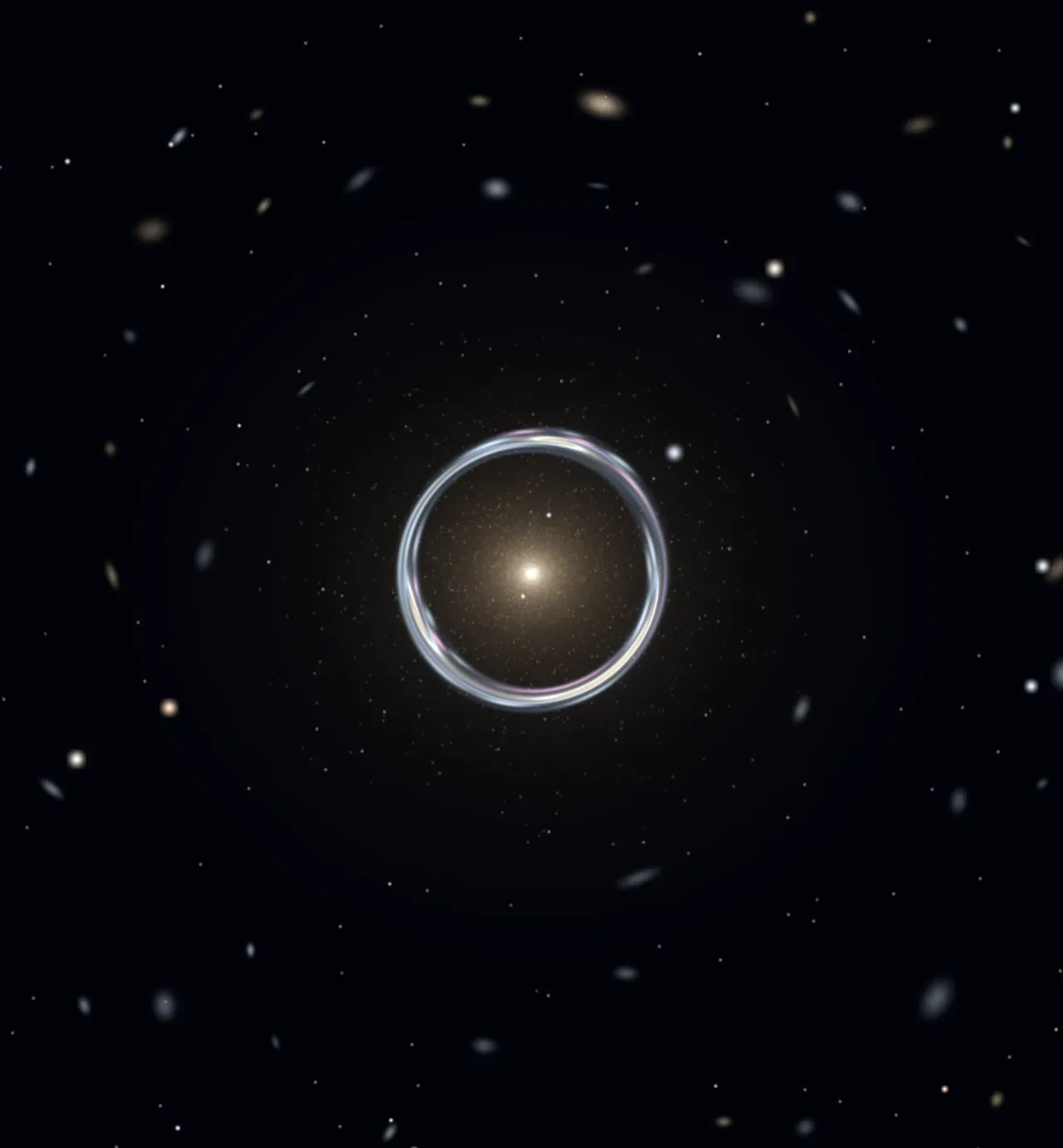
In 1919 astronomers measured stars seen near the Sun during an eclipse and found they had shifted exactly as Einstein predicted: the Sun’s gravity had bent their light. A whole galaxy, a trillion times heavier than the Sun, is a gravitational lens. The Scene has a giant elliptical galaxy, and a spiral twice as far away almost exactly behind it.
Step 2 of 5
The ring’s size
The ring’s radius, the Einstein radius, depends on the lens’s mass and the distances:
and are the distances to the lens and to the source, and the distance between them. Lens mass is locked at Galaxy group, trillion solar masses.
Step 3 of 5
Arcs
A complete ring needs almost perfect alignment. Offset from the line moves the distant galaxy sideways, in arcseconds.
Step 4 of 5
A cross
Real galaxies are not perfectly round. Flattening of the lens makes it oval, and changes how many images there are.
Step 5 of 5
Weighing what we cannot see
Show where it really is is halfway: lines follow the light from points on the rim of the distant galaxy, bent at the lens and sent on to us. Turn the view to see them from the side. Go on to Where it really is: the bending relaxes, and the arcs gather back into one small spiral.
Loading the interactive version…
Loading the interactive version…
Each step sets up the Scene for you, and a control marked “fixed” stays put for that step.
Practice · Choose
The distant galaxy lies almost exactly behind the lens galaxy, and we see it as a complete ring round it. Why a ring?
Practice · Choose
The distant galaxy lies almost exactly behind the lens galaxy, and we see it as a complete ring round it. Why a ring?
Practice · Calculate
A lens of a trillion solar masses makes a ring about arcseconds in radius. Lens mass is now locked at trillion. The ring’s radius is proportional to . What is the radius now, in arcseconds?
Practice · Calculate
A lens of a trillion solar masses makes a ring about arcseconds in radius. Lens mass is now locked at trillion. The ring’s radius is proportional to . What is the radius now, in arcseconds?
Practice · Predict, then look
What will happen to the ring when the distant galaxy moves a little to one side, to 0.4 arcsec?
Practice · Predict, then look
What will happen to the ring when the distant galaxy moves a little to one side, to 0.4 arcsec?
Practice · Reach the target
A flattened lens can split the galaxy behind it into four images, an “Einstein cross”. Change the Scene until you see four separate images, and press Check.
Practice · Reach the target
A flattened lens can split the galaxy behind it into four images, an “Einstein cross”. Change the Scene until you see four separate images, and press Check.
Practice · Choose
From the size of the ring you can work out the lens’s mass. Doing it for real galaxies gives a mass several times that of all their stars and gas. What follows?
Practice · Choose
From the size of the ring you can work out the lens’s mass. Doing it for real galaxies gives a mass several times that of all their stars and gas. What follows?
Lesson complete. Every practice question here is done.