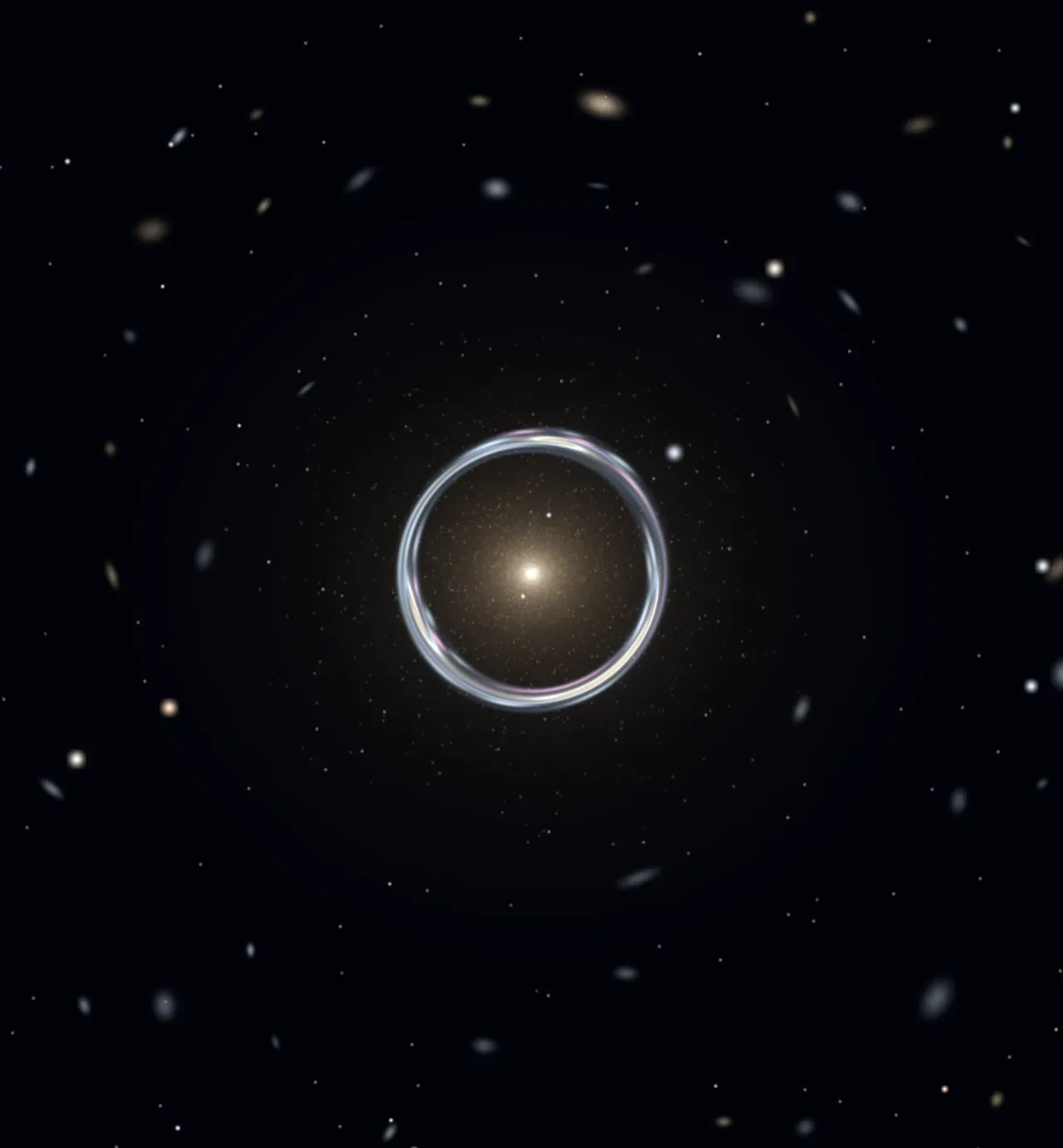
Light that follows curved space
Gravity pulls on light as well as on matter. In Einstein’s theory of gravity, general relativity, a mass curves the space and time around it, and light passing nearby follows the curve. The bending is tiny: starlight grazing the edge of the Sun is turned aside by 1.75 arcseconds, about the width of a coin seen from two kilometres away. Arthur Eddington’s expeditions measured it during the total eclipse of 1919, when stars near the darkened Sun could be photographed, and the result, twice what Newton’s gravity would give, made Einstein famous.
An arcsecond is a 3,600th of a degree. Everything in this article happens at that scale: the whole scene would fit behind a grain of sand held at arm’s length.
A galaxy as a lens
A galaxy is a far bigger mass than the Sun, and a galaxy halfway to another galaxy far behind it bends that galaxy’s light on its way to us. Light passing to the left of the lens is bent right, and light passing to the right is bent left, so rays that started out diverging can meet again at a telescope. We then see the galaxy behind not where it is, but where the bent light seems to come from, and often more than once.
The angle at which this happens is the Einstein radius:
where is the lens’s mass, the gravitational constant, the speed of light, and , and the distances to the lens, to the source and between them. For a giant elliptical galaxy of a trillion Suns, 3.3 billion light years away, in front of a galaxy twice as far, it comes to about 2 arcseconds. The ring grows only as the square root of the mass: four times the mass makes it twice as wide.
Try it: with Offset from the line at 0, the spiral behind is stretched all the way round the lens into an Einstein ring. Slide it to 0.4 arcsec: the ring breaks into two arcs on opposite sides, the brighter one on the side the galaxy has moved to. At 1.2 arcsec a faint second image stays close to the lens’s middle, and at 2.5 arcsec only one image is left, a little stretched and pushed outwards.
Arcs, crosses and rings
Lensing does not change the brightness of each patch of a galaxy’s surface. It changes the shape: the parts of the galaxy behind that are closest to the line are spread round the lens into long thin arcs, stretched along a circle and squeezed across it. A point exactly behind the middle of a perfectly round lens would be smeared all the way round the Einstein radius. A real galaxy is not a point, so it makes a complete ring as long as it covers the line through the lens’s centre.
Real lenses are rarely round. A flattened galaxy has a small diamond-shaped zone behind it, and a source inside that zone is seen four times, in a cross round the lens. The first gravitational lens, found in 1979, was a quasar seen twice; the most famous cross, the Einstein Cross, is a quasar whose light set out about 10 billion years ago, seen four times round the middle of a galaxy only about half a billion light years away. The first complete ring was found with radio telescopes in 1988.
Try it: set Flattening of the lens to 0.5 with Offset from the line at 0: the ring breaks into four images. Move Offset from the line slowly to 0.4 arcsec, and two of them merge into one long arc.
Brighter as well as bigger
Because lensing keeps the brightness of each patch but spreads the galaxy over more sky, it gathers more of the galaxy’s light into the telescope. The chart beside the scene shows how many times brighter the galaxy behind looks: lined up behind the giant elliptical, about 30 times, and still almost twice as bright when it is far off the line.
That makes lenses natural telescopes. Clusters of galaxies, a thousand times heavier than a single galaxy, have Einstein radii of tens of arcseconds and bring some of the most distant galaxies known within reach. In 2022 astronomers used one to pick out a single star, nicknamed Earendel, whose light left it when the universe was under a billion years old.
Try it: set Lens mass to Galaxy group. The ring doubles in size, and the chart shows the galaxy behind looking more than 50 times brighter when lined up.
Weighing what we cannot see
The Einstein radius depends on the mass inside it, and on nothing else about the lens: not what the mass is made of, nor whether it gives off light. So a ring is a scale. Measure its radius and the distances, and the formula gives the mass inside it. Rings round galaxies show that their mass is spread much wider than their stars, the same conclusion rotation curves reach: most of a galaxy’s mass is dark matter. Lensing by clusters maps where their dark matter sits, and in clusters that have collided it sits apart from the hot gas that holds most of their ordinary matter.
The paths round the lens are not all the same length. When the source flickers, as quasars and exploding stars do, the flicker arrives in each image at a different time, days to years apart, and the delays give a measure of how fast the universe is expanding. Much smaller lenses work too: when one star passes in front of another in the Milky Way, the images are too close to separate, but the star behind brightens for a few weeks, and a planet round the lens adds a blip of its own. Near a black hole the bending becomes so strong that light can circle it, and gravitational waves should be lensed by galaxies just as light is.
Try it: slide Show where it really is halfway. Lines trace the light from six points on the rim of the galaxy behind, bent at the lens and sent on towards us, each one to the part of the ring it lights. Turn the view to see them from the side. Slide on to Where it really is: the bending relaxes, the arcs slide back into one small spiral, and when the two are lined up, the lens galaxy would hide it.
What this model leaves out
- The angles are hugely enlarged. The scene draws an arcsecond as a few scene units, about 8,000 times larger than it is, and squeezes billions of light years of depth into the same space. The paths are drawn as straight lines that bend once, where they cross the lens; the real bending happens gradually, over hundreds of thousands of light years round the lens, but that is a sliver of the whole journey.
- The distances are simplified. The lens is put at 3.3 billion light years and the source at twice that, in flat space. In an expanding universe the distances that set the Einstein radius are defined differently, and the numbers shift by tens of per cent.
- The lens is a smooth shape. Its mass is a singular isothermal ellipsoid, the standard simple model of a galaxy’s stars and dark matter together, with no core, no clumps and no neighbouring galaxies. Real lenses are nudged by all three, which is why real crosses and rings are rarely symmetrical.
- The lens galaxy’s light is toned down. A real giant elliptical outshines the faint arcs round it, and astronomers subtract a model of its light to see them. The scene draws it dimmer instead, with a few thousand points for its stars so it keeps a shape when the view is turned.
- Seen from the side, the images stay where their light crosses the lens. That is where the Milky Way sees them; a viewer somewhere else would see a different arrangement. The real spiral behind appears where it really is once you turn away from the line of sight.
- No time passes. The images do not flicker, the delays between them are not shown, and stars in the lens do not add microlensing of their own.