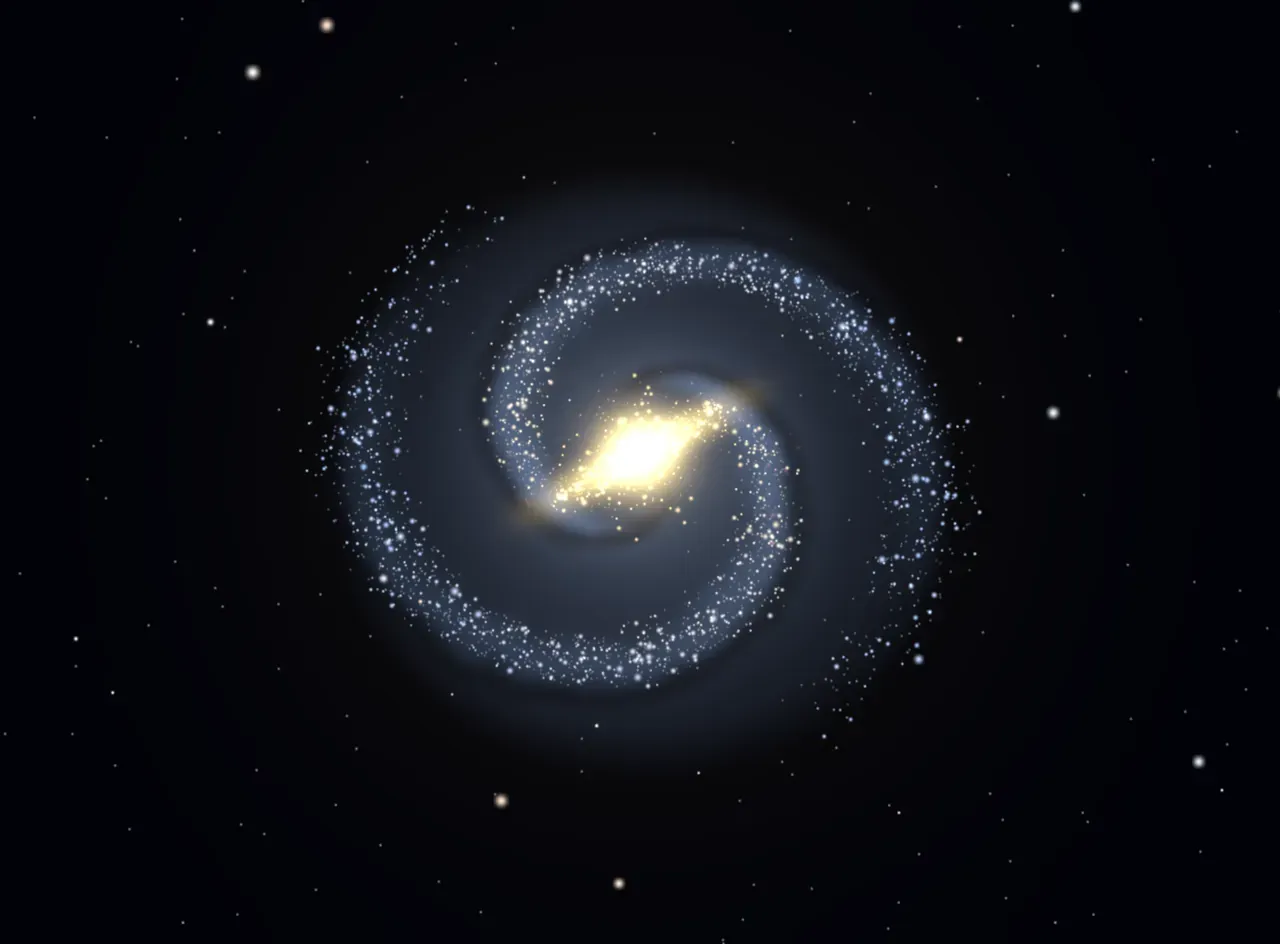
Islands of stars
On a dark night, away from city lights, a pale band crosses the sky. Through a telescope it breaks into countless faint stars. It is our galaxy, the Milky Way, seen from inside: a flat disc about 100,000 light years across holding a few hundred billion stars, with the Sun about 26,000 light years from the centre. We see it as a band because we are looking along the disc.
A century ago many astronomers thought the Milky Way was the whole universe. In the 1920s Edwin Hubble measured the distance to the fuzzy patch in Andromeda and found it far outside our galaxy, a separate island of stars, now known to be about 2.5 million light years away. Telescopes have since shown hundreds of billions of galaxies.
Four shapes
Hubble sorted galaxies by their look, and his classes are still used. Spirals are flat, spinning discs with a bright central bulge and arms that wind out from it. In many of them, including the Milky Way, the arms start from the ends of a straight bar of stars across the middle. Spirals differ in how tightly their arms wind: tight arms usually go with a big bulge, loose arms with a small one.
Ellipticals are smooth balls of stars, from small ones to the giants at the hearts of galaxy clusters. Their stars are old and reddish, and they have little of the gas needed to make new ones. Irregulars have no clear shape; many have been pulled about by a bigger neighbour. The Large and Small Magellanic Clouds, seen from the southern hemisphere, are irregular companions of the Milky Way.
Try it: choose Spiral, then slide Arm winding from 2.5 to 7.5 radians and Spiral arms from two to four. Switch to Barred spiral, then compare Elliptical and Irregular. Finally choose On under Show the dark matter.
Arms that don’t wind up
Stars near a galaxy’s centre take less time to go round than stars far out. If the arms were fixed chains of stars, they would wind tighter and tighter until they disappeared after a few turns. They do not, because an arm is a pattern rather than a structure: a slow-moving region where stars and gas crowd together, like a traffic jam that stays in one place while cars pass through. Gas squeezed in the jam collapses into new stars, and the brightest, bluest of them burn out before they leave it. That is why the arms glow blue.
Too fast at the edge
The Sun orbits the centre of the Milky Way at about 230 km per second and takes about 230 million years to go round once. Stars and gas much farther out should orbit more slowly, the way the outer planets crawl round the Sun, since most of the visible mass lies near the middle. In the 1970s Vera Rubin and Kent Ford measured the speeds across galaxies and found that they don’t fall: the outer parts orbit about as fast as the inner ones. At those speeds the visible stars and gas could not hold on to them.
The usual explanation is a vast halo of dark matter surrounding each galaxy: mass that pulls but gives off no light. Measurements of galaxies, clusters and the early universe suggest it outweighs ordinary matter about five to one. What it is made of is still unknown.
What the model leaves out
The scene has a few thousand stars and turns its disc as one piece, so the arms are fixed shapes rather than waves. Real galaxies also hold gas, dust and a central black hole: the Milky Way’s weighs about four million Suns. The rotation curve is a smooth sketch of the measured pattern, and the violet halo stands in for something that cannot be seen at all.