Islands of billions of stars: why a spiral galaxy’s arms are blue and why they don’t wind up, what an elliptical galaxy’s colour tells, and how long the Sun takes to go round the Milky Way.
Step 1 of 5 · Islands of stars
Step 1 of 5
Islands of stars
A galaxy is a system of millions to trillions of stars, with gas and dust, held together by gravity. The Milky Way, our galaxy, holds a few hundred billion stars and is about light-years across. Until 1924 it was not clear there were other galaxies; then Edwin Hubble showed that the Andromeda nebula lies far beyond any star of the Milky Way. Today the visible universe is thought to hold hundreds of billions of galaxies.
Step 2 of 5
Four shapes
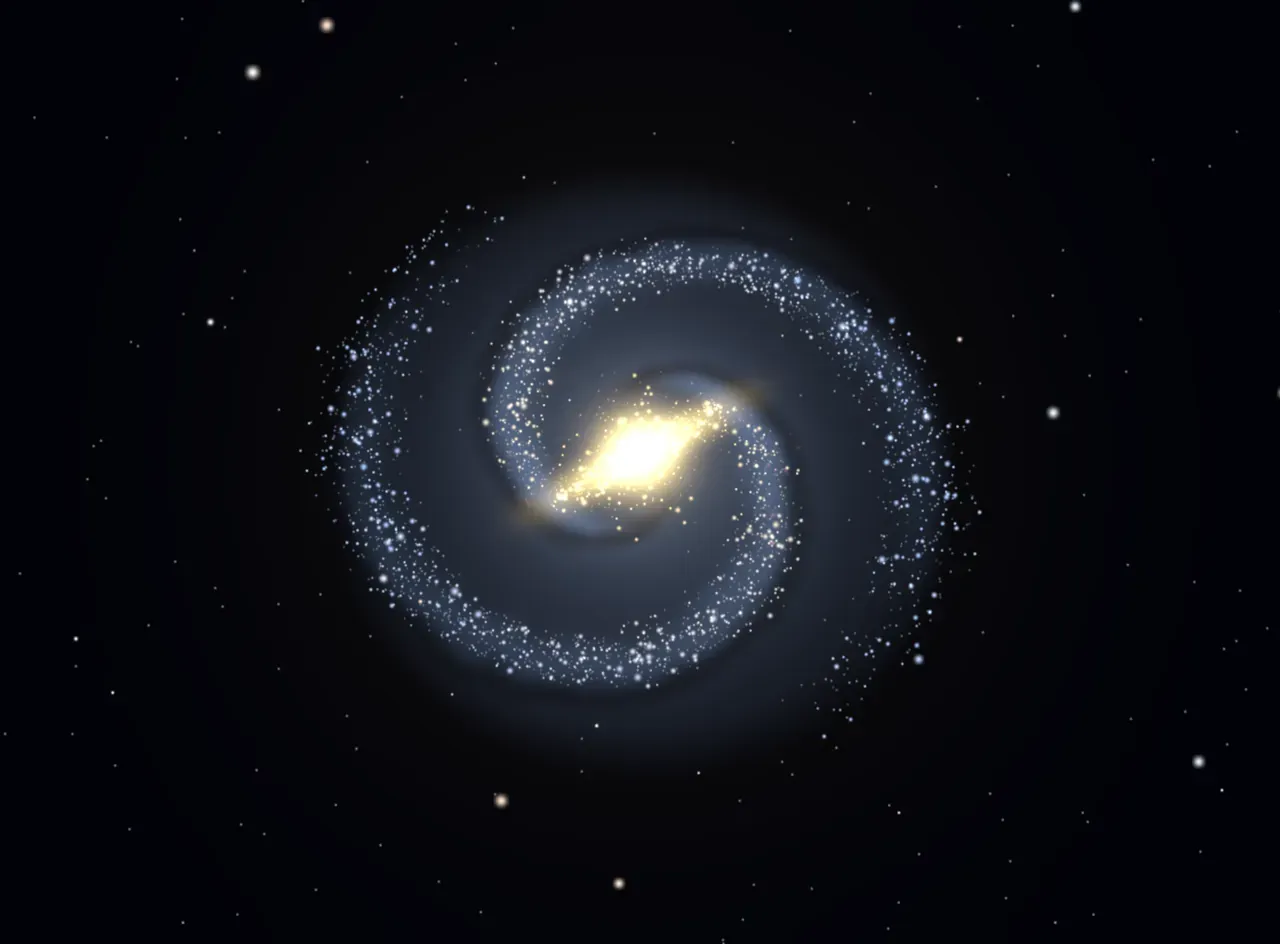
Hubble sorted galaxies by shape: spirals, with a flat disc and arms, barred spirals, whose arms start from the ends of a bar of stars across the middle, ellipticals, smooth clouds of stars, and irregulars, with no clear shape. The Milky Way is a barred spiral. Switch between the kinds with Galaxy type.
Step 3 of 5
Arms that don’t wind up
The Scene turns, and the inner stars complete a lap faster than the outer ones. Change Spiral arms and Arm winding and compare.
Step 4 of 5
The galactic year
The Sun is one star in the Milky Way’s disc, between two arms, about two thirds of the way from the centre to the rim. Like the Earth round the Sun, it circles the centre of the Galaxy, on a nearly circular orbit.
Step 5 of 5
Too fast at the edge
Show the dark matter is On: a blue halo surrounds the galaxy, and a chart shows the orbital speeds at each distance from the centre. You will study these measurements in depth in the next Lesson.
Loading the interactive version…
Loading the interactive version…
Each step sets up the Scene for you, and a control marked “fixed” stays put for that step.
Practice · Choose
In a spiral galaxy the middle is yellowish and the arms bluish. Why are the arms blue?
Practice · Choose
In a spiral galaxy the middle is yellowish and the arms bluish. Why are the arms blue?
Practice · Choose
Galaxy type is now Elliptical: a smooth cloud of stars with no arms, yellow-orange in colour. What does that tell you about it?
Practice · Choose
Galaxy type is now Elliptical: a smooth cloud of stars with no arms, yellow-orange in colour. What does that tell you about it?
Practice · Choose
Stars near the centre complete a lap faster than distant ones. So why don’t the arms wind up and vanish after a few turns?
Practice · Choose
Stars near the centre complete a lap faster than distant ones. So why don’t the arms wind up and vanish after a few turns?
Practice · Calculate
The Sun is about light-years from the centre of the Milky Way and goes round it at about 230 km/s. How many years does one lap take? A light-year is , and a year has seconds. (You can type as 2e8.)
Practice · Calculate
The Sun is about light-years from the centre of the Milky Way and goes round it at about 230 km/s. How many years does one lap take? A light-year is , and a year has seconds. (You can type as 2e8.)
Practice · Choose
Show the dark matter is On: the rotation curve shows stars and gas at the galaxy’s edge going round about as fast as the inner stars, although nearly all the light comes from the middle. What follows?
Practice · Choose
Show the dark matter is On: the rotation curve shows stars and gas at the galaxy’s edge going round about as fast as the inner stars, although nearly all the light comes from the middle. What follows?
Lesson complete. Every practice question here is done.