Weighing a galaxy by its stars’ speeds: the speeds do not fall at the edge, so it holds far more mass than shines, spread in a halo round it.
Step 1 of 5 · What was expected
Step 1 of 5
What was expected
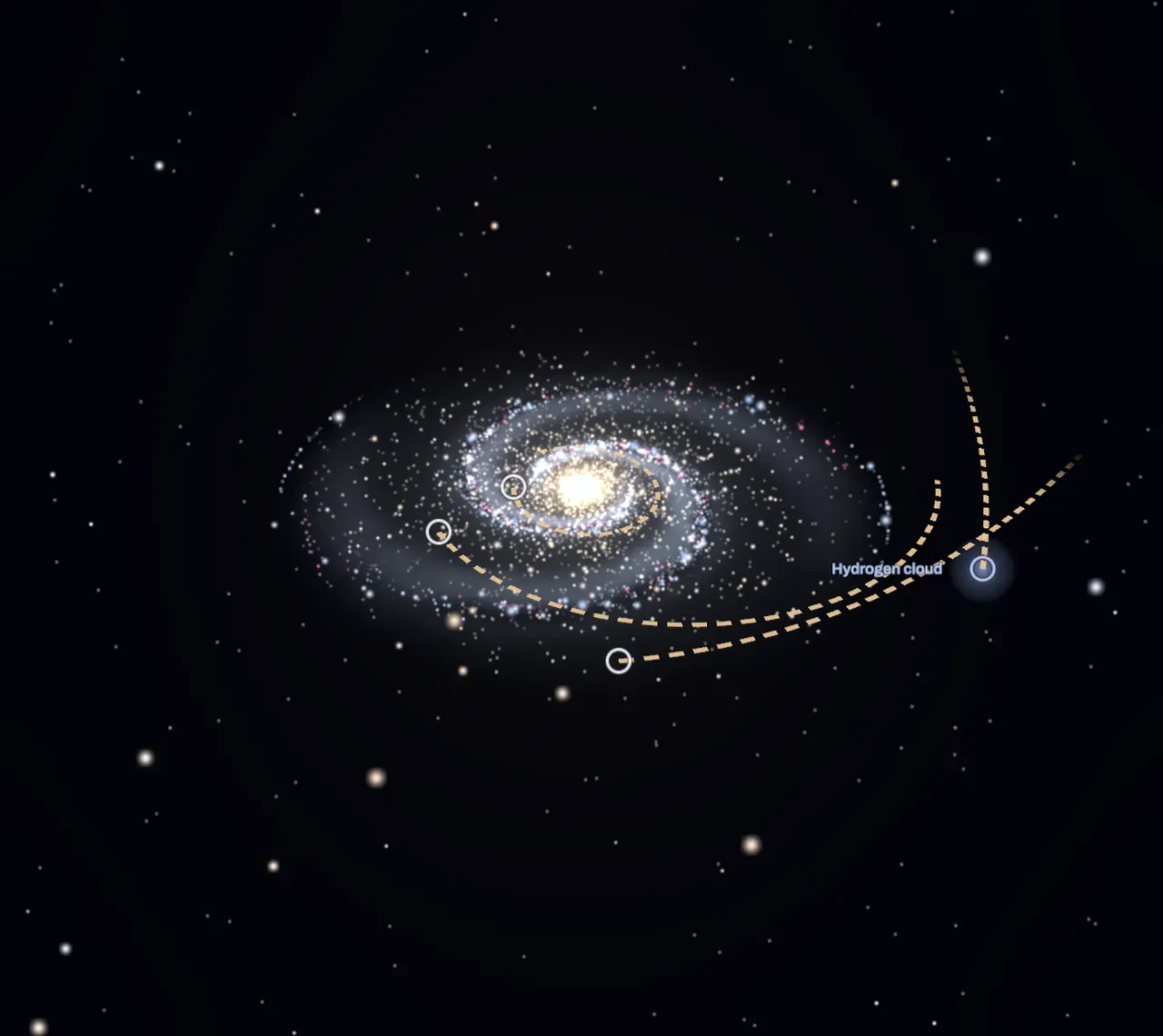
In the Solar System nearly all the mass is in the Sun, and the distant planets are slow: . In a galaxy too, most of the light comes from the middle. The Scene shows a galaxy like the Milky Way, with three marked stars and a far hydrogen cloud that shows only in radio waves.
Step 2 of 5
How much is missing
Show the speeds is at Speeds: beside each marked body are two arrows, the measured speed and the speed your chosen mass could hold on a circle. When they differ, the body’s dashed path does not close.
Step 3 of 5
Weighing with an orbit
A body’s orbital speed reveals the mass inside its orbit. Rearranging :
That is how the Sun is weighed by the Earth’s year, and how a galaxy can be weighed by a cloud of gas circling it.
Step 4 of 5
A halo
Dark matter in the halo adds mass that gives no light, in a wide sphere round the galaxy, denser in the middle and thinner outside. Each dashed path shows what would happen to a body moving at its measured speed but feeling only the mass you chose.
Step 5 of 5
Why not more stars
Perhaps there are simply more stars and gas than we thought? Stars and gas is at 195 billion Suns, three times as much, with no dark matter. Look at the paths of the three stars and the cloud.
Loading the interactive version…
Loading the interactive version…
Each step sets up the Scene for you, and a control marked “fixed” stays put for that step.
Practice · Predict, then look
The stars and gas are concentrated in the galaxy’s middle, and a marked hydrogen cloud circles far beyond the edge of the light. What will the measured orbital speeds show, going out from the centre?
Practice · Predict, then look
The stars and gas are concentrated in the galaxy’s middle, and a marked hydrogen cloud circles far beyond the edge of the light. What will the measured orbital speeds show, going out from the centre?
Practice · Calculate
With Stars and gas alone, at 65 billion Suns from the starlight, the mass can hold the far hydrogen cloud on a circle only at about 124 km/s. The cloud is measured moving at about 218 km/s. Assuming the extra mass is spread like the mass already there, by how many times must the mass inside the orbit grow?
Practice · Calculate
The far hydrogen cloud is kiloparsecs from the centre, , and moves at 218 km/s. Using , what is the mass inside its orbit, in kilograms? .
Practice · Calculate
The far hydrogen cloud is kiloparsecs from the centre, , and moves at 218 km/s. Using , what is the mass inside its orbit, in kilograms? .
Practice · Reach the target
Stars and gas is locked at 65 billion Suns, the mass from the starlight, and the marked bodies’ dashed paths fly outwards. Change Dark matter in the halo until every path closes into the circle the body really moves on, and press Check.
Practice · Reach the target
Stars and gas is locked at 65 billion Suns, the mass from the starlight, and the marked bodies’ dashed paths fly outwards. Change Dark matter in the halo until every path closes into the circle the body really moves on, and press Check.
Practice · Choose
With no dark matter, Stars and gas at 195 billion Suns, three times as much: the far cloud is held at last, but the inner stars plunge towards the middle. Why can’t more stars and gas set every path right?
Practice · Choose
With no dark matter, Stars and gas at 195 billion Suns, three times as much: the far cloud is held at last, but the inner stars plunge towards the middle. Why can’t more stars and gas set every path right?
Lesson complete. Every practice question here is done.