The oldest light we can see: a glowing fog that filled the young universe, cleared about 380,000 years after the Big Bang, and has stretched into microwaves since.
Step 1 of 8 · A glow from every direction
Step 1 of 8
A glow from every direction
The Scene is the sphere of the sky round you, with you in the middle. Time since the Big Bang is measured in powers of ten: means , about billion years, today. Look with is set to Microwave telescope.
Step 2 of 8
A universe of glowing fog
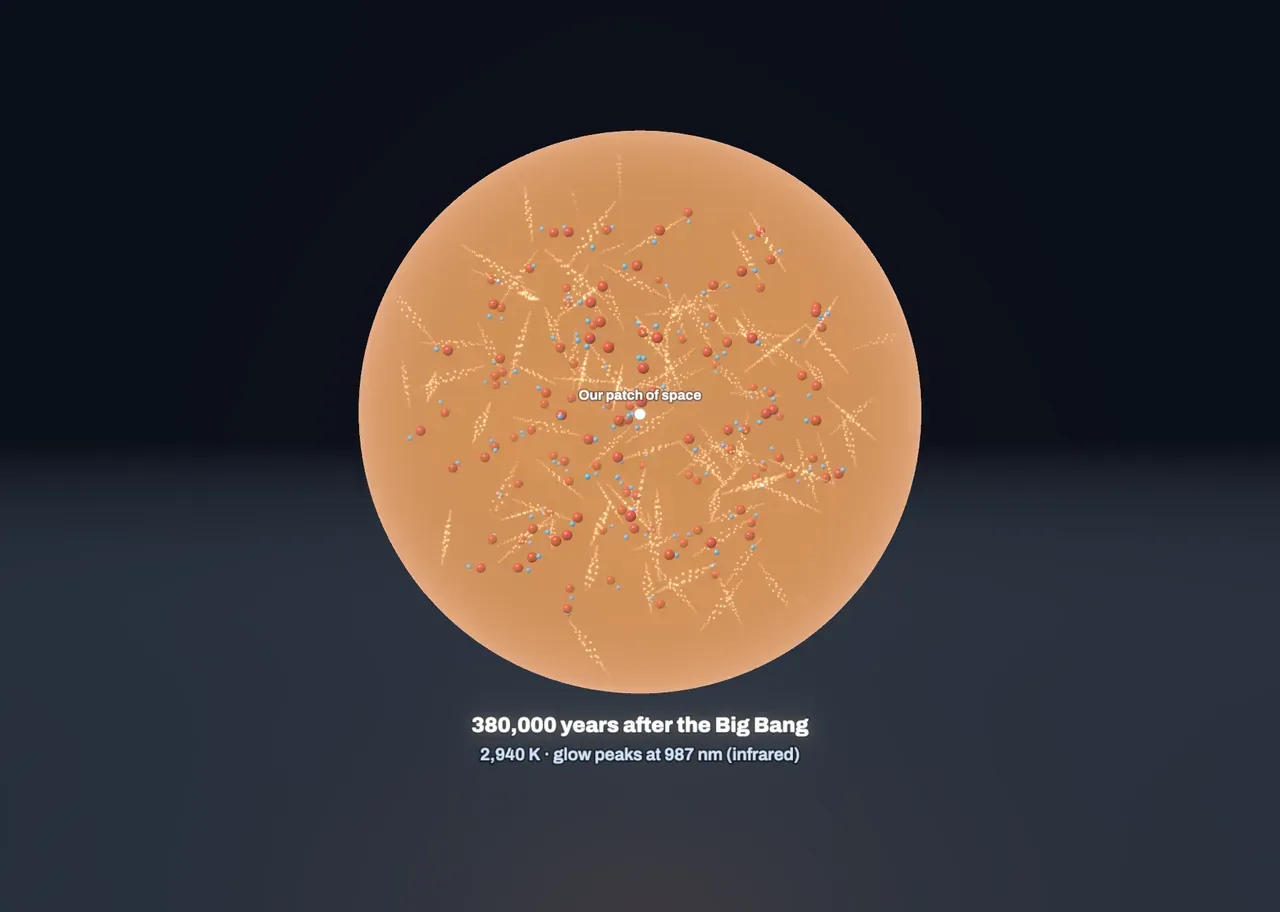
In the Stars and the universe Unit you saw that the universe is expanding, so in the past it was denser and hotter. For its first few hundred thousand years it was a hot soup of hydrogen and helium nuclei, free electrons and light.
Step 3 of 8
The fog clears
When the universe cooled below about 3000 K, the electrons settled onto the nuclei and made atoms. Atoms hardly scatter light, the fog cleared, and the light set off in straight lines. That moment is called recombination. Drag Time since the Big Bang from Glowing fog to Fog clears and watch the electrons.
Step 4 of 8
Stretched into microwaves
The light set free then is still travelling. As it crosses the expanding universe, its waves stretch with space itself, and the glow cools. Predict what eyes would see a few tens of millions of years later.
Step 5 of 8
The glow today
Today, billion years after the Big Bang, the glow is an almost perfect blackbody, at 2.7255 K, under three degrees above absolute zero. The COBE satellite measured its spectrum in 1990.
Step 6 of 8
Ripples in the glow
The glow is almost perfectly even, but satellites such as WMAP and Planck have mapped tiny differences in it from point to point across the sky.
Step 7 of 8
Catching electrons
The fog does not clear all at once. The electrons are caught by nuclei gradually, as the universe cools.
Step 8 of 8
The first galaxies
Astronomers date what they see by how much its light has stretched: not in years, but by its redshift.
Loading the interactive version…
Loading the interactive version…
Each step sets up the Scene for you, and a control marked “fixed” stays put for that step.
Practice · Choose
A microwave telescope pointed anywhere in the sky picks up a faint glow, almost equally strong in every direction. Where does it come from?
Practice · Choose
A microwave telescope pointed anywhere in the sky picks up a faint glow, almost equally strong in every direction. Where does it come from?
Practice · Choose
Time since the Big Bang is at Glowing fog, about a hundred thousand years after the Big Bang. The light in the Scene zigzags and gets nowhere. Why?
Practice · Choose
Time since the Big Bang is at Glowing fog, about a hundred thousand years after the Big Bang. The light in the Scene zigzags and gets nowhere. Why?
Practice · Calculate
Time since the Big Bang is at Fog clears, about years. Since then the universe and every light wave in it have stretched about times. Today the glow is at 2.7255 K, and the temperature falls in the same ratio as the waves stretch. What was the glow’s temperature then, in kelvin?
Practice · Predict, then look
Look with is set to Eyes. What will eyes see when Time since the Big Bang moves on to Dark ages, about million years after the Big Bang, before any stars formed?
Practice · Predict, then look
Look with is set to Eyes. What will eyes see when Time since the Big Bang moves on to Dark ages, about million years after the Big Bang, before any stars formed?
Practice · Calculate
Time since the Big Bang is at Today: the glow is at 2.7255 K. At what wavelength is its peak, in millimetres? .
Practice · Calculate
Time since the Big Bang is at Today: the glow is at 2.7255 K. At what wavelength is its peak, in millimetres? .
Practice · Choose
Show the ripples is On: the contrast is turned up thousands of times, and warmer and cooler spots show that differ by only about one part in . What are they?
Practice · Choose
Show the ripples is On: the contrast is turned up thousands of times, and warmer and cooler spots show that differ by only about one part in . What are they?
Practice · Reach the target
At Glowing fog every electron is free, and today almost all are bound to nuclei. Move Time since the Big Bang (powers of ten) to the moment when exactly half the electrons have been caught in atoms, and press Check.
Practice · Reach the target
At Glowing fog every electron is free, and today almost all are bound to nuclei. Move Time since the Big Bang (powers of ten) to the moment when exactly half the electrons have been caught in atoms, and press Check.
Practice · Reach the target
Light that set off at some moment has been stretched times since, where is the redshift of that moment. The most distant galaxies the James Webb Space Telescope sees are at about . Move Time since the Big Bang (powers of ten) to the moment when , and press Check.
Practice · Reach the target
Light that set off at some moment has been stretched times since, where is the redshift of that moment. The most distant galaxies the James Webb Space Telescope sees are at about . Move Time since the Big Bang (powers of ten) to the moment when , and press Check.
Lesson complete. Every practice question here is done.