A glow from every direction
Point a radio telescope at any patch of sky, between the stars and galaxies, and it picks up a faint, steady hiss of microwaves. Arno Penzias and Robert Wilson found it by accident in 1964, while testing a large horn-shaped antenna in New Jersey. They cleaned the antenna, even evicted pigeons nesting in it, and the hiss stayed, the same in every direction, day and night.
They had found the cosmic microwave background: light left over from the young universe. Ralph Alpher and Robert Herman had predicted it in 1948. If the universe began hot and dense and has been expanding ever since, its first light should still be all around us, cooled to a few degrees above absolute zero. Measured today it is 2.7 kelvin, and there are about 400 of its photons in every cubic centimetre of space.
A universe of glowing fog
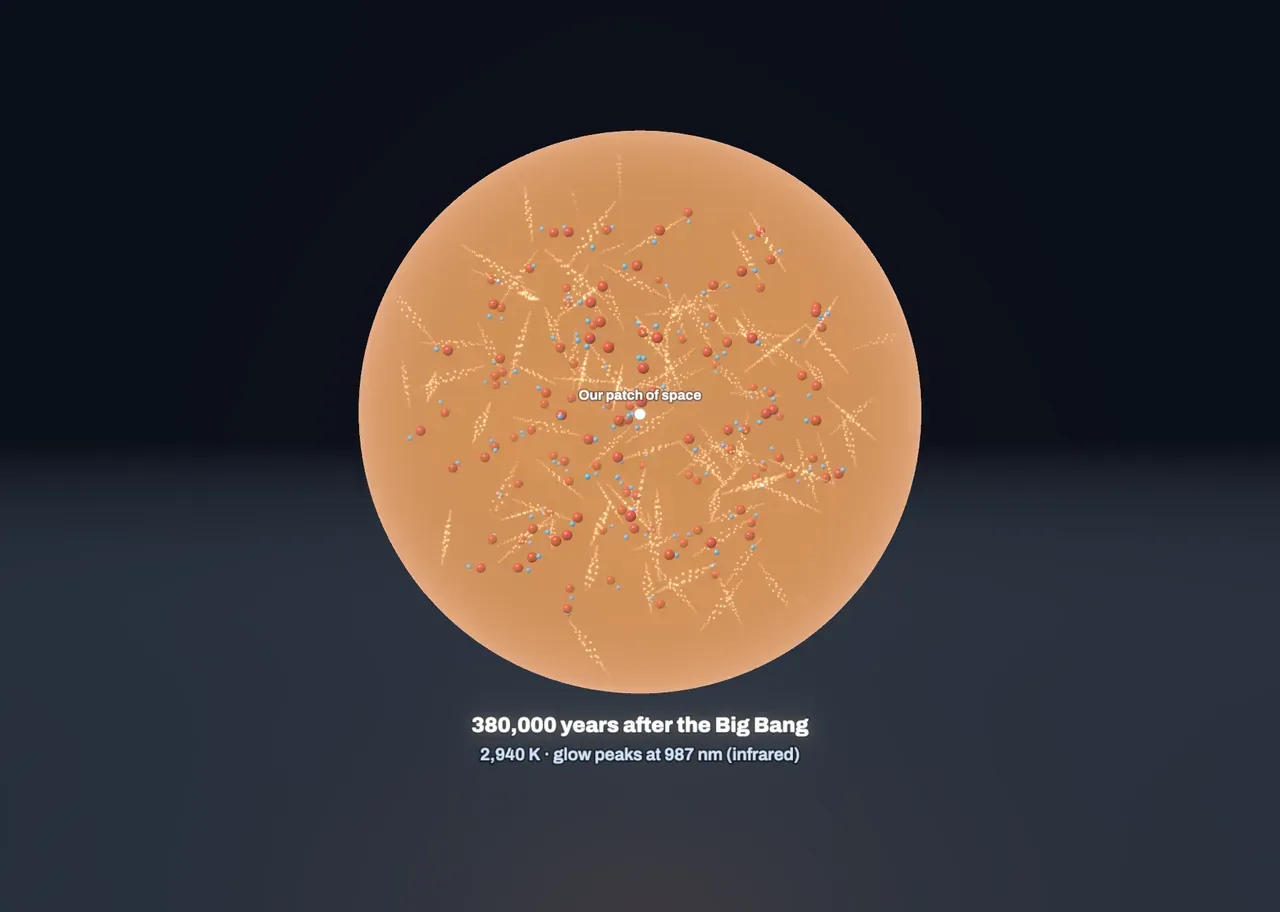
For its first few hundred thousand years the universe was a hot soup of hydrogen and helium nuclei, free electrons and light. Light could not get far. Free electrons scatter light very easily, so each ray was knocked into a new direction almost at once, like headlights in thick fog. The whole universe glowed, but you could not see through it.
The fog was hot because everything was squeezed close together. As space expanded, the glow cooled. Its colour followed the temperature, as hot metal’s does when it cools: white at 6,000 kelvin, then yellow, then orange.
The fog clears
Hydrogen needs only a little energy to lose its electron. Yet atoms could not form until the universe had cooled to about 3,000 kelvin, far cooler than you might expect, because light outnumbers atoms more than a billion to one. Even when a typical photon was too weak, the rare energetic ones were still common enough to break every atom apart again.
Below 3,000 kelvin they were not. Within about a hundred thousand years nearly every electron settled onto a nucleus, making neutral atoms. Atoms hardly scatter light, so the fog cleared and light could cross the universe in straight lines. This moment, about 380,000 years after the Big Bang, is called recombination, and the place each ray last bounced off an electron is the surface of last scattering.
Try it: choose Glowing fog, then drag Time since the Big Bang slowly to Fog clears. Watch the electrons drop into orbits round the nuclei and the zigzagging light start running straight in from the sky.
Stretched into microwaves
The light set free at that moment glowed orange, at about 3,000 kelvin. It is still travelling. As it crossed the expanding universe its waves were stretched with space itself, so their wavelength grew and the glow cooled. Since recombination the universe has grown about 1,100 times, and so has every wave: light that peaked near one micrometre, in the near infrared, now peaks near one millimetre, in microwaves.
The light reaching us now has been travelling for 13.8 billion years. The fog that sent it is today about 45 billion light years away, because space kept expanding while the light was on its way. Looking at the microwave background means looking at a shell of glowing fog all around us, the farthest we can see with light.
Try it: set Look with to Eyes and step to Dark ages. The sky is black: the glow has stretched beyond what eyes can see, and no stars have formed yet. Switch to Microwave telescope and it is still there.
Ripples in the glow
The glow is astonishingly even. In 1992 the COBE satellite found the first differences across the sky: patches slightly warmer and slightly cooler, by only about 1 part in 100,000. The WMAP and Planck satellites have since mapped them in fine detail.
Those ripples mark places where the fog was a little denser or thinner. Gravity pulled the denser regions together over billions of years into the galaxies and clusters of galaxies we see today. The typical size of the spots, about a degree across, also tells cosmologists that space on the largest scales is flat, and how much ordinary matter, dark matter and dark energy the universe holds.
Try it: choose On under Show the ripples. The contrast is turned up thousands of times so the warmer and cooler spots show.
What this model leaves out
The scene shows hydrogen only. A quarter of the ordinary matter by mass is helium, which caught its electrons earlier. The fog’s clearing follows a smooth fit to the real recombination curve, and the second hazy spell, when the first stars and galaxies ionised the gas again a few hundred million years later, is left out because by then the universe was too thin for that fog to block much light. Our own motion through space makes one side of the sky about 1 part in 1,000 warmer than the other, and the Milky Way glows in front of the background; real maps remove both. The spots in the scene are far larger than the real ones and their pattern is invented; they only show what a map of the ripples looks like.