Lesson 5 of 5
The expanding universe.
Galaxies are moving apart, the distant ones faster: Hubble's law. The universe has no centre, space itself stretches and stretches light with it, and the Hubble time says roughly when it all began.
Step 1 of 6 · Galaxies move apart
Step 1 of 6
Galaxies move apart
In 1929 Edwin Hubble compared the distances to galaxies, which he had measured with Cepheids, with the redshift of the lines in their spectra. Almost all were moving away, and the farther a galaxy was, the faster it moved away.
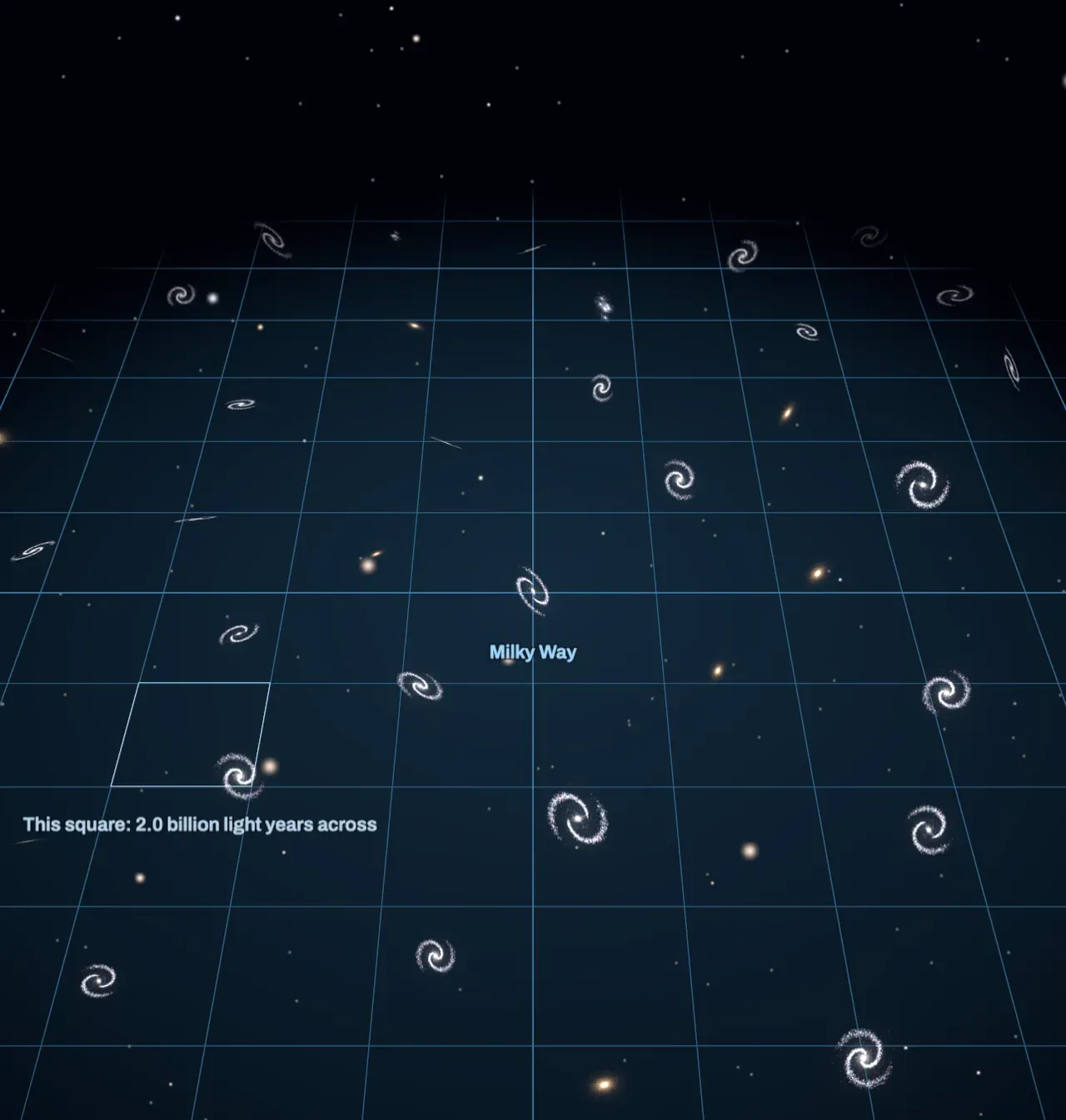
In the Scene there is a sheet of space with a grid and galaxies, today, billion years after the Big Bang. Show speeds and light has given each galaxy an arrow for its speed away from the Milky Way. Change Time since the Big Bang and watch the grid stretch.
Step 2 of 6
Hubble’s law
The arrows are longer the farther away the galaxy is, in direct proportion. This is Hubble’s law:
is called the Hubble constant. It is measured in kilometres per second per megaparsec, a million parsecs, about million light years. Time since the Big Bang is locked on today.
Step 3 of 6
Faster than light
By , as the distance grows the speed grows without limit.
Step 4 of 6
The Hubble time
Run the film backwards: if the galaxies are moving apart, once they were close together. Time since the Big Bang is locked, and Show speeds and light is at Galaxies.
Step 5 of 6
Stretched light
Show speeds and light now follows light from a marked galaxy, as a wave that stretches on the way. The redshift of distant galaxies is not the ordinary Doppler effect of a moving source: while the light is on its way, the space it travels through stretches, and its wavelength stretches with it.
Step 6 of 6
Speeding up
In 1998 two teams measured distant supernovae, and found them fainter than expected: the expansion is not slowing down, it is speeding up. Whatever causes this is called dark energy. In the Scene, the speeding up began about billion years after the Big Bang.
Loading the interactive version…
Loading the interactive version…
Each step sets up the Scene for you, and a control marked “fixed” stays put for that step.
Practice · Predict, then look
From our galaxy, the Milky Way, all the other galaxies seem to be moving away, the distant ones faster. We switch to watching from another galaxy, billion light years from us. What will we see from there?
Practice · Predict, then look
From our galaxy, the Milky Way, all the other galaxies seem to be moving away, the distant ones faster. We switch to watching from another galaxy, billion light years from us. What will we see from there?
Practice · Calculate
Today, by the Scene, kilometres per second per megaparsec. A galaxy is megaparsecs from us, about million light years. How fast is it moving away? Give the answer in kilometres per second.
Practice · Calculate
Today, by the Scene, kilometres per second per megaparsec. A galaxy is megaparsecs from us, about million light years. How fast is it moving away? Give the answer in kilometres per second.
Practice · Choose
By Hubble’s law, a galaxy more than about billion light years away is moving away from us faster than light. Does that contradict relativity?
Practice · Choose
By Hubble’s law, a galaxy more than about billion light years away is moving away from us faster than light. Does that contradict relativity?
Practice · Calculate
If the galaxies had always moved apart at the same speeds, how long ago would they all have been in one place? That time, , is called the Hubble time. Work it out in billions of years, with kilometres per second per megaparsec. One megaparsec is kilometres, and a year is seconds.
Practice · Calculate
Show speeds and light follows light that left the marked galaxy at a wavelength of 420 nm, violet. On its way to us space stretched, and its redshift is . At what wavelength does it arrive?
Practice · Calculate
Show speeds and light follows light that left the marked galaxy at a wavelength of 420 nm, violet. On its way to us space stretched, and its redshift is . At what wavelength does it arrive?
Practice · Predict, then look
Since about billion years after the Big Bang the expansion has been speeding up: every galaxy moves away from us faster and faster. What will happen to , the ratio of speed to distance, billion years from now?
Practice · Predict, then look
Since about billion years after the Big Bang the expansion has been speeding up: every galaxy moves away from us faster and faster. What will happen to , the ratio of speed to distance, billion years from now?
Lesson complete. Every practice question here is done.