Galaxies rushing away
In the 1910s the American astronomer Vesto Slipher measured the light of the faint spiral smudges then called nebulae. He spread their light into a spectrum and found the dark lines that elements such as calcium and hydrogen leave in it. In most of them the lines sat towards the red end, at longer wavelengths than in a laboratory lamp. A shift like that, a redshift, usually means the source is moving away, so most of the spirals were rushing away from us, some at more than a thousand kilometres a second.
By the end of the 1920s it was clear that the spirals are galaxies like our own, far outside the Milky Way. In 1927 the Belgian physicist and priest Georges Lemaître put the measured speeds together with rough distances and saw that the farther galaxies were moving away faster. Two years later Edwin Hubble showed the same pattern with better distances. A galaxy twice as far away recedes twice as fast:
This is the Hubble–Lemaître law, and , the Hubble constant, is the expansion rate today: about 70 kilometres per second for every megaparsec of distance (a megaparsec is 3.26 million light years). That is about 21 kilometres per second for every million light years. Measuring those distances is hard, and astronomers have built a ladder of methods to do it, from the parallax of nearby stars to exploding stars in faraway galaxies.
No centre and no edge
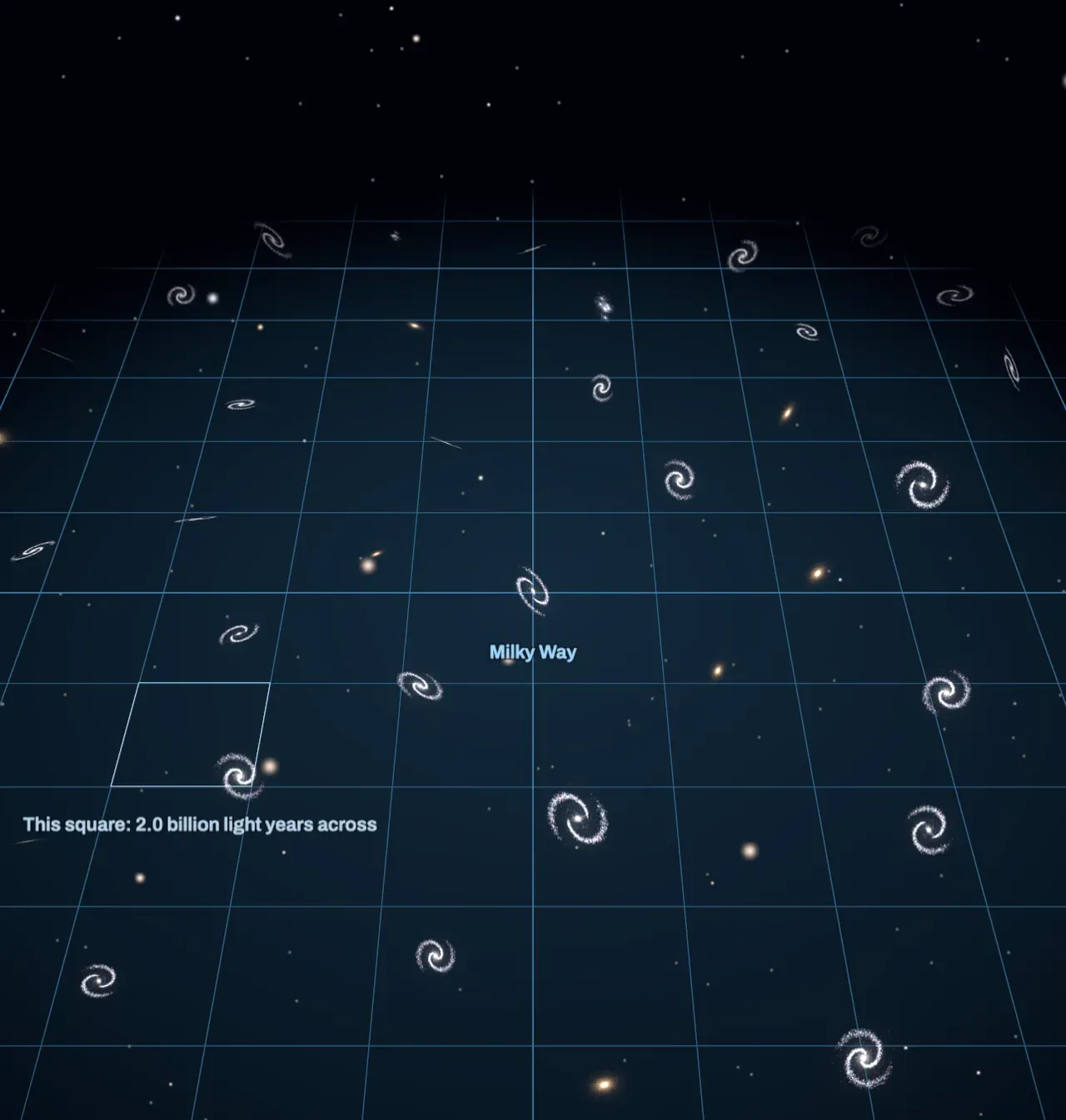
If everything is moving away from us, it is tempting to think that we sit at the middle of an explosion. We don’t. Picture a grid drawn on a rubber sheet with a coin glued at every few crossings. Stretch the sheet evenly and every coin moves away from every other. Whichever coin you stand on, the others recede, and those twice as far away recede twice as fast, because there is twice as much stretching sheet between you.
The universe works the same way. The galaxies are not flying through space away from one point. They stay roughly where they are, and the space between them grows. Every galaxy sees the same thing: all the others moving away, faster with distance. The expansion has no centre, and as far as anyone can tell the universe has no edge for it to spread into.
Try it: drag Time since the Big Bang from Young universe to Future. The grid’s squares grow, and the label under the highlighted square says by how much. Then set Watch from to Another galaxy. The sheet moves so that galaxy sits in the middle, and as you move time again everything spreads out from there instead, the Milky Way included.
Space stretches, galaxies don’t
The galaxies in the scene keep their size while the grid stretches. That is not a shortcut. Stars in a galaxy are held together by gravity, much more tightly than the slow stretching of space could pull them apart, so a galaxy does not grow. Neither does the Solar System, the Earth, or you. The Milky Way and its neighbour Andromeda are close enough that gravity is pulling them together, and they will merge in a few billion years. The expansion shows only between groups and clusters of galaxies, over many millions of light years.
The grid in the scene is fixed to the galaxies. Each galaxy keeps the same place on it, and the whole grid stretches by one number, the scale factor: how big the universe is compared with today. It is 1 today; it was 0.5 when every distance between distant galaxies was half what it is now.
Try it: slide Show speeds and light halfway, to the arrows. Each one shows a galaxy’s speed away from home to scale. They all point away from home, and the farther galaxies have the longer ones. The chart beside the scene puts them on one straight line.
Far enough away, the speed passes the speed of light. Today that happens at about 14 billion light years. Nothing breaks: no galaxy overtakes a light beam near it. The distance grows because space between grows, and Einstein’s speed limit is about moving through space, not about how fast space can stretch.
Light stretched on the way
Light travelling between galaxies crosses stretching space, and its waves stretch with it. If the universe grows by half while the light is travelling, every wave arrives half as long again as it left. Astronomers write the stretch as , where is the redshift:
So redshift is not quite the Doppler shift of a passing siren, whose pitch drops as it drives away. It is a record of how much the universe grew while the light was on its way. Light from nearby galaxies has had little time to stretch. Light from far away has been travelling for billions of years, through a universe that grew a lot meanwhile, so it arrives much redder. Blue light becomes red, red light becomes infrared, and the most distant galaxies known shine mostly in infrared by the time their light gets here.
Try it: slide Show speeds and light all the way to Speeds and light. Each galaxy takes on the colour its light has when it reaches home, and the farthest fade out. A wave runs from the marked galaxy to home: it sets off violet and short, and stretches and reddens as it comes. The label says how long the light was travelling.
The view also shows something easy to miss. The sheet is a snapshot of every galaxy at the same moment, which nobody could ever see. Light takes time to arrive, so we see each galaxy as it was when its light set off, and the farthest ones as they were billions of years ago. Early on, some galaxies were so far away that their light had not yet had time to reach us at all.
The most stretched light of all is the cosmic microwave background: it set off 380,000 years after the Big Bang as an orange glow and has been stretched about 1,100 times into microwaves.
Slowing down, then speeding up
For most of the universe’s history, the gravity of all the matter in it was slowing the expansion down, as a ball thrown upwards slows. Astronomers expected to measure how fast it was slowing. In 1998 two teams used exploding white dwarf stars in faraway galaxies to look back in time, and found the opposite: for the past six billion years or so, the expansion has been speeding up.
Whatever drives the speeding up is called dark energy. Little is known about it except that it seems to be part of space itself, the same in every cubic metre, so as space grows there is more of it and its push wins. Ordinary matter and the unseen dark matter that holds galaxies together thin out as space grows; dark energy does not. In the scene’s model the turn comes 7.6 billion years after the Big Bang.
Try it: watch the chart’s curve as you move Time since the Big Bang. It is steep and bending over at first, as gravity slows the growth. Past Speeding up starts it bends up. With the arrows showing, compare the marked galaxy’s speed at Speeding up starts and at Future: the same galaxy, moving away faster.
Running the film backwards
Run the expansion backwards and the galaxies crowd together, space shrinks, and everything grows hotter and denser. About 13.8 billion years ago the universe was so hot and dense that no atoms or stars could exist. That beginning, and the hot, expanding universe that came out of it, is what the Big Bang means. It was not an explosion at one point in space: it happened everywhere at once, and the glow left from it fills the whole sky.
Because light has had 13.8 billion years to travel while the universe kept stretching, the most distant places we can see are now about 46 billion light years away. That sphere is the observable universe. The universe probably goes on beyond it; we simply cannot see farther. For a sense of the sizes involved, from atoms up to that sphere, see the scale of the universe.
What this model leaves out
- The galaxies sit still in the grid. Real galaxies also move through space, a few hundred kilometres a second, as they fall towards their neighbours. That is why nearby Andromeda is coming towards us. Far away, the expansion swamps these motions.
- The sheet is flat and has no thickness. The real universe is three-dimensional; a slice through it shows the same pattern. Its geometry on the largest scales is measured to be flat, as here.
- The sizes are not to scale. Galaxies are drawn thousands of times larger than life, and each stands for a great many real ones; the part of the universe we can see holds hundreds of billions of galaxies.
- The colours are simplified. Each galaxy’s light is treated as a 6,500 K glow cooled by the stretch, which is exactly how a stretched glow behaves. Real galaxies have more complicated spectra, and they dim far more steeply with distance than shown. Galaxies whose light set off in the first 400 million years, when galaxies were only beginning to form, are hidden.
- The model is a fit. The scale factor follows the standard model with 31 % matter and 69 % dark energy, a Hubble constant of 67.7 km/s per megaparsec and an age of 13.8 billion years. Radiation, which mattered only in the first hundred thousand years or so, is left out. Measurements of the Hubble constant using nearby galaxies give about 73, a disagreement that is not yet understood.