Too fast at the edge
In the Solar System, almost all the mass is in the Sun, and the planets show what that does. Mercury, closest in, orbits at 48 km/s; the Earth at 30; Neptune, thirty times farther out, at only 5.4. The farther a planet is from the Sun, the weaker the Sun’s pull on it, and the slower it has to go to stay in orbit. Kepler’s laws describe that pattern exactly.
A spiral galaxy looks as if it should behave the same way. Its light is concentrated in a bright middle and fades steadily outwards, so if the mass follows the light, stars far from the centre should crawl round, like the outer planets. They don’t. In the 1970s Vera Rubin and Kent Ford measured the speeds of stars across the Andromeda galaxy and then across dozens of others, and found that beyond the middle the speeds stop rising and simply stay the same. Radio astronomers mapping the hydrogen gas in spirals found the same thing much farther out, well beyond the last visible stars.
A plot of orbital speed against distance from the centre is a galaxy’s rotation curve. The visible matter predicts a curve that rises and then falls. What is measured rises and then stays flat.
Weighing with an orbit
An orbit is a scale. A star going round a galaxy on a circle is held there by the pull of the mass inside its orbit, and that pull has to supply exactly the circular motion the star has. Setting the gravity of mass equal to the pull a circle needs gives
where is the star’s speed, the radius of its orbit and the gravitational constant. Measure a speed and a distance, and you have weighed everything inside the orbit. The Sun goes round the Milky Way at about 230 km/s, 26,000 light years from the centre, which puts about 100 billion Suns’ worth of mass inside its orbit.
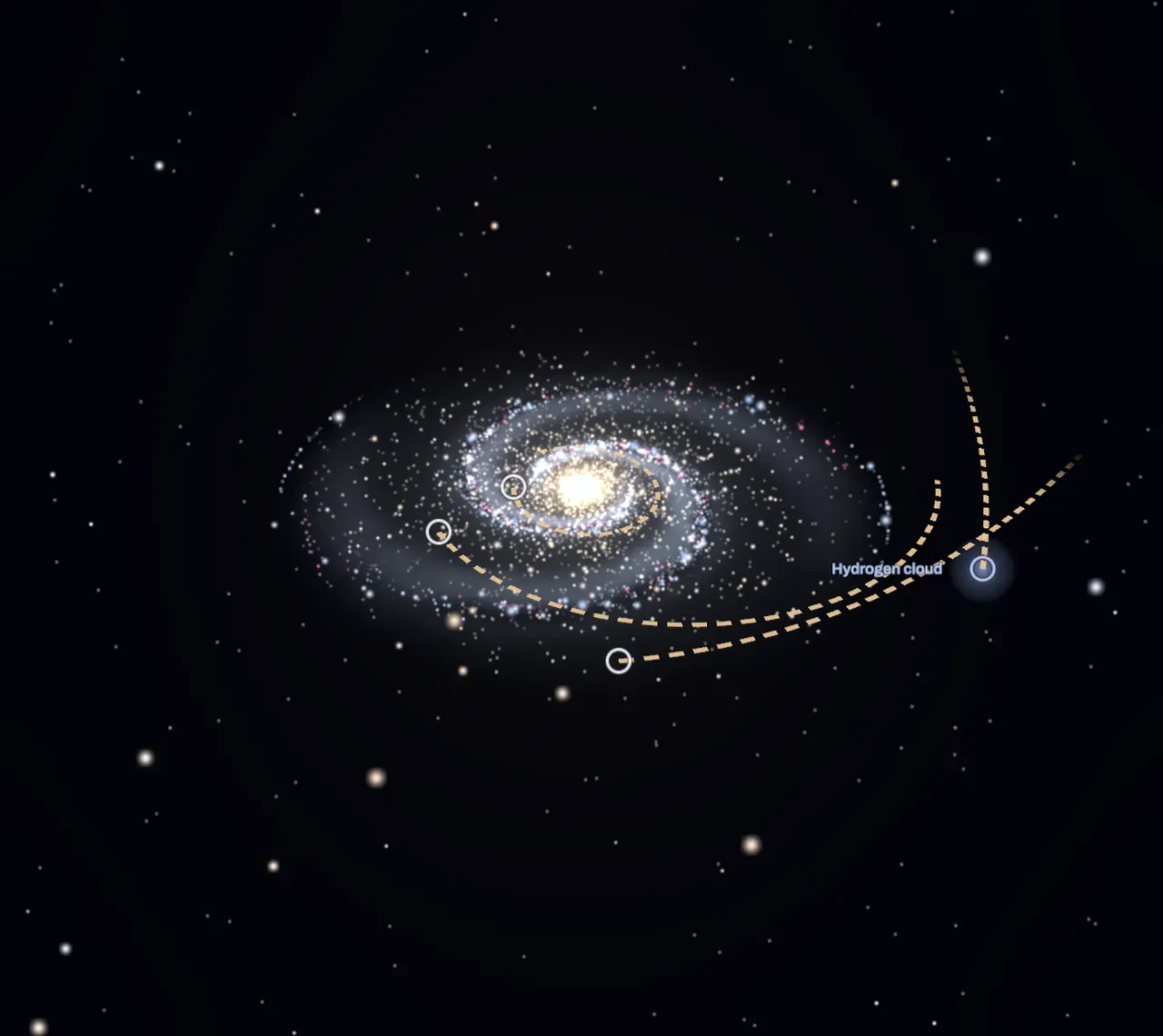
A flat rotation curve then says something startling. If stays the same as grows, the mass inside grows in proportion to the distance: twice as far out, twice as much mass inside, even where there is almost no starlight left to add. At the hydrogen cloud in the scene, 65,000 light years out and still moving at about 220 km/s, the mass inside comes to roughly 210 billion Suns, more than three times what all the stars and gas add up to.
Try it: with Dark matter in the halo at 0, only the visible stars and gas are pulling. The inner marked star’s dashed path bulges a little outwards; the outer ones swing far out or leave altogether, because they are moving too fast for that much mass to hold. Raise it to 250 billion Suns, and every path closes into the circle the star is really on. Push it to 600, and the paths dive inwards.
Why heavier stars won’t do
Astronomers estimate the mass of the stars from their light, and that estimate could be off: a galaxy might hold more faint, low-mass stars than its light suggests. So perhaps the visible matter is just heavier than thought.
That does not work, because the problem is the shape of the curve, not its height. Any mass that is concentrated where the light is pulls hard on the inner stars and weakly on the outer ones. Make it heavy enough to hold the edge and it grips the middle far too tightly.
Try it: set Dark matter in the halo to 0 and Stars and gas to 130 billion Suns, twice as much. The inner marked stars’ paths now dive inwards, while the hydrogen cloud still drifts away. At 195, three times as much, the cloud is held at last, but every star inside it plunges towards the middle. No setting of Stars and gas alone closes every path.
What does fit is extra mass spread far beyond the disc, in a roughly round halo whose density falls off as the square of the distance far out. Such a halo adds mass in proportion to radius, which is exactly what a flat curve needs. In the scene the halo holds about 70 % of the mass inside the cloud’s orbit, and real halos reach out much farther still. Because no light comes from it, it is called dark matter.
How the speeds are measured
No one can watch a star go round a galaxy: one turn takes hundreds of millions of years. The speeds come from light instead, through the Doppler effect. Atoms absorb and give off light at exact wavelengths, which show up as lines in a spectrum. Light from something moving towards us arrives squeezed to slightly shorter wavelengths, and from something moving away, stretched to slightly longer ones. The size of the shift gives the speed along the line of sight.
A spiral seen at a tilt has one side turning towards us and the other turning away, so the lines on one side are shifted to the blue and on the other to the red. Correcting for the tilt turns those shifts into orbital speeds. For stars, astronomers use the dark lines in starlight. For the gas beyond the stars, they use the radio line of cold hydrogen at a wavelength of 21 cm, which reaches much farther out than starlight does and is what showed that the curves stay flat beyond the visible edge.
Try it: slide Show the speeds halfway. Every star and the hydrogen gas take the colour of their motion along your line of sight, blue on the side coming towards you and red on the side going away. The faint lines across the gas join points with the same speed towards or away from you; orbit the view and watch the colours follow your eye. Then slide it to Speeds: each marked star gets its measured speed and the speed your chosen mass could hold, side by side, and the chart beside the scene fills in with measurements that stay flat.
What dark matter might be
Rotation curves are only one of many clues. In 1933 Fritz Zwicky found that the galaxies in the Coma cluster move far too fast to be held together by the light he could see. Clusters of galaxies bend the light of galaxies behind them more strongly than their visible mass can explain. And the pattern of hot and cold spots in the cosmic microwave background can only be matched if, in the young universe, there was about five times as much dark matter as ordinary matter, the same matter whose pull later slowed the expansion of the universe.
The early universe also fixes how much ordinary matter there can be, and it is far too little, so dark matter cannot be faint stars, dead stars or cold gas. Searches for dark objects such as black holes in the Milky Way’s halo have ruled out most of it. The favourite idea is a kind of particle that feels gravity but not light, perhaps a heavy one or an extremely light one called an axion. Detectors deep underground and experiments at particle colliders have looked for one for decades. None has been found.
A minority of physicists think the answer is not unseen mass but gravity itself behaving differently at the tiny accelerations of a galaxy’s edge. In 1983 the Israeli physicist Mordehai Milgrom proposed such a change, called MOND, and it matches many rotation curves strikingly well. It has much more trouble with galaxy clusters, with collisions between clusters where the bending of light is offset from the visible gas, and with the microwave background. Most astronomers therefore think dark matter is real stuff, but what it is remains one of the biggest open questions in physics.
What this model leaves out
- The measurements are illustrative. The measured points come from the same kind of model as the curves, a galaxy with 65 billion Suns of stars and gas and 250 billion of dark matter inside 100,000 light years, plus a few km/s of scatter. They are shaped like a real rotation curve, not taken from one.
- The masses are simple shapes. The visible matter is a small round bulge and a thin disc whose density falls off exponentially; the halo is a round cloud with a soft core. Computer simulations of dark matter give halos that keep getting denser right into the middle, and which kind real galaxies have is still argued about.
- The paths are a thought experiment. Each dashed path keeps a marked star’s measured speed and lets it feel only the mass you set, pulling as if it were all at the centre of a sphere. A star in a real disc also feels the tug of nearby arms, and a hypothesis is counted as holding a star when the speed it allows is within 7 % of the measured one.
- The stars go round on perfect circles. Real stars wander in and out and up and down by tens of km/s. The arms are drawn as a pattern that turns slower than the stars: young blue stars are born in it and fade before they drift far, which is roughly how real spiral arms work.
- The Doppler colours are exaggerated. A star moving at 220 km/s shifts its light by less than a thousandth of its wavelength, far too little to see by eye; instruments measure it from the lines in a spectrum.
- The sizes are squeezed. The galaxy has a few thousand stars instead of a few hundred billion, and the halo, which in reality reaches several times farther than drawn, is cut off at the edge of the view.