Not quite a circle
For two thousand years astronomers assumed that the planets moved on circles, at steady speeds, because the circle seemed the perfect shape for the heavens. The trouble was that the planets refused to cooperate. Mars in particular kept turning up in the wrong place by amounts that careful observers could measure.
The Danish astronomer Tycho Brahe spent twenty years measuring the positions of the planets, with the best instruments ever built before the telescope. When he died in 1601, his assistant Johannes Kepler inherited the records and set out to find the orbit of Mars. After years of failed circles he tried an ellipse, and everything fitted. He published the result in 1609.
The first law: an ellipse with the star at a focus
An ellipse is a stretched circle. Every ellipse has two special points inside it, its foci: for every point on the curve, the distances to the two foci add up to the same total. You can draw one with two pins, a loop of string and a pencil.
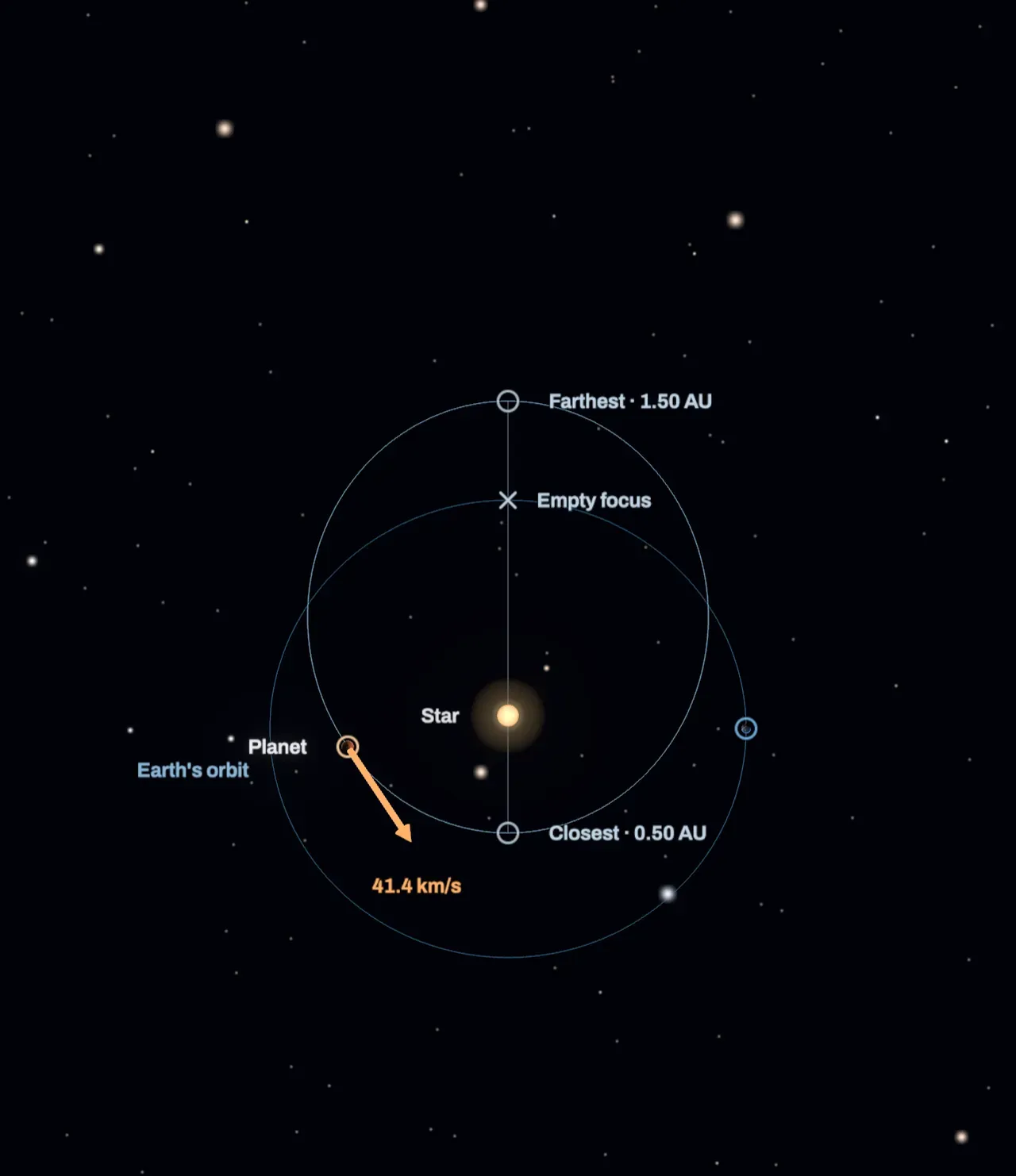
Kepler’s first law says that each planet moves on an ellipse with the Sun at one focus. The other focus is empty. Nothing is there; it is just a point of the geometry, marked with a cross in the scene.
How stretched an ellipse is is measured by its eccentricity, the distance from the centre to a focus divided by the half-length of the long axis. A circle has eccentricity 0, and the two foci merge at its centre. As the eccentricity rises towards 1 the ellipse grows long and thin and the star sits ever nearer one end. The closest point to the star is the perihelion and the farthest the aphelion. For an orbit of half-length and eccentricity they are and .
The planets’ orbits are very nearly circles. Earth’s eccentricity is 0.017: we are 147 million kilometres from the Sun in early January and 152 million in early July, a difference you could not see in a drawing. Mercury’s orbit, at 0.21, is the most stretched of the eight. Comets, which fall in from far away, can have eccentricities of 0.99 or more.
The second law: equal areas in equal times
The planet does not keep a steady speed. It is fastest at perihelion and slowest at aphelion. Kepler found the rule that ties its speed to its place: the line from the star to the planet sweeps out equal areas in equal times. Close to the star the line is short, so the planet must cover a lot of ground to sweep a given area. Far away the line is long, and a short step sweeps the same area.
At the two ends of the orbit this gives a simple result. The speed times the distance is the same at both ends, so the planet is faster at perihelion by the ratio of the two distances, . Earth is about 3 % faster in January than in July. A planet with eccentricity 0.5 goes three times as fast past the star as it does at the far end.
Try it: set Eccentricity to Comet Tempel 1 and watch the speed arrow grow as the planet swings round the star. Then slide Show equal areas halfway: the shaded wedge is what the planet has swept in the last twelfth of its year. It is long and thin far out and short and wide close in, and its area never changes. Slide on to Equal areas to see the whole orbit cut into twelve equal times.
The chart beside the scene measures it. For each twelfth of the year, the Path covered bar shows how much of its path the planet travelled and the Area swept bar how much area its line to the star swept. The path changes several times over; the area does not change at all.
Why the areas are equal
The second law is not special to gravity. It holds for anything pulled straight towards a fixed point. The pull can speed the planet up or slow it down along its path, but it never pushes sideways round the star, so it cannot change how fast the line to the star sweeps. Physicists call that sweeping rate, multiplied by the mass, the planet’s angular momentum, and a pull aimed at the centre leaves it unchanged. It is the same rule that makes a skater spin faster when she pulls her arms in: see angular momentum and gyroscopes.
So as the planet falls inwards towards perihelion, gravity pulls partly along its path and speeds it up, and the line to the star shortens. As it climbs back out, gravity pulls partly backwards, slowing it, and the line grows long. The area swept each day stays exactly the same.
The third law: bigger orbits, longer years
Ten years after his first two laws, Kepler found a rule linking the planets to one another. The square of a planet’s year is proportional to the cube of its orbit’s size. Measured in Earth years and in astronomical units (AU, the average Earth–Sun distance, about 150 million kilometres), it becomes simply:
where is half the long axis of the ellipse, the average of the closest and farthest distances. Mars, at 1.52 AU, takes years to go round. Mercury, at 0.39 AU, takes 0.24 years, or 88 days.
A bigger orbit takes longer for two reasons: the planet has farther to go, and the star’s pull out there is weaker, so it moves more slowly. The eccentricity does not come into it at all. Two orbits of the same size take the same time, however stretched one of them is.
Try it: change Size of the orbit and watch the Earth on its faint 1 AU ring. Pick Mercury and the planet goes round about four times while the Earth goes round once. Pick Mars and the Earth laps it. Now change Eccentricity with the size fixed: the shape changes, but the year in the chart’s title does not.
From Kepler to Newton
Kepler described how the planets move but could not say why. In 1687 Isaac Newton showed that all three laws follow from one idea: a pull towards the Sun that weakens with the square of the distance, the same gravity that makes an apple fall. Newton also found that orbits need not be ellipses. A body moving fast enough follows a parabola or a hyperbola and escapes for good; all of them are conic sections, the curves made by slicing a cone.
Kepler’s laws work far beyond the Solar System. Moons follow them round planets, satellites round the Earth, and planets round other stars, which is how astronomers weigh a distant star from the year of its planet, as in exoplanets. Comets on long ellipses show the second law at its most extreme: Halley’s comet spends about 75 years on each orbit, but only a few months of them anywhere near the Sun.
What this model leaves out
- The star does not move. Strictly, the star and planet both orbit their shared centre of mass, and the third law includes the planet’s mass. For a planet the size of Earth round a star like the Sun the difference is about three parts in a million, far too small to see.
- There is only one planet. Real planets tug on each other, so their ellipses slowly turn and change shape over thousands of years. Mercury’s ellipse also turns a little faster than Newton predicts, by an amount that Einstein’s general relativity explained in 1915.
- The sizes are not to scale. The star is drawn about ten times larger than life, and the planets hundreds of times larger, so you can see them. The distances, the shape of the orbit and the speeds are true.
- Time is sped up. One Earth year passes in 8 seconds. The relative speeds, and the times the planet and the Earth take to go round, are correct.
- The orbit is flat. Real orbits are tilted a little to one another; here everything lies in one plane.