Pull in, spin faster
A figure skater starts a spin with her arms held wide, turning about once a second. Then she draws her arms in to her chest, and within a moment she is a blur. Nobody pushed her. The ice under a sharp blade barely grips, so nothing outside her made her faster. Top skaters reach more than five turns a second this way.
The same trick works anywhere something turns freely. A diver tucks into a ball to somersault quickly and stretches out to slow down before entering the water. A cat dropped upside down twists itself round by tucking some legs and stretching others. Sit on a spinning office chair holding two heavy books out at arm’s length, pull them in, and you will feel it yourself.
Angular momentum: how much turning there is
A spinning thing carries a quantity called angular momentum, usually written L. It depends on two things. One is how fast the object spins, its angular velocity ω. The other is how its mass is spread around the line it turns about, its moment of inertia I. Mass far from that line counts for much more than mass close in: a kilogram held 80 cm from the line counts sixteen times as much as the same kilogram held 20 cm from it, because what matters is the distance squared. Angular momentum is the product of the two: L = I × ω.
The rule is that angular momentum stays the same unless something outside twists the object. That twist is called a torque. A skater on smooth ice has nothing twisting her, so her L is fixed. When she pulls her arms in, her moment of inertia falls, and her spin has to rise by exactly the same factor to keep the product unchanged.
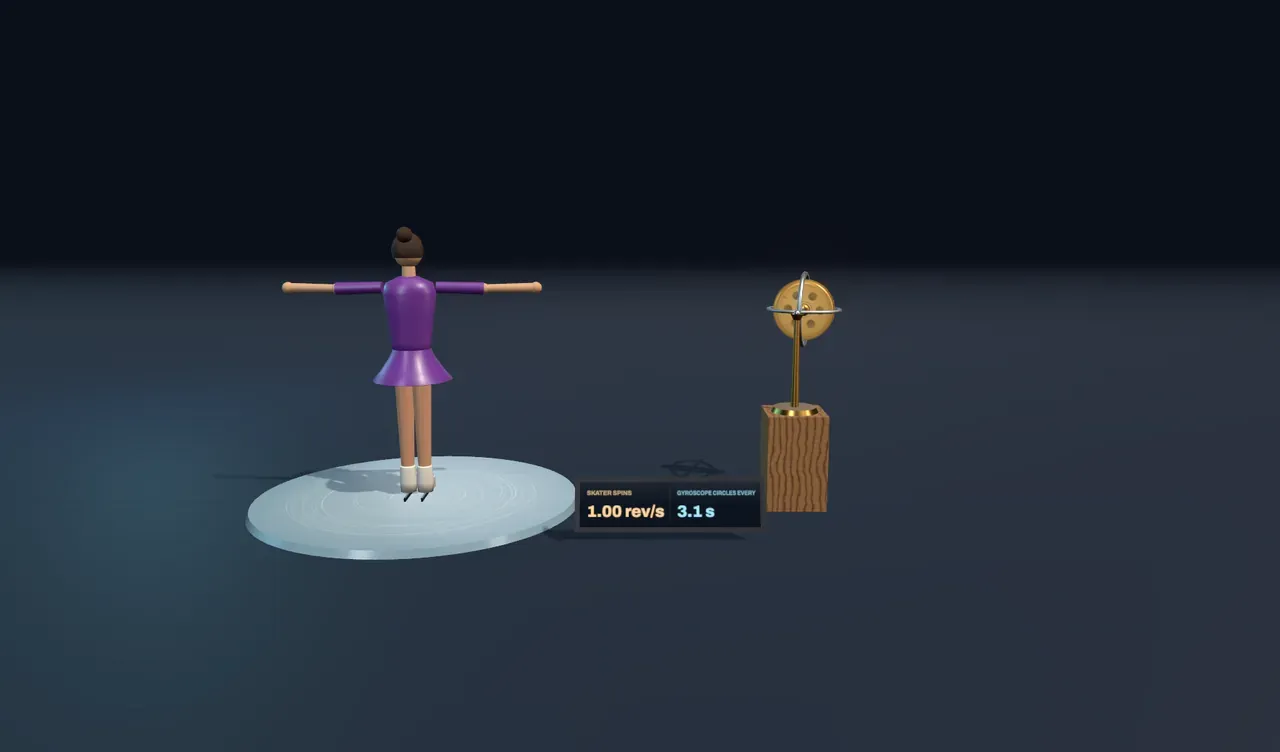
Try it: slide Arm reach down to 0.15 m. The skater’s moment of inertia drops from 2.6 to 1.0 kg·m², and the readout climbs from 1.0 to 2.6 turns a second.
Her energy does not stay the same, though. The energy of a spin is L² ÷ 2I, so with the same L and a smaller I she ends up with about two and a half times the energy she started with, roughly 80 joules more. It comes from her own muscles. Pulling a spinning arm inward takes effort, because the arm keeps trying to fly outward, and that work turns into faster spin.
A gyroscope that will not fall
Rest one end of a gyroscope’s axle on a stand and let go. If the wheel is not spinning, it simply tips over, as you would expect: gravity pulls the far end down. If the wheel is spinning fast, something strange happens. The axle stays almost level and swings slowly round the stand in a horizontal circle. That sideways circling is called precession.
The same rule explains it. Gravity pulling down on the wheel, with the stand pushing up at the pivot, makes a torque. A torque does not set a direction of motion. It changes the angular momentum, and the change points the same way as the torque. Here the torque points sideways, level with the floor and at right angles to the axle. The spinning wheel’s angular momentum points along the axle, so each moment gravity adds a little sideways angular momentum to it. The axle’s direction swings sideways rather than down, and it keeps swinging round as long as the wheel spins.
The faster the wheel spins, the more angular momentum it has, and the smaller the swing that the same torque produces. Doubling the spin halves the circling rate. For a fast wheel the rate is the torque divided by the angular momentum: Ω = M g ℓ ÷ (I ω), where M is the wheel’s mass, g is gravity, ℓ is the distance from the pivot to the wheel and I ω is the wheel’s angular momentum.
Try it: set Gyroscope spin to 3,000 rpm and the gyroscope circles its post every 3.1 seconds. At 6,000 rpm it takes 6.2 seconds. At 800 rpm it sags about 19° and races round in under a second. At 0 it falls against the post.
Choose On under Show angular momentum to see the arrows. The skater’s arrow points straight up her spin axis and stays the same length whatever her arms do, while the numbers above her trade I against ω. On the gyroscope, the blue arrow along the axle is its angular momentum, the orange arrow is its weight, and the violet arrow at the pivot is the twist that weight makes. The blue arrow’s tip always moves the way the violet arrow points, which carries it round the circle.
Why it does not quite stay level
Let go of the gyroscope and it does not start circling at once. At first it drops a little, because nothing is yet moving it sideways. That small drop is what gets the circling going, and the axle overshoots and bobs up and down a few times as it settles. This bobbing is called nutation. In the scene a little friction at the pivot calms it within a second or two, as happens with a real toy. For a fast wheel the bobbing is a buzz you can barely see; for a slow one it throws the axle into wide loops.
Spin that holds steady
Angular momentum changes only when something twists it, so a fast spinning object is hard to turn. A spinning top stays up, a thrown frisbee keeps its tilt, and a rifle bullet spins so that it flies point first. Spacecraft use spinning wheels inside them to turn and hold steady without burning fuel, and the Hubble Space Telescope senses its slightest rotation with gyroscopes.
The Earth itself is a spinning top. It bulges slightly at the equator, and the pull of the Sun and the Moon on that bulge makes a torque. As a result the Earth’s axis precesses, tracing out a circle in the sky about once every 26,000 years. The pole star today, Polaris, will not stay the pole star.
What this model leaves out
The skater’s ice has no friction at all, so her spin never fades. A real skater slows within seconds and pushes off again. Her body is treated as rigid apart from her arms, which are modelled as two uniform rods. Real skaters also pull in a raised leg, which is how they reach their fastest spins.
The gyroscope’s wheel also never slows, so it circles forever. A real one loses spin to friction in its bearings, its circling speeds up, and its dip grows until it falls. The scene adds a little friction at the pivot only to calm the bobbing. Beside the skater, the gyroscope is drawn about six times too big, and its wheel turns on screen 25 times slower than it really spins, because the true spin would only flicker. Its angular-momentum arrow starts beyond the end of the axle so that the wheel does not hide it, though in the physics it belongs at the pivot.