Lesson 5 of 5
Angular momentum: a skater and a gyroscope.
A spinning body keeps its angular momentum, L = Iω, as long as no torque acts on it: a skater who pulls in her arms and spins faster, the energy she adds, and a gyroscope that circles its stand instead of falling.
Step 1 of 6 · Pulling in
Step 1 of 6
Pulling in
A body moving on a circle needs a force pulling it towards the centre. A body spinning about itself raises a new question: what keeps the spin going, and what changes it? A skater on ice is a good example. The blade is sharp and the ice smooth, so almost nothing outside pushes or brakes her.
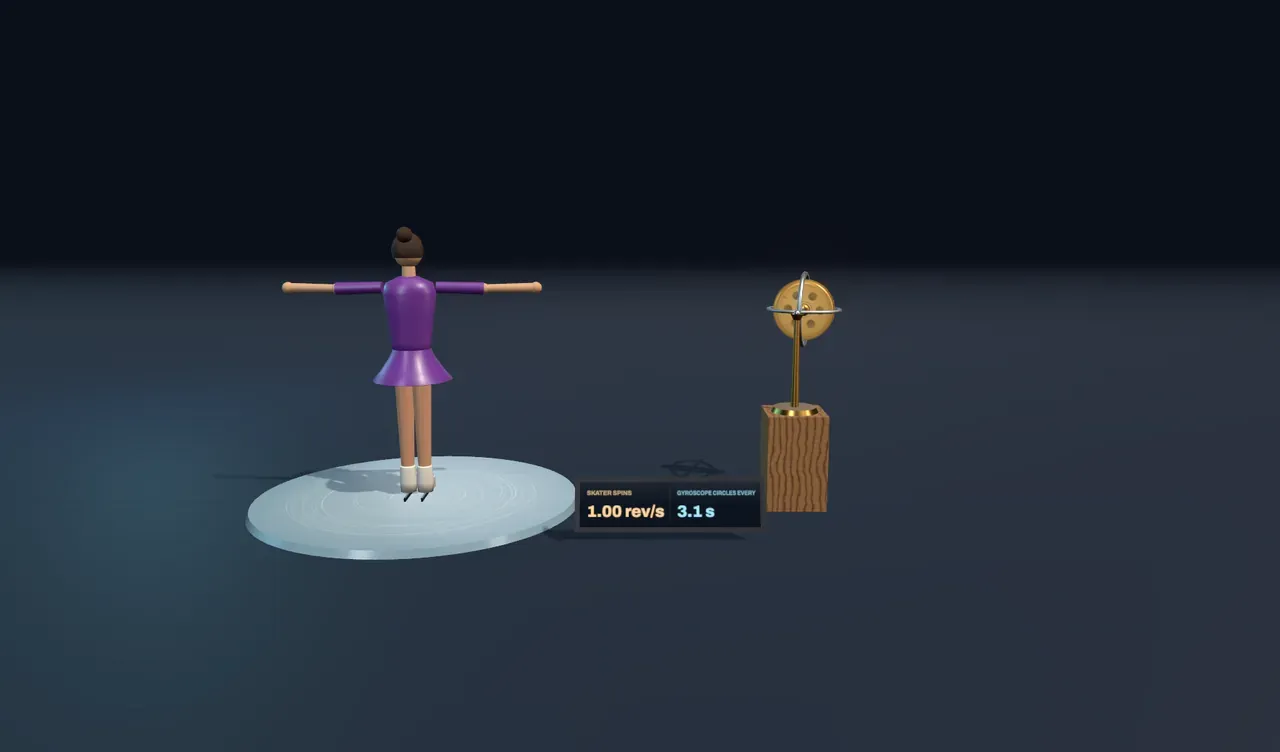
She starts with her arms out, Arm reach 0.8 m from the axis, turning about once a second. Predict what will happen when she pulls them in, then look.
Step 2 of 6
The moment of inertia
A spinning body has angular momentum, . It depends on two things: how fast the body turns, its angular velocity , and how its mass is spread around the axis, its moment of inertia . Mass far from the axis counts for much more than mass close in: by the square of the distance. So
Angular momentum is kept unless something outside twists the body. Such a twist is called a torque. With Show angular momentum set to On, the board above the skater shows , and their product. Gyroscope spin is fixed.
Step 3 of 6
The energy of the spin
The angular momentum is kept, but the energy is not. The energy of a spin is
so with fixed and smaller, the energy grows. Her arms are tucked now, and Arm reach is fixed.
Step 4 of 6
The gyroscope
Beside the skater stands a gyroscope: a heavy brass wheel on an axle, with one end of the axle resting on a stand. When the wheel is not spinning, what you expect happens: gravity pulls the far end down, and the gyroscope falls against the post. Predict what will happen when the wheel spins fast.
Step 5 of 6
The rate of precession
The wheel’s weight and the stand’s push make a torque about the pivot, pointing level, at right angles to the axle. A torque does not set a direction of motion: it changes the angular momentum, and the change points the same way as the torque. So the blue arrow, the angular momentum, always moves the way the violet arrow, the torque, points, and the axle goes round the stand.
For a fast wheel the rate is the torque divided by the angular momentum:
Here is the wheel’s mass, its distance from the pivot, and its angular momentum.
Step 6 of 6
A slowing wheel
At 800 rpm, the gyroscope already dips and wobbles before it settles, and goes round the stand quickly. A real gyroscope loses spin to friction in its bearings. The Earth is a spinning top too: the pull of the Sun and the Moon on its bulge at the equator makes a torque, and its axis traces a circle in the sky about once every 26,000 years.
Loading the interactive version…
Loading the interactive version…
Each step sets up the Scene for you, and a control marked “fixed” stays put for that step.
Practice · Predict, then look
The skater spins with her arms out, about one turn a second. The ice is smooth and nobody pushes her. What will happen when she pulls her arms in to her body?
Practice · Predict, then look
The skater spins with her arms out, about one turn a second. The ice is smooth and nobody pushes her. What will happen when she pulls her arms in to her body?
Practice · Reach the target
With her arms out, 0.8 m from the axis, the skater turns once a second. Change Arm reach until she turns exactly twice as fast, 2 Hz, and press Check.
Practice · Reach the target
With her arms out, 0.8 m from the axis, the skater turns once a second. Change Arm reach until she turns exactly twice as fast, 2 Hz, and press Check.
Practice · Calculate
Her arms are tucked, and the board shows and . The energy of a spin is . How much energy does the skater’s spin have now?
Practice · Calculate
Her arms are tucked, and the board shows and . The energy of a spin is . How much energy does the skater’s spin have now?
Practice · Predict, then look
The gyroscope is not spinning, with one end of its axle resting on the stand: it has fallen against the post. What will happen if the wheel spins at 3000 rpm and the gyroscope is let go with its axle level?
Practice · Predict, then look
The gyroscope is not spinning, with one end of its axle resting on the stand: it has fallen against the post. What will happen if the wheel spins at 3000 rpm and the gyroscope is let go with its axle level?
Practice · Predict, then look
At 3000 rpm the gyroscope goes round its stand once every 3.1 s. How long will one circle take at 6000 rpm?
Practice · Predict, then look
At 3000 rpm the gyroscope goes round its stand once every 3.1 s. How long will one circle take at 6000 rpm?
Practice · Choose
In a real gyroscope, friction in the bearings slowly slows the wheel. What happens to the precession as the wheel slows?
Practice · Choose
In a real gyroscope, friction in the bearings slowly slows the wheel. What happens to the precession as the wheel slows?
Lesson complete. Every practice question here is done.