A shadow too small to see
Even the nearest stars are so far away that a planet beside one is lost in its glare. The first planet found around a Sun-like star, 51 Pegasi b, was announced in 1995, and today more than 6,000 are known. Hardly any of them have been photographed. Most were found by watching the star.
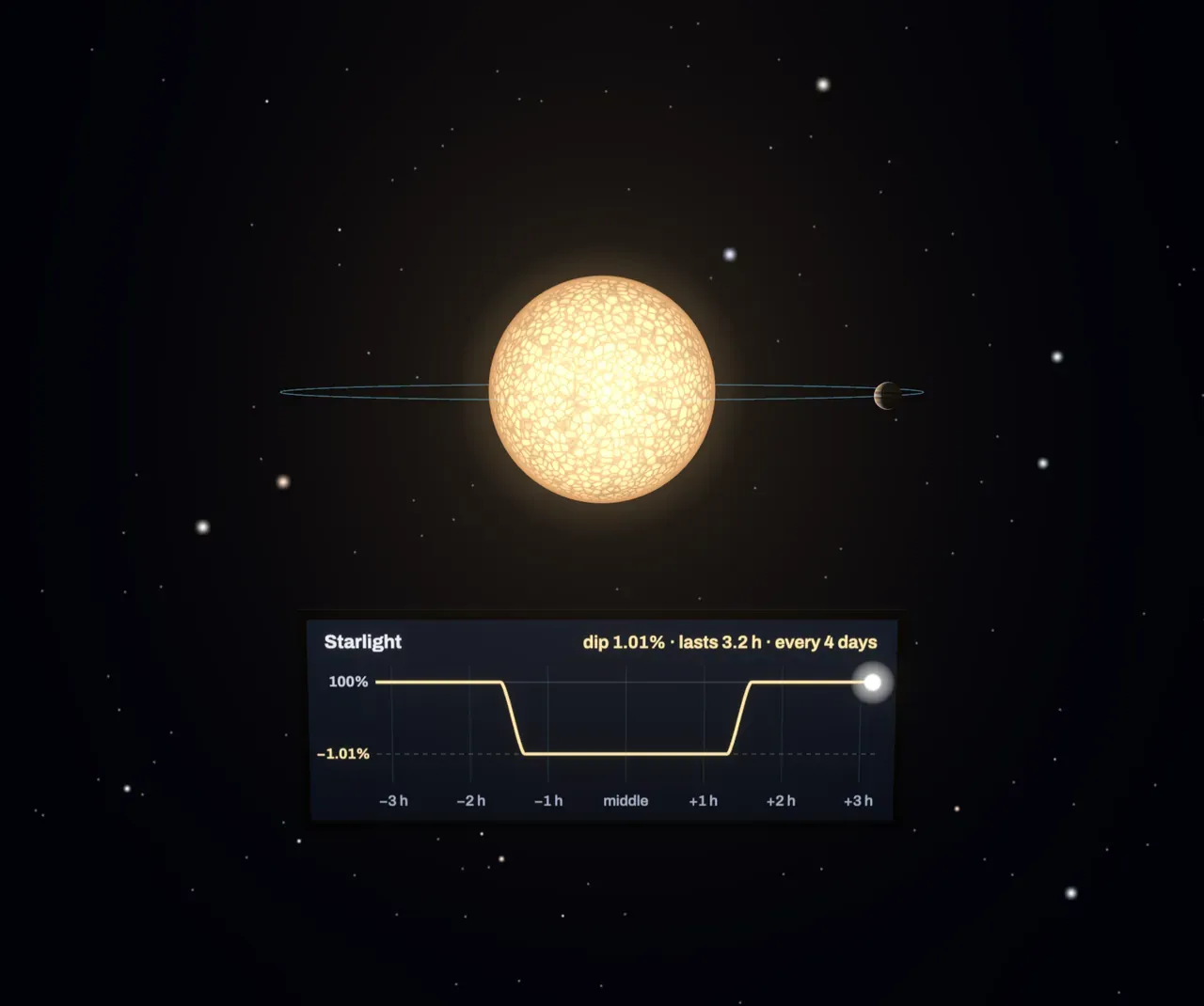
One method waits for a transit: the moment a planet passes between its star and us. The planet is far too small to see as a dot, but it blocks a little of the starlight, and a sensitive telescope measures the star’s brightness getting slightly lower, staying low for a few hours, then recovering. Repeat that dip on a regular schedule and you have found a planet.
How deep the dip goes
A planet in front of a star covers a small disc of it. The fraction of light lost is the planet’s area divided by the star’s: the ratio of their radii, squared. Jupiter is about a tenth as wide as the Sun, so it would block about one per cent of the light. The Earth is about a hundredth as wide, so it would block about 84 parts per million, less than a hundredth of a per cent. Seen from far away, our own planet would be a dip almost too faint to measure.
Try it: choose Jupiter, then Neptune, then Earth, and watch the floor of the dip on the plot rise toward the top line. Then slide Orbit tilt to 86° and choose Earth for the orbit size: the planet slips past above the star and the dip vanishes.
How long, and how often
Two more numbers come from the same curve. The time between dips is the planet’s year. The length of the dip is the time the planet takes to cross the star’s face. By Kepler’s law a planet close to its star moves fast and goes round quickly. A hot Jupiter at a twentieth of Earth’s distance from the Sun circles in about four days and crosses in about three hours. An Earth twin crosses in about thirteen hours, but only once a year, so confirming it takes years of patient watching.
Lining up
A transit only happens if we see the orbit almost exactly edge-on. Turn the scene to look from above and the reason is plain: only a thin strip of the orbit lies between the star and our telescope. The wider the orbit, the more precisely it has to line up. For a planet like the Earth the chance is about one in 200, so for every Earth-like planet that transits, a couple of hundred more pass unseen. Telescopes like Kepler, which stared at about 150,000 stars for years, found thousands of planets by watching enough stars that some of them had to line up.
Starlight through air
When a planet with an atmosphere passes in front, a thin ring of starlight shines through its air on the way to us. Gases absorb particular colours, so the ring is a little darker at some colours than others. By measuring the dip colour by colour, astronomers can tell which gases a distant world’s air holds. The James Webb Space Telescope has found carbon dioxide and water vapour this way on planets hundreds to more than a thousand light years away.
What the model leaves out
The telescope in the scene sees the star as a disc; a real one sees a single point and measures only its total brightness, with noise from the star’s own flickering and from the instrument. Real stars are darker toward their edges, which rounds the bottom of the dip. The star here is like the Sun, and the planet’s orbit is a perfect circle. Many planets are also found by other means, such as the slight wobble a planet’s pull gives its star.