How to find a planet you cannot see: the shadow it casts on its star’s light. How deep the dip is, how often it comes back, and why the orbit has to be seen almost edge-on.
Step 1 of 9 · A shadow too small to see
Step 1 of 9
A shadow too small to see
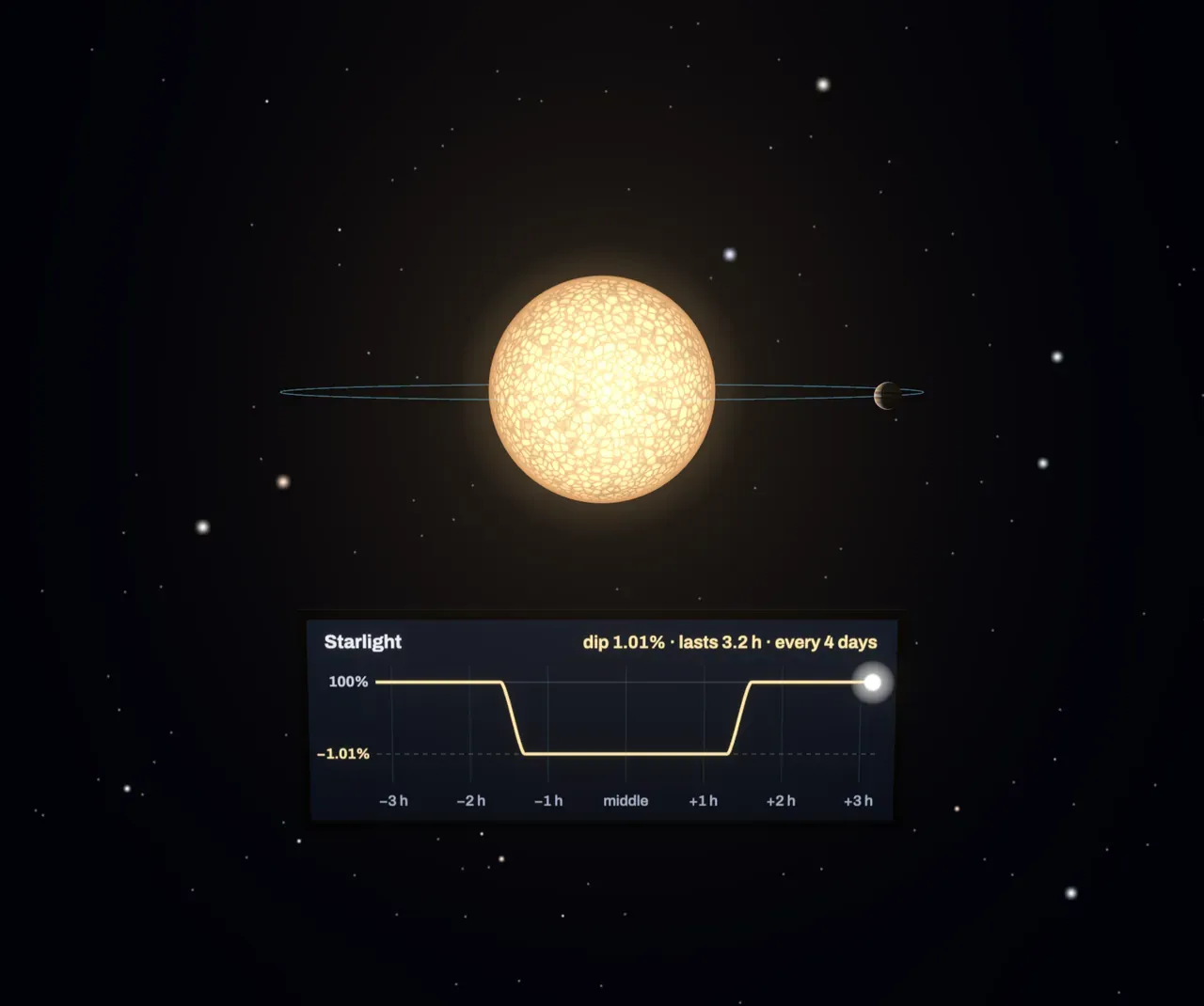
A planet round another star is billions of times fainter than its star, and you cannot see it in the glare. But if its orbit is seen from the Earth almost edge-on, once each lap it passes in front of the star and hides a small part of its disc. That is a transit. The plot below the Scene shows the star’s light over time, and the dip in it gives the planet away. Most of the thousands of known planets were found this way.
Step 2 of 9
An Earth-sized planet
The depth of the dip tells how big the planet is compared with its star. Predict what will happen when we shrink it to the size of the Earth.
Step 3 of 9
How often
View from above turns the system to show the orbit from above, with an arrow towards the telescope. The time between two dips is the planet’s year, and from it Kepler’s third law gives the size of the orbit. For a Sun-like star, as in the Solar System.
Step 4 of 9
Lining up
A transit shows only when the Earth lies almost in the plane of the orbit. Orbit tilt is the angle between the orbit’s axis and our line of sight: degrees means exactly edge-on.
Step 5 of 9
Close to the star
The first surveys found mostly hot Jupiters, gas giants hugging their stars, although they are not the most common kind. Part of the reason is geometry. Change the size of the orbit and find when the planet crosses the star again.
Step 6 of 9
The size from the dip
Astronomers do not see the planet itself, only the drop in the light. From the drop they find how big it is compared with its star.
Step 7 of 9
How long it lasts
The dip in the light is not only deep or shallow: it also has a length. The planet crosses the disc at its orbital speed, so the transit’s length tells how fast it moves.
Step 8 of 9
Not through the middle
When the orbit tilts a little, the planet crosses the disc above or below its middle. The distance from the middle, in star radii, is called the impact parameter : through the middle, and near at the edge.
Step 9 of 9
What are the odds
Under View from above you see the orbit and the arrow to the telescope. If the orbit is tilted at random, it crosses the star only when it lines up almost exactly with us.
Loading the interactive version…
Loading the interactive version…
Each step sets up the Scene for you, and a control marked “fixed” stays put for that step.
Practice · Calculate
Planet size is locked at Earth radii, like Jupiter, and the star is like the Sun, Earth radii across its radius. What percentage of the starlight does the planet block while it is wholly in front of the disc?
Practice · Calculate
Planet size is locked at Earth radii, like Jupiter, and the star is like the Sun, Earth radii across its radius. What percentage of the starlight does the planet block while it is wholly in front of the disc?
Practice · Predict, then look
The Earth’s radius is times smaller than Jupiter’s. When you choose Earth for the planet size, by how many times will the dip in the light shrink?
Practice · Predict, then look
The Earth’s radius is times smaller than Jupiter’s. When you choose Earth for the planet size, by how many times will the dip in the light shrink?
Practice · Calculate
Orbit size is locked at AU, a “hot Jupiter” hugging a Sun-like star. By ( in years, in AU), how many days does a year on this planet last?
Practice · Calculate
Orbit size is locked at AU, a “hot Jupiter” hugging a Sun-like star. By ( in years, in AU), how many days does a year on this planet last?
Practice · Predict, then look
Orbit size is AU, like the Earth’s, and the orbit is seen exactly edge-on. What will happen to the dip when Orbit tilt changes by just degree, to degrees?
Practice · Predict, then look
Orbit size is AU, like the Earth’s, and the orbit is seen exactly edge-on. What will happen to the dip when Orbit tilt changes by just degree, to degrees?
Practice · Reach the target
Orbit tilt is locked at degrees, and the planet at AU misses the star. Change Orbit size until there is a transit again, and press Check.
Practice · Reach the target
Orbit tilt is locked at degrees, and the planet at AU misses the star. Change Orbit size until there is a transit again, and press Check.
Practice · Calculate
Planet size is hidden. While the planet is wholly in front of the star, the light drops by 1.0%. What is the ratio of the planet’s radius to the star’s, ?
Practice · Calculate
Planet size is hidden. While the planet is wholly in front of the star, the light drops by 1.0%. What is the ratio of the planet’s radius to the star’s, ?
Practice · Calculate
A “hot Jupiter” 11 Earth radii across its radius, about 70,000 km, circles a star like the Sun, 695,700 km in radius, at 0.05 AU, and its year lasts 4.08 days. The orbit is seen exactly edge-on. How many hours does the transit last, from first contact to last?
Practice · Calculate
A “hot Jupiter” 11 Earth radii across its radius, about 70,000 km, circles a star like the Sun, 695,700 km in radius, at 0.05 AU, and its year lasts 4.08 days. The orbit is seen exactly edge-on. How many hours does the transit last, from first contact to last?
Practice · Reach the target
Orbit size is locked at 0.05 AU. Change the Orbit tilt until the planet crosses the disc halfway between the star’s middle and its edge: an impact parameter . Press Check.
Practice · Reach the target
Orbit size is locked at 0.05 AU. Change the Orbit tilt until the planet crosses the disc halfway between the star’s middle and its edge: an impact parameter . Press Check.
Practice · Calculate
A planet circles a star like the Sun at 1 AU, like the Earth, and its orbit is tilted at random. The chance that we see it transit is about . What is the chance, as a percentage? 1 AU = 1.496 × 10⁸ km, and the Sun’s radius is 695,700 km.
Practice · Calculate
A planet circles a star like the Sun at 1 AU, like the Earth, and its orbit is tilted at random. The chance that we see it transit is about . What is the chance, as a percentage? 1 AU = 1.496 × 10⁸ km, and the Sun’s radius is 695,700 km.
Lesson complete. Every practice question here is done.