Slicing a cone
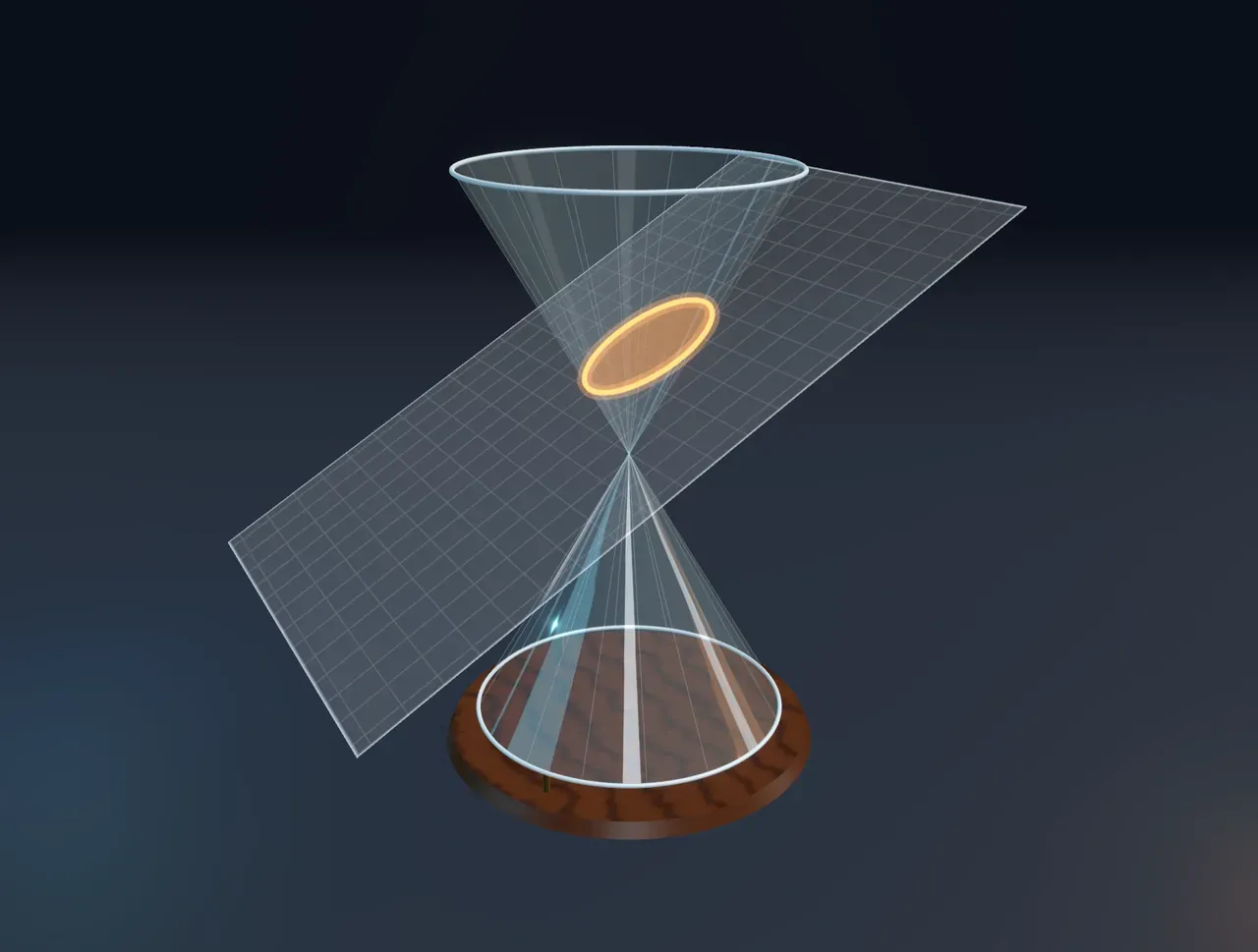
Shine a torch straight at a wall and its beam makes a circle of light. Tilt the torch and the circle stretches into an oval. Tilt it further and the far edge of the light runs off across the wall, never closing. The beam is a cone of light and the wall slices it, so the patch of light is a conic section.
Greek geometers were studying these curves by about 350 BC, and around 200 BC Apollonius of Perga gathered them into eight books, giving them the names we still use: ellipse, parabola and hyperbola.
Four curves from one cut
The shape depends only on how steeply the cut is tilted compared with the side of the cone.
- Level: a circle.
- Tilted, but less steeply than the side: an ellipse, a closed oval.
- Exactly parallel to the side: a parabola, which opens up and never closes.
- Steeper than the side: a hyperbola. The cut now reaches past the tip into the second cone, so the curve has two separate branches.
Try it: press Circle, Ellipse, Parabola and Hyperbola in turn and watch the blue line on the cone’s side. Then press Through the tip on Distance from the tip.
Moving the cut away from the tip only scales the curve up; its shape stays the same. A cut through the tip itself collapses the curve to a single point, a line or a pair of crossing lines.
Foci and the hidden spheres
Every conic except the circle can be drawn in another way. Pick a point, the focus, and a straight line, the directrix. Collect every point whose distance to the focus divided by its distance to the line is the same number, the eccentricity. Below 1 you get an ellipse, exactly 1 a parabola, above 1 a hyperbola. A circle is the limit at 0.
In 1822 Germinal Pierre Dandelin showed why a slice of a cone obeys this rule. Wedge a ball into the cone so that it touches both the cone and the cut. Choose On under Show the focus spheres: the ball touches the cut at exactly one point, the focus. It touches the cone along a circle, and that circle’s level meets the cut along the directrix. For a cone with a 30° half-angle, the eccentricity works out to the sine of the tilt divided by the cosine of 30°.
Where the curves turn up
Johannes Kepler showed in 1609 that planets move on ellipses with the Sun at one focus. Earth’s orbit has an eccentricity of about 0.017, close to a circle; Halley’s comet’s is about 0.97, a long thin loop. A thrown ball follows a parabola, as long as the air barely slows it. A satellite dish is a parabola spun round its axis, so signals arriving straight on all bounce to the receiver at its focus. A spacecraft that flies past a planet faster than escape speed swings round it on one branch of a hyperbola.
What this model leaves out
A real cone goes on forever; this one is cut off at a fixed height, so a long ellipse or a parabola is drawn only as far as the glass reaches, and very large focus spheres are not shown. The cone’s angle is fixed at 30°, which puts the parabola at a tilt of exactly 60°. Real orbits and throws are only close to perfect conics: other planets tug on orbits and air drags on a thrown ball.