Why an ellipse has two foci whose distances add up to a constant: Dandelin spheres, the gardener’s ellipse with a string, the link between a, b and c, the parabola with one focus and a directrix, and the hyperbola with a fixed difference.
Step 1 of 6 · The gardener’s ellipse
Step 1 of 6
The gardener’s ellipse
A gardener who wants an oval bed drives in two pegs, ties a slack string to them, and pulls it taut with a stick that marks the line in the soil. The stick runs round an ellipse, and the pegs are its foci: at every point of the ellipse, equals the string’s length.
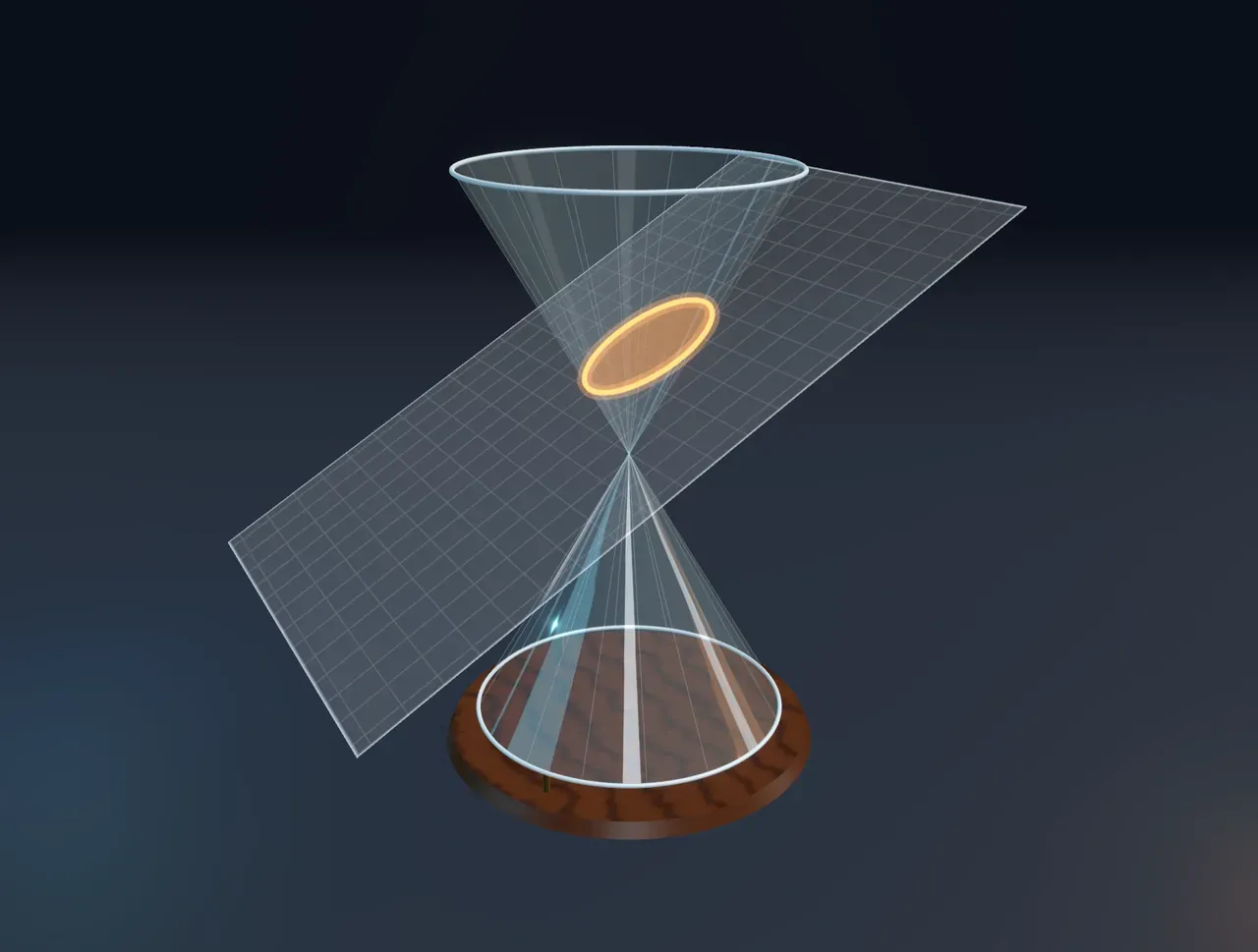
In 1822 Germinal Pierre Dandelin proved this with the cone. Show the focus spheres shows two balls that fit snugly inside the cone, one above the cut and one below. Each ball touches the cut at one point, a focus, and the cone along a circle. From you can measure to each ball in two ways: to the focus, or along the cone’s side to the circle, and those two tangents are equal. Work out the sum of the distances.
Step 2 of 6
a, b and c
The semi-major axis , the semi-minor axis and the distance to a focus are linked by a right triangle: from the end of the minor axis, the distance to each focus is , because the sum is and the two distances are equal. So . Work out .
Step 3 of 6
One focus
As the tilt approaches , the ellipse stretches out, and the larger ball is pushed up the cone. Predict what happens to it at the parabola, then increase Tilt of the cut.
Step 4 of 6
The directrix
Each ball touches the cone along a circle, and that circle’s plane cuts the plane of the cut in a straight line: the directrix. On every conic section, the ratio of a point’s distance to the focus, , to its distance to the directrix, , is the eccentricity. The point running along the curve measures both distances. This parabola has one focus and one directrix, and it is also the parabola of the quadratic function .
Step 5 of 6
Hyperbola
On a hyperbola the balls are in the two halves of the cone, one above the tip and one below, and each focus is inside one of the branches. Move Distance from the tip, and watch both balls stay touching the cut.
Step 6 of 6
Vertex and focus
Back to the first ellipse. The vertices are the two points farthest apart, and the foci sit between them on the same axis.
Loading the interactive version…
Loading the interactive version…
Each step sets up the Scene for you, and a control marked “fixed” stays put for that step.
Practice · Calculate
The ellipse is units long from vertex to vertex, so . is any point on the ellipse. What is , the sum of the distances from to the two foci?
Practice · Calculate
The ellipse is units long from vertex to vertex, so . is any point on the ellipse. What is , the sum of the distances from to the two foci?
Practice · Calculate
In the same ellipse and . What is , the semi-minor axis?
Practice · Calculate
In the same ellipse and . What is , the semi-minor axis?
Practice · Predict, then look
The tilt is , and both focus spheres are shown. What will happen to the larger ball when the tilt reaches and the cut is a parabola?
Practice · Predict, then look
The tilt is , and both focus spheres are shown. What will happen to the larger ball when the tilt reaches and the cut is a parabola?
Practice · Choose
The point running along the parabola shows its distance to the focus, , and to the directrix, . The eccentricity is . What is true at every point of the parabola?
Practice · Choose
The point running along the parabola shows its distance to the focus, , and to the directrix, . The eccentricity is . What is true at every point of the parabola?
Practice · Choose
The tilt is : a hyperbola, with a focus inside each branch. is on one branch. What stays the same along the hyperbola?
Practice · Choose
The tilt is : a hyperbola, with a focus inside each branch. is on one branch. What stays the same along the hyperbola?
Practice · Calculate
In the ellipse , and the distance from the centre to each focus is . What is the distance from a vertex to the focus nearest it?
Practice · Calculate
In the ellipse , and the distance from the centre to each focus is . What is the distance from a vertex to the focus nearest it?
Lesson complete. Every practice question here is done.