Two kinds of leftover
The planets formed about 4.6 billion years ago from a disc of gas and dust around the young Sun. Not everything ended up in a planet. Billions of smaller bodies were left over, and they come in two broad kinds.
Asteroids are rock and metal. Most of them orbit in the asteroid belt between Mars and Jupiter, the faint ring of points in the scene. They formed close to the Sun, where it was too warm for ice to survive. The largest, Ceres, is about 940 kilometres across, but most are far smaller, and all of them together weigh only a few per cent as much as our Moon.
Comets are ice mixed with dust and rock, often called dirty snowballs. They formed farther out, where water, carbon dioxide and other ices could freeze, and most still live there: in the Kuiper belt beyond Neptune, and in the far larger Oort cloud, a shell of icy bodies reaching perhaps a third of the way to the nearest star. Now and then a nudge sends one falling toward the Sun on a long, thin ellipse.
A frozen lump wakes up
Far from the Sun a comet is just its nucleus: a dark lump of ice and dust a few kilometres across, blacker than coal and almost impossible to see. As it falls inward, the sunlight on each square metre grows with the inverse square of its distance. At about two to three times the Earth’s distance from the Sun (2 to 3 AU, astronomical units), it becomes warm enough for water ice to turn straight into gas.
The gas streams off the nucleus and carries dust with it, building a cloud called the coma. The coma can be wider than Jupiter, around a nucleus you could walk across in an hour or two. It glows partly by reflecting sunlight off its dust and partly because sunlight makes its gases shine, which is why many comets have a greenish head.
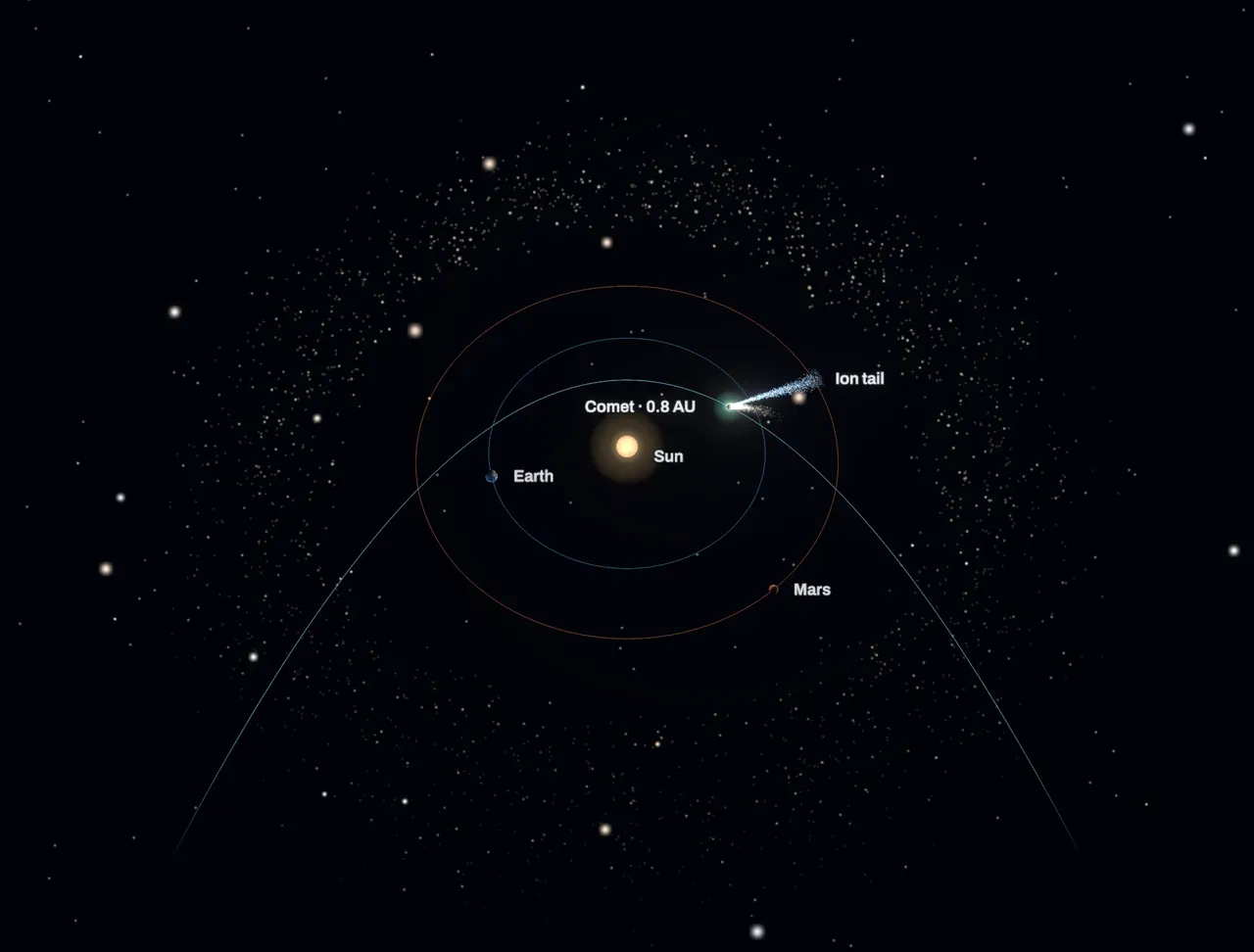
Try it: drag the Along the orbit slider from Falling in toward the middle. Watch the distance on the comet’s label fall, and the coma and tails appear and lengthen as it nears the Sun.
Two tails, two causes
A bright comet usually shows two tails, and they are made differently.
The ion tail is gas. Ultraviolet sunlight knocks electrons off the gas molecules, turning them into electrically charged ions. The Sun blows a constant stream of charged particles, the solar wind, outward at around 400 kilometres per second, with magnetic field carried along inside it. The ions are caught by that field and swept straight downwind. So the ion tail is narrow, straight and points almost directly away from the Sun, tilted by only a few degrees by the comet’s own motion. It glows blue, mostly from carbon monoxide ions.
The dust tail is grains of dust. Sunlight itself pushes on them, gently, and the smallest grains feel that push most. Once a grain leaves the comet it follows its own orbit, with the Sun’s pull partly cancelled by the push of light. It drifts outward and falls behind the comet, so the dust tail is broad, curved and bends back along the comet’s path. It shines yellowish-white with reflected sunlight. The heaviest grains hardly drift at all and spread out along the orbit as a trail of debris.
Tail first
Because the solar wind and sunlight both push outward from the Sun, a comet’s tails always point away from it, not behind the comet. On the way in the tails trail behind. Swinging round the Sun they sweep across the sky, and on the way out the comet travels tail first.
Try it: scrub slowly from the middle toward Heading out. The blue ion tail stays aimed away from the Sun and ends up leading the comet, while the curved dust tail lags round the bend.
The scrub moves through time at an even rate, so it also shows Kepler’s second law: the comet crawls when far out and whips round the Sun. A Halley-like comet spends only about two and a half months of each orbit closer to the Sun than the Earth is, then decades far out in the cold.
How close it comes
How strongly a comet wakes depends on how near the Sun it passes. One that grazes the Sun can grow a spectacular tail, and may break apart. One whose closest approach stays beyond Mars barely warms enough for its ice to boil, so it shows only a small coma and faint tails.
Try it: choose Grazing, then Beyond Mars, and scrub through the closest approach each time.
Each pass costs the comet a thin layer of ice. After hundreds or thousands of trips round the Sun, a comet may run out of ice near its surface or bury it under dust, and then it looks just like an asteroid. Some asteroids on long, comet-like orbits are probably exactly that.
Rock stays quiet
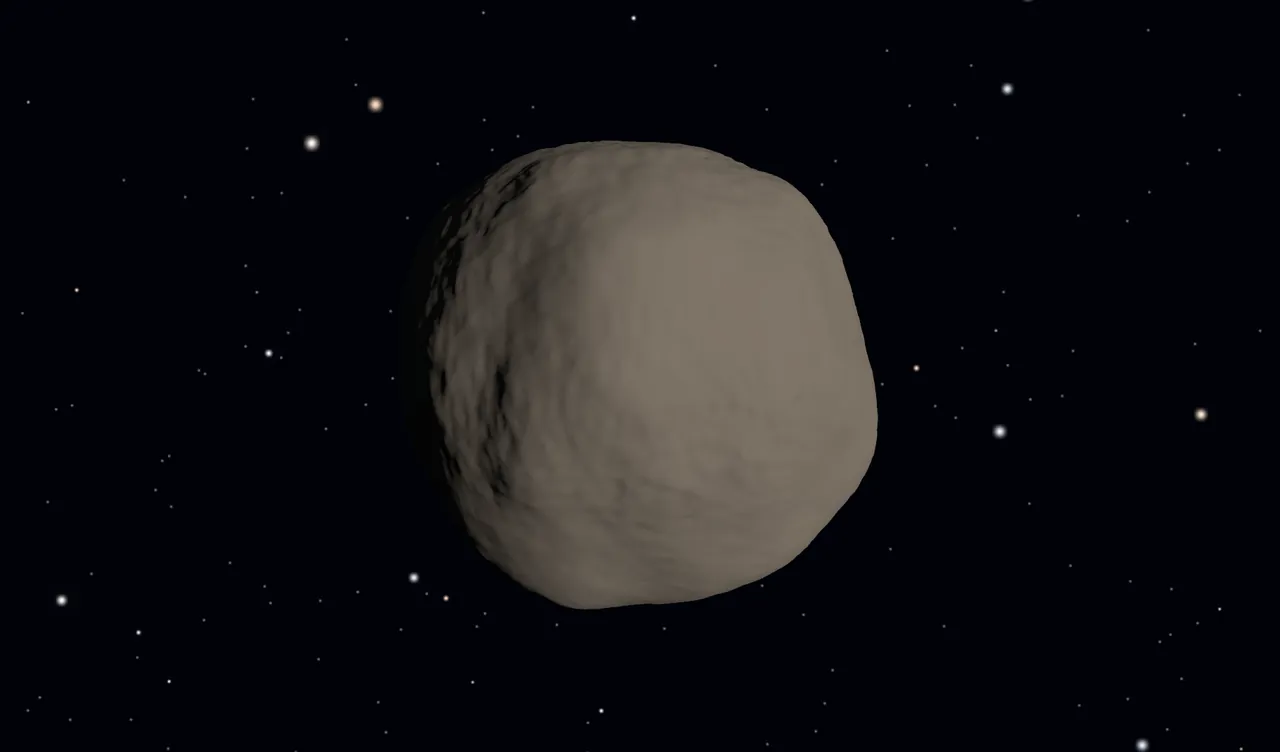
Now change Made of to Rock and metal (asteroid) and scrub through the same orbit. Nothing happens: there is little ice to turn to gas, so there is no coma and no tail, however close it comes. The asteroid is just a sunlit rock, and the only way to tell how close it is to the Sun is by where it is and how fast it moves.
That is the real difference between the two. An asteroid and a comet can share an orbit. What sets them apart is what they are made of, and whether sunlight can turn any of it into gas.
Debris and shooting stars
Dust left along a comet’s orbit stays there for centuries. When the Earth crosses such a trail, the grains hit our air at tens of kilometres per second and burn up as meteors, or shooting stars. Showers return on the same dates every year because the Earth crosses the same trails: the Perseids in August come from comet Swift–Tuttle, and the Orionids in October from Halley’s comet. Larger pieces, mostly broken off asteroids, sometimes survive the fall and land as meteorites.
Spacecraft have now visited both kinds of body. Rosetta orbited comet 67P for two years and watched it wake up as it neared the Sun. Hayabusa2 and OSIRIS-REx brought samples of asteroids back to Earth, and in 2022 the DART spacecraft deliberately struck a small asteroid and measurably changed its orbit, a first test of defending the Earth from one.
What this model leaves out
Everything is drawn far too big except the distances and the tails. A real nucleus a few kilometres across would be far smaller than a pixel at this scale, and even the coma is enlarged. The orbit lies flat in the plane of the planets and always reaches out to Neptune’s distance; real comet orbits are tilted at every angle, some go round the wrong way, and Jupiter’s pull changes them over time. The model does not include the small push the escaping gas gives the nucleus, which slightly alters a comet’s orbit.
The gas output is a rule of thumb: it grows with sunlight and switches off beyond about 2.5 AU, where water ice stays frozen. Real comets are patchier, often brightening suddenly or venting through a few active jets, and some stay active far out because carbon monoxide and carbon dioxide freeze at much lower temperatures than water. The solar wind is drawn as steady; the real one is gusty, and a strong gust can even snap off a comet’s ion tail.