A long, thin orbit round the Sun: how long one lap takes, why the comet races near the Sun and crawls far from it, and why its tail always points away from the Sun.
Step 1 of 9 · A long ellipse
Step 1 of 9
A long ellipse
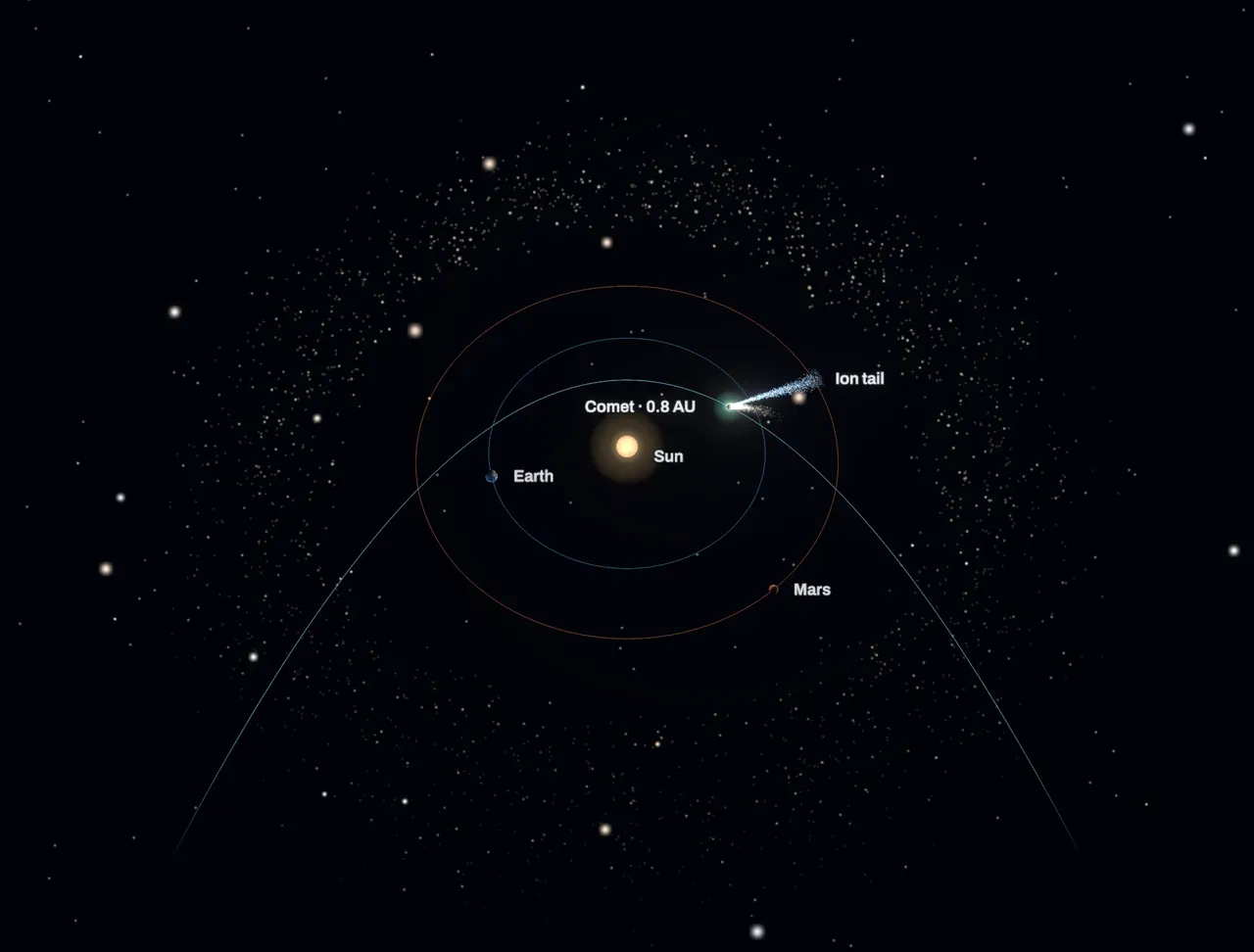
A comet is a lump of ice and dust a few kilometres across, born in the cold beyond Neptune. Its orbit is a long, thin ellipse: it falls towards the Sun, swings round it and heads out again. Closest distance to the Sun is locked at AU, and the farthest point of the orbit in the Scene is AU, about Neptune’s distance.
Kepler’s third law holds for an ellipse too, if you put in the semi-major axis, , the average of the closest and farthest distances, instead of the radius.
Step 2 of 9
Fast near the Sun, slow far out
Drag Along the orbit from Falling in to Heading out. The scrub moves through time at a steady rate, and still the comet crawls far from the Sun and whips round it. That is Kepler’s second law: the line from the Sun to the comet sweeps equal areas in equal times.
Step 3 of 9
Two tails
Near the Sun the comet’s ice evaporates, and gas and dust burst out of it into a cloud round it, a coma as big as a planet. Two tails stream from the coma: a bluish ion tail of charged gas, straight and narrow, and a yellowish dust tail, broad and curved. Predict where the ion tail will point once the comet is on its way out.
Step 4 of 9
Too far for a tail
A comet’s activity depends on how much sunlight reaches its ice. Here the comet comes no closer to the Sun than AU, beyond Mars. Compare it with Halley-like.
Step 5 of 9
Rock and metal
Asteroids are rocky and metallic leftovers from the forming of the Solar System. Most go round the Sun in the asteroid belt, between Mars and Jupiter, the ring of dots in the Scene. The largest, Ceres, is about kilometres across, and the whole belt together weighs less than of the Moon.
Step 6 of 9
How stretched the orbit is
A planet’s orbit is nearly round, and a comet’s is long and narrow. The difference is measured by the eccentricity .
Step 7 of 9
The average distance
A comet’s year is set not by its nearest or farthest distance from the Sun, but by the semi-major axis , half the length of the ellipse.
Step 8 of 9
At its fastest
The comet falls towards the Sun from 30 AU and gathers speed all the way. How fast does it move as it swings past?
Step 9 of 9
At its slowest
Drag Along the orbit to the end, with the comet far from the Sun. Out there it moves slowly, and spends most of its year.
Loading the interactive version…
Loading the interactive version…
Each step sets up the Scene for you, and a control marked “fixed” stays put for that step.
Practice · Calculate
The comet comes within AU of the Sun and swings out to AU, Neptune’s distance. By Kepler’s third law, how many years does one orbit take?
Practice · Calculate
The comet comes within AU of the Sun and swings out to AU, Neptune’s distance. By Kepler’s third law, how many years does one orbit take?
Practice · Calculate
By Kepler’s second law, at the closest and farthest points . The comet comes within AU and goes out to AU. How many times faster is it near the Sun than at its farthest?
Practice · Calculate
By Kepler’s second law, at the closest and farthest points . The comet comes within AU and goes out to AU. How many times faster is it near the Sun than at its farthest?
Practice · Predict, then look
The comet is now passing the Sun. Soon it will start heading away from it. Where will the bluish ion tail point when the comet is on its way out?
Practice · Predict, then look
The comet is now passing the Sun. Soon it will start heading away from it. Where will the bluish ion tail point when the comet is on its way out?
Practice · Calculate
Closest distance to the Sun is locked at AU, beyond Mars, and even at its closest the comet grows only a faint coma and hardly any tail. At the Earth’s distance, AU, each square metre facing the Sun gets about 1361 W. How much sunlight does each square metre of the ice get at the comet’s closest point, in W/m²?
Practice · Choose
Made of is now an asteroid, on exactly the same orbit, and it passes the Sun with no coma and no tail. Why?
Practice · Choose
Made of is now an asteroid, on exactly the same orbit, and it passes the Sun with no coma and no tail. Why?
Practice · Calculate
The comet comes within 0.6 AU of the Sun and swings out to 30 AU. What is the eccentricity of its orbit, ?
Practice · Calculate
The comet comes within 0.6 AU of the Sun and swings out to 30 AU. What is the eccentricity of its orbit, ?
Practice · Calculate
Closest distance to the Sun is locked at 2.2 AU, and the comet still swings out to 30 AU. What is the semi-major axis of its orbit, , the distance that sets its year?
Practice · Calculate
Closest distance to the Sun is locked at 2.2 AU, and the comet still swings out to 30 AU. What is the semi-major axis of its orbit, , the distance that sets its year?
Practice · Calculate
On an orbit round the Sun the speed at distance is kilometres per second, with and in astronomical units. The comet comes within 0.6 AU and swings out to 30 AU. How fast does it move at its closest to the Sun?
Practice · Calculate
On an orbit round the Sun the speed at distance is kilometres per second, with and in astronomical units. The comet comes within 0.6 AU and swings out to 30 AU. How fast does it move at its closest to the Sun?
Practice · Calculate
Closest distance to the Sun is locked at 2.2 AU, where the comet moves at 27.4 km/s. It swings out to 30 AU. By Kepler’s second law, , how fast does it move at the farthest point?
Practice · Calculate
Closest distance to the Sun is locked at 2.2 AU, where the comet moves at 27.4 km/s. It swings out to 30 AU. By Kepler’s second law, , how fast does it move at the farthest point?
Lesson complete. Every practice question here is done.