Lesson 1 of 4
Kepler's laws.
Orbits are ellipses with the Sun at one focus, a planet is faster when it is close to the Sun, and the length of the year depends only on the size of the orbit.
Step 1 of 6 · Ellipse and focus
Step 1 of 6
Ellipse and focus
In the Unit on circular motion and gravity we worked out circular orbits. But a satellite moving a little too fast or a little too slow neither falls nor escapes: it moves on a stretched orbit. Johannes Kepler found, in 1609, from measurements of Mars, that this is what happens to every planet. Kepler’s first law: every planet moves on an ellipse, with the Sun at one of its two foci.
Two numbers describe the orbit. Size of the orbit is the semi-major axis , half the long diameter, in astronomical units: 1 AU is the Earth’s mean distance from the Sun, about . Eccentricity says how stretched the orbit is: is a circle, and close to is a long, thin ellipse. The foci are on the long axis, each from the centre.
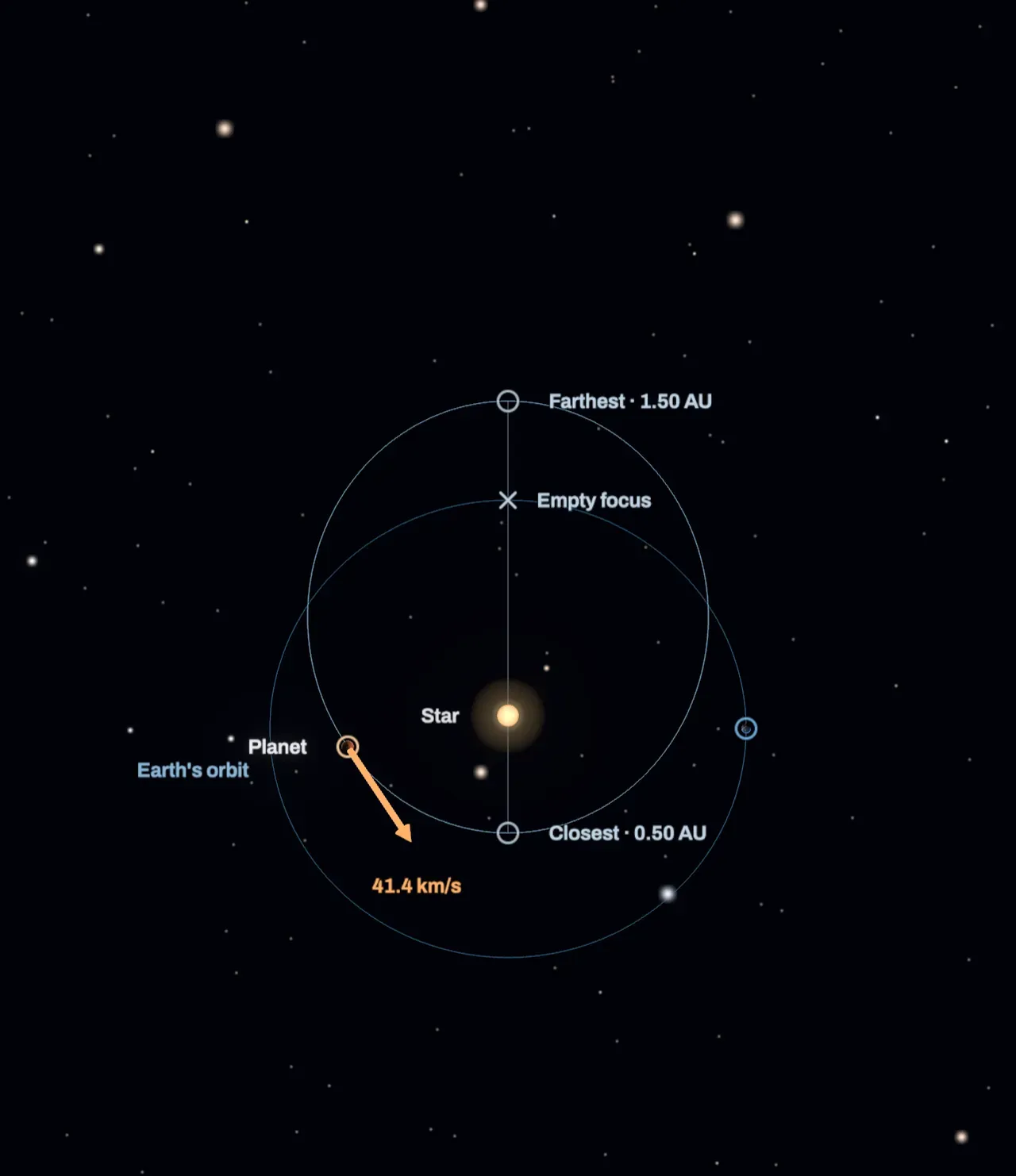
In the Scene the eccentricity is , far more than any real planet’s, so that the shape stands out. The thin ring is the Earth’s orbit.
Step 2 of 6
Closest and farthest
The point of the orbit closest to the Sun is called perihelion, and the farthest aphelion. Both are on the long axis, and their distances from the Sun are:
The Earth’s orbit is almost a circle, : in January our distance from the Sun is only about less than in July. Eccentricity and Size of the orbit are now locked.
Step 3 of 6
Equal areas in equal times
Run the motion and watch the planet. Kepler’s second law says what happens to the speed: the line joining the Sun to the planet sweeps out equal areas in equal times. Close to the Sun the line is short, so to sweep the same area every week, the planet has to cover more path.
Today we know this is the conservation of angular momentum: gravity always pulls towards the Sun, so it does not turn the planet round it, and at perihelion equals at aphelion. Predict, and then Show equal areas will shade the area the line swept in the last month.
Step 4 of 6
Fast and slow
At perihelion and aphelion the motion is at right angles to the line to the Sun, so keeping gives the ratio of the speeds directly:
Now the orbit is locked on Mercury’s, the most stretched of the planets’ orbits. The wedges of Show equal areas show the same area, wide and short on one side and thin and long on the other.
Step 5 of 6
The third law
In the last Unit we derived Kepler’s third law for a circular orbit, . It holds for an ellipse too, with the semi-major axis in place of . Round the Sun, measuring in astronomical units and in years, the constant comes out as :
So the Earth, , goes round in one year. Eccentricity is locked at , like Mars’s, and the Earth goes round in the Scene so you can compare.
Step 6 of 6
Shape and year
The third law does not contain the eccentricity. Size of the orbit is now locked at 1 AU, and the orbit is a circle. Predict what will happen to the year when we stretch it.
Loading the interactive version…
Loading the interactive version…
Each step sets up the Scene for you, and a control marked “fixed” stays put for that step.
Practice · Choose
The planet in the Scene moves on an elliptical orbit, with Eccentricity . Where is the star it goes round?
Practice · Choose
The planet in the Scene moves on an elliptical orbit, with Eccentricity . Where is the star it goes round?
Practice · Calculate
The size of the orbit, the semi-major axis, is locked at 1.2 AU, and the eccentricity at . How close to the star does the planet come? One astronomical unit is .
Practice · Calculate
The size of the orbit, the semi-major axis, is locked at 1.2 AU, and the eccentricity at . How close to the star does the planet come? One astronomical unit is .
Practice · Predict, then look
The planet moves on an orbit with eccentricity . On which part of the orbit does it move fastest?
Practice · Predict, then look
The planet moves on an orbit with eccentricity . On which part of the orbit does it move fastest?
Practice · Calculate
The orbit is locked on Mercury’s: eccentricity and size 0.39 AU. How many times faster is Mercury at its closest point to the Sun than at its farthest?
Practice · Calculate
The orbit is locked on Mercury’s: eccentricity and size 0.39 AU. How many times faster is Mercury at its closest point to the Sun than at its farthest?
Practice · Reach the target
A year on Mars lasts Earth years. Change Size of the orbit until the planet’s year in the Scene lasts years, and press Check.
Practice · Reach the target
A year on Mars lasts Earth years. Change Size of the orbit until the planet’s year in the Scene lasts years, and press Check.
Practice · Predict, then look
The orbit is now a circle of size 1 AU, and the planet’s year is the same as the Earth’s. Size of the orbit stays as it is, and the orbit is stretched to eccentricity . What will happen to the planet’s year?
Practice · Predict, then look
The orbit is now a circle of size 1 AU, and the planet’s year is the same as the Earth’s. Size of the orbit stays as it is, and the orbit is stretched to eccentricity . What will happen to the planet’s year?
Lesson complete. Every practice question here is done.