Going round means always turning
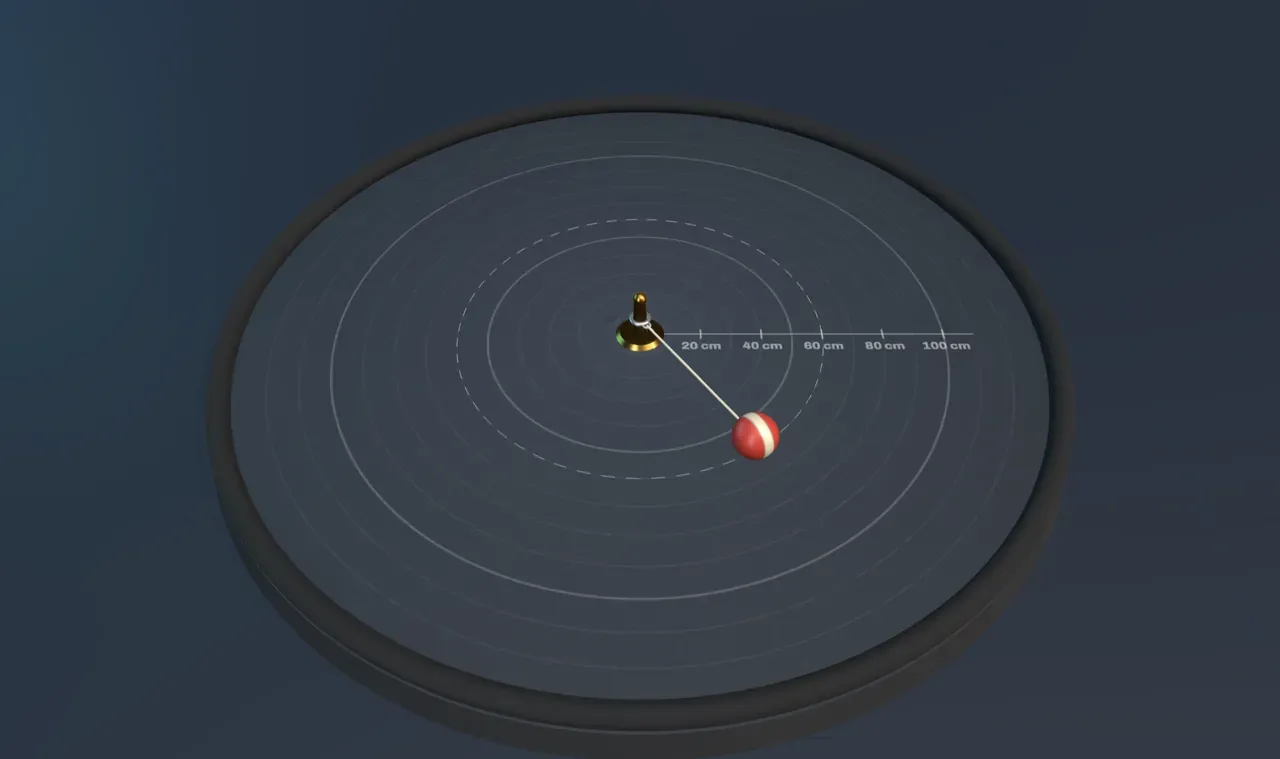
Swing a conker on a string, spin a bucket of water or take a sharp bend in a car, and the same thing happens: something moves round a curve. The ball on the table does it in the simplest way. It rolls round the peg at a steady speed, the same distance from the centre all the time.
Steady speed does not mean nothing is changing. Velocity is speed together with direction, and the ball’s direction is different at every moment: heading right at the front of the table, away from you on the right-hand side, left at the back. A change of velocity is an acceleration, so a ball going round a circle at constant speed is accelerating all the time.
The pull points to the centre
By Newton’s second law, an acceleration needs a force. Here the only sideways force on the ball is the string, and a string can only pull along its own length, straight towards the peg. That inward pull is called the centripetal force, from the Latin for “centre-seeking”. It does not speed the ball up or slow it down, because it always acts at right angles to the motion. It only bends the path.
Try it: move Forces, then cut halfway. The blue arrow is the ball’s velocity, always along the edge of the circle. The orange arrow is the string’s pull, always aimed at the peg, at right angles to the blue one.
Faster and tighter turns need more pull
How hard must the string pull? The ball needs an acceleration towards the centre of its speed squared divided by the radius, , so the force is
where is the ball’s mass. Speed counts twice over. Slide Speed from 1 m/s to 2 m/s and the pull grows from 0.33 N to 1.33 N, four times as much: at double speed the direction has to turn twice as fast, and there is twice as much velocity to turn. A shorter string means a tighter bend, so at the same speed a 0.5 m string has to pull twice as hard as a 1 m one.
The same rule sets how fast a car can take a bend before its tyres lose grip, why a road curve is gentler on a motorway than in town, and how fast a satellite must travel to stay in orbit, where gravity does the string’s job.
Cut the string and it goes straight on
Move Forces, then cut to Cut the string. The ball lets go wherever it is, and it does not fly outward away from the peg, and it does not keep curving. It rolls off in a straight line along the tangent, the direction it was heading at that instant, and the evenly spaced ghosts show its speed does not change either. With no force on it, it obeys Newton’s first law. After a pause the ball is tied on again a little way back round the circle, so you can watch it let go at the same place again and again.
That is why mud flies off a bicycle wheel along the tyre’s edge, and why a hammer thrower lets go at exactly the right moment in the spin.
There is no outward force on the ball
Whirling a ball, you feel it tugging outward on your hand, and in a car going round a bend you feel thrown to the outside. It is tempting to call this a centrifugal force pushing outward. On the ball, there is none. The string pulls the ball inward, and the ball pulls back on the string, outward, with an equal force, which is what your hand or the peg feels (Newton’s third law). Your body in the car is simply trying to go straight on, while the car turns underneath you. Describing things from inside the turning car, physicists do use a centrifugal force as a bookkeeping device, but it is not a push from anything.
What this model leaves out
The table holds up the ball, so the string can lie flat. Whirl a ball over your head instead and gravity drags it down, so the string sweeps out a cone and must pull a little upward as well as inward. The model also leaves out friction, the energy of the ball’s spin, air drag and the mass and stretch of the string, so the ball would go round for ever; a real one slows down and needs a gentle push from the hand to keep going. When the string is cut, the loose end would trail after the ball rather than stay on the table. The ball is drawn several times larger than a real 3 cm ball would be at this scale.